

4.4 Mechanism Design and Verification of Lunar Lander
131
2) Analysis of static moment margin for folding/unfolding on lunar surface
Usually, mechanisms of spacecraft on orbit operate under zero gravity. The inertial
load generated by spacecraft orbital maneuvers is the major load that affects the
movement of mechanisms whose magnitude is generally small. Nevertheless, the
solar panel mechanism of the Chang’E-3 lunar lander should implement unfolding
and folding on lunar surface under lunar gravity. So, the lunar gravity on lunar
surface had a greater influence on movement of solar panel mechanism. It was an
important part of the design and analysis of solar panel mechanism of the Chang’E-3
lunar lander to analyze the static moment margin for folding/unfolding of solar panel
mechanism on lunar surface.
During the deployment of solar panel mechanism of the Chang’E-3 lunar lander,
it should be overcome including lunar surface gravity moment, frictional resistance
moment of hinge and additional resistance moment on output shaft of electric motor
during the cable unrolling process, while the static moment margin was minimal.
Among the moment, lunar surface gravity moment could be accurately obtained
through analysis and calculation, and its uncertainty was far below friction resistance
moment of hinge and the cable deployment resistance moment. Therefore, when the
static moment margin during development of solar panel mechanism was analyzed,
only uncertainty of the friction resistance moment of hinge and the cable deployment
resistance moment was analyzed, while lunar surface gravity moment was removed
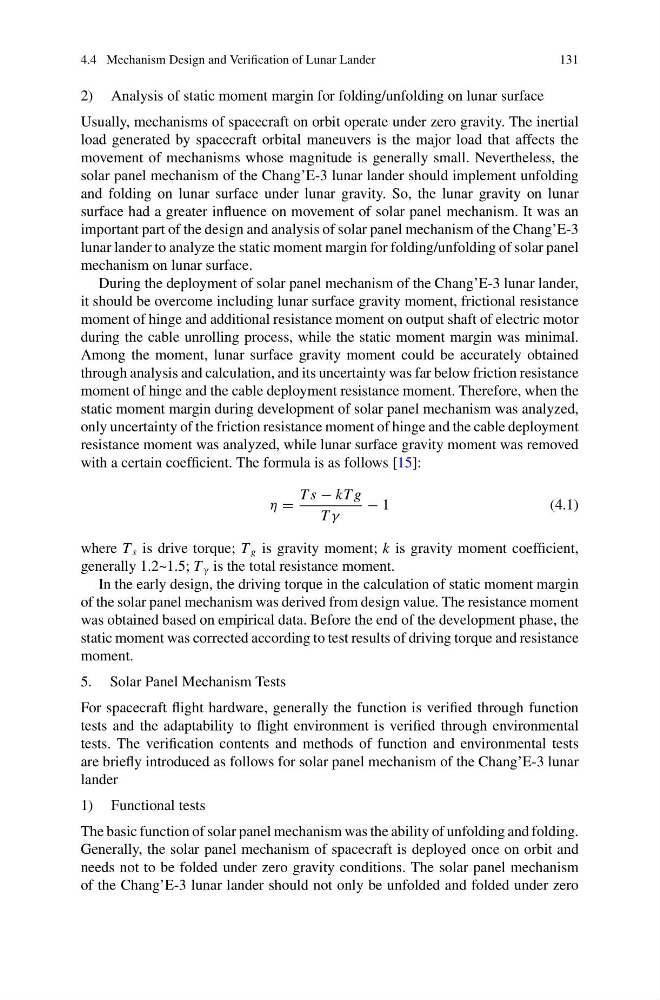
with a certain coefficient. The formula is as follows [15]:
η =
T s − kT g
T γ
− 1
(4.1)
where T s is drive torque; T g is gravity moment; k is gravity moment coefficient,
generally 1.2~1.5; T γ is the total resistance moment.
In the early design, the driving torque in the calculation of static moment margin
of the solar panel mechanism was derived from design value. The resistance moment
was obtained based on empirical data. Before the end of the development phase, the
static moment was corrected according to test results of driving torque and resistance
moment.
5. Solar Panel Mechanism Tests
For spacecraft flight hardware, generally the function is verified through function
tests and the adaptability to flight environment is verified through environmental
tests. The verification contents and methods of function and environmental tests
are briefly introduced as follows for solar panel mechanism of the Chang’E-3 lunar
lander
1) Functional tests
The basic function of solar panel mechanism was the ability of unfolding and folding.
Generally, the solar panel mechanism of spacecraft is deployed once on orbit and
needs not to be folded under zero gravity conditions. The solar panel mechanism
of the Chang’E-3 lunar lander should not only be unfolded and folded under zero
131
2) Analysis of static moment margin for folding/unfolding on lunar surface
Usually, mechanisms of spacecraft on orbit operate under zero gravity. The inertial
load generated by spacecraft orbital maneuvers is the major load that affects the
movement of mechanisms whose magnitude is generally small. Nevertheless, the
solar panel mechanism of the Chang’E-3 lunar lander should implement unfolding
and folding on lunar surface under lunar gravity. So, the lunar gravity on lunar
surface had a greater influence on movement of solar panel mechanism. It was an
important part of the design and analysis of solar panel mechanism of the Chang’E-3
lunar lander to analyze the static moment margin for folding/unfolding of solar panel
mechanism on lunar surface.
During the deployment of solar panel mechanism of the Chang’E-3 lunar lander,
it should be overcome including lunar surface gravity moment, frictional resistance
moment of hinge and additional resistance moment on output shaft of electric motor
during the cable unrolling process, while the static moment margin was minimal.
Among the moment, lunar surface gravity moment could be accurately obtained
through analysis and calculation, and its uncertainty was far below friction resistance
moment of hinge and the cable deployment resistance moment. Therefore, when the
static moment margin during development of solar panel mechanism was analyzed,
only uncertainty of the friction resistance moment of hinge and the cable deployment
resistance moment was analyzed, while lunar surface gravity moment was removed
with a certain coefficient. The formula is as follows [15]:
η =
T s − kT g
T γ
− 1
(4.1)
where T s is drive torque; T g is gravity moment; k is gravity moment coefficient,
generally 1.2~1.5; T γ is the total resistance moment.
In the early design, the driving torque in the calculation of static moment margin
of the solar panel mechanism was derived from design value. The resistance moment
was obtained based on empirical data. Before the end of the development phase, the
static moment was corrected according to test results of driving torque and resistance
moment.
5. Solar Panel Mechanism Tests
For spacecraft flight hardware, generally the function is verified through function
tests and the adaptability to flight environment is verified through environmental
tests. The verification contents and methods of function and environmental tests
are briefly introduced as follows for solar panel mechanism of the Chang’E-3 lunar
lander
1) Functional tests
The basic function of solar panel mechanism was the ability of unfolding and folding.
Generally, the solar panel mechanism of spacecraft is deployed once on orbit and
needs not to be folded under zero gravity conditions. The solar panel mechanism
of the Chang’E-3 lunar lander should not only be unfolded and folded under zero