

130
4 Structure and Mechanism Technology of Lunar Lander
panel mechanism was deployed. The deployment of the solar panel mechanism was a
process of the mechanism movement. Special analysis and calculations were required
according to the characteristics of solar panel mechanism in order to meet design
requirements of the solar panel mechanism. For example, in addition to structural
mechanics analysis of folded solar panel mechanism, following analysis was done
to the solar panel.
1) Analysis of inertia overload impact of engine ignition
The 7500 N throttling engine on Chang’E-3 lunar lander was used for orbit maneuver
and powered descent. When engine was ignited or shut off, there would be large
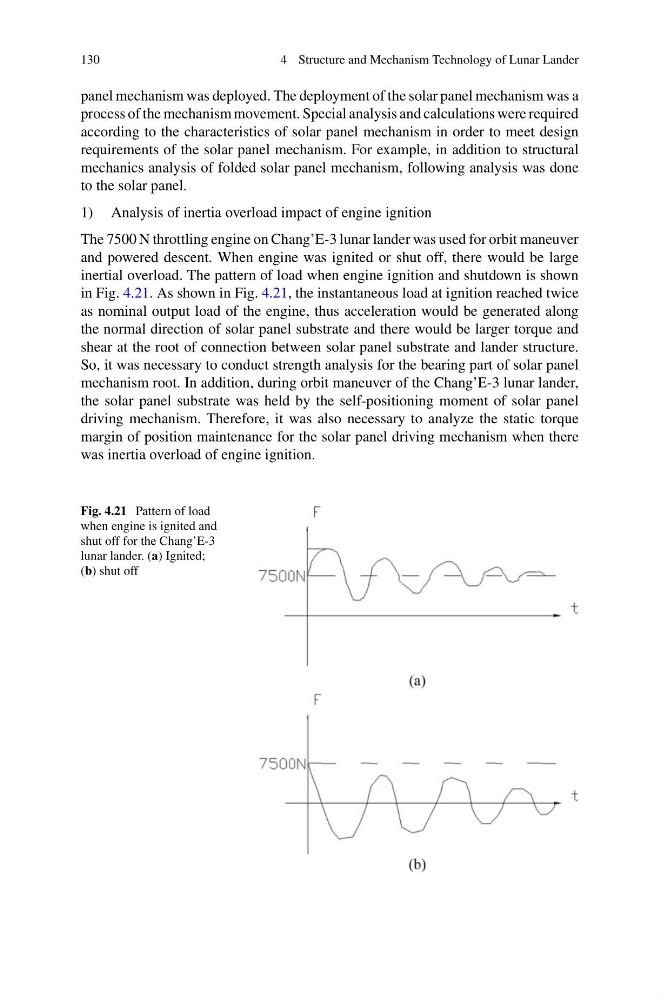
inertial overload. The pattern of load when engine ignition and shutdown is shown
in Fig. 4.21. As shown in Fig. 4.21, the instantaneous load at ignition reached twice
as nominal output load of the engine, thus acceleration would be generated along
the normal direction of solar panel substrate and there would be larger torque and
shear at the root of connection between solar panel substrate and lander structure.
So, it was necessary to conduct strength analysis for the bearing part of solar panel
mechanism root. In addition, during orbit maneuver of the Chang’E-3 lunar lander,
the solar panel substrate was held by the self-positioning moment of solar panel
driving mechanism. Therefore, it was also necessary to analyze the static torque
margin of position maintenance for the solar panel driving mechanism when there
was inertia overload of engine ignition.
Fig. 4.21 Pattern of load
when engine is ignited and
shut off for the Chang’E-3
lunar lander. (a) Ignited;
(b) shut off
4 Structure and Mechanism Technology of Lunar Lander
panel mechanism was deployed. The deployment of the solar panel mechanism was a
process of the mechanism movement. Special analysis and calculations were required
according to the characteristics of solar panel mechanism in order to meet design
requirements of the solar panel mechanism. For example, in addition to structural
mechanics analysis of folded solar panel mechanism, following analysis was done
to the solar panel.
1) Analysis of inertia overload impact of engine ignition
The 7500 N throttling engine on Chang’E-3 lunar lander was used for orbit maneuver
and powered descent. When engine was ignited or shut off, there would be large
inertial overload. The pattern of load when engine ignition and shutdown is shown
in Fig. 4.21. As shown in Fig. 4.21, the instantaneous load at ignition reached twice
as nominal output load of the engine, thus acceleration would be generated along
the normal direction of solar panel substrate and there would be larger torque and
shear at the root of connection between solar panel substrate and lander structure.
So, it was necessary to conduct strength analysis for the bearing part of solar panel
mechanism root. In addition, during orbit maneuver of the Chang’E-3 lunar lander,
the solar panel substrate was held by the self-positioning moment of solar panel
driving mechanism. Therefore, it was also necessary to analyze the static torque
margin of position maintenance for the solar panel driving mechanism when there
was inertia overload of engine ignition.
Fig. 4.21 Pattern of load
when engine is ignited and
shut off for the Chang’E-3
lunar lander. (a) Ignited;
(b) shut off