

4.3 Design and Verification of Lunar Lander Structure
123
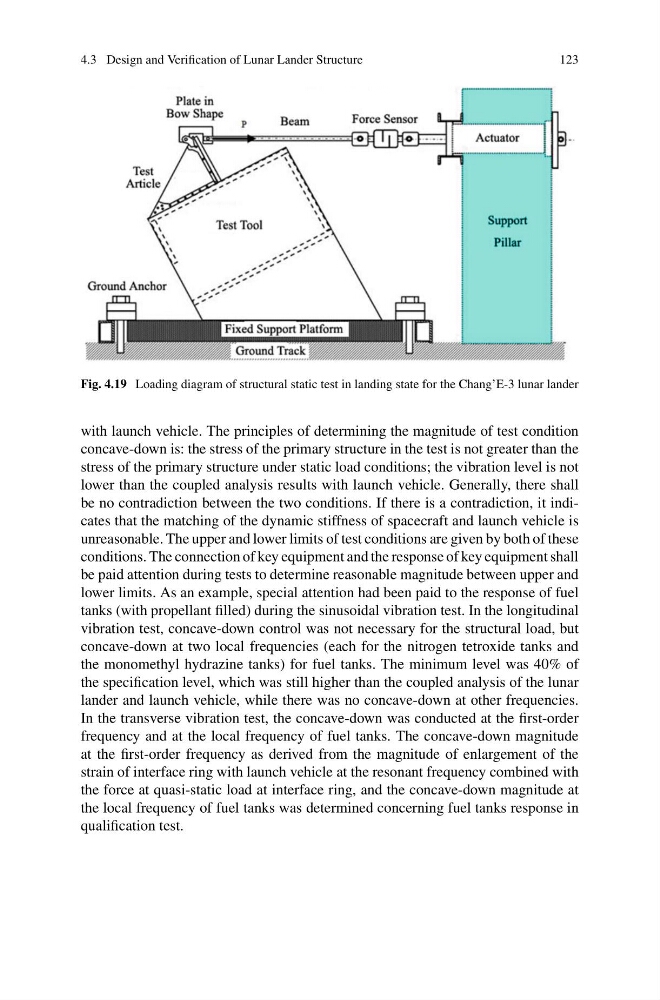
Fig. 4.19 Loading diagram of structural static test in landing state for the Chang’E-3 lunar lander
with launch vehicle. The principles of determining the magnitude of test condition
concave-down is: the stress of the primary structure in the test is not greater than the
stress of the primary structure under static load conditions; the vibration level is not
lower than the coupled analysis results with launch vehicle. Generally, there shall
be no contradiction between the two conditions. If there is a contradiction, it indicates that the matching of the dynamic stiffness of spacecraft and launch vehicle is
unreasonable. The upper and lower limits of test conditions are given by both of these
conditions. The connection of key equipment and the response of key equipment shall
be paid attention during tests to determine reasonable magnitude between upper and
lower limits. As an example, special attention had been paid to the response of fuel
tanks (with propellant filled) during the sinusoidal vibration test. In the longitudinal
vibration test, concave-down control was not necessary for the structural load, but
concave-down at two local frequencies (each for the nitrogen tetroxide tanks and
the monomethyl hydrazine tanks) for fuel tanks. The minimum level was 40% of
the specification level, which was still higher than the coupled analysis of the lunar
lander and launch vehicle, while there was no concave-down at other frequencies.
In the transverse vibration test, the concave-down was conducted at the first-order
frequency and at the local frequency of fuel tanks. The concave-down magnitude
at the first-order frequency as derived from the magnitude of enlargement of the
strain of interface ring with launch vehicle at the resonant frequency combined with
the force at quasi-static load at interface ring, and the concave-down magnitude at
the local frequency of fuel tanks was determined concerning fuel tanks response in
qualification test.
123
Fig. 4.19 Loading diagram of structural static test in landing state for the Chang’E-3 lunar lander
with launch vehicle. The principles of determining the magnitude of test condition
concave-down is: the stress of the primary structure in the test is not greater than the
stress of the primary structure under static load conditions; the vibration level is not
lower than the coupled analysis results with launch vehicle. Generally, there shall
be no contradiction between the two conditions. If there is a contradiction, it indicates that the matching of the dynamic stiffness of spacecraft and launch vehicle is
unreasonable. The upper and lower limits of test conditions are given by both of these
conditions. The connection of key equipment and the response of key equipment shall
be paid attention during tests to determine reasonable magnitude between upper and
lower limits. As an example, special attention had been paid to the response of fuel
tanks (with propellant filled) during the sinusoidal vibration test. In the longitudinal
vibration test, concave-down control was not necessary for the structural load, but
concave-down at two local frequencies (each for the nitrogen tetroxide tanks and
the monomethyl hydrazine tanks) for fuel tanks. The minimum level was 40% of
the specification level, which was still higher than the coupled analysis of the lunar
lander and launch vehicle, while there was no concave-down at other frequencies.
In the transverse vibration test, the concave-down was conducted at the first-order
frequency and at the local frequency of fuel tanks. The concave-down magnitude
at the first-order frequency as derived from the magnitude of enlargement of the
strain of interface ring with launch vehicle at the resonant frequency combined with
the force at quasi-static load at interface ring, and the concave-down magnitude at
the local frequency of fuel tanks was determined concerning fuel tanks response in
qualification test.