

122
4 Structure and Mechanism Technology of Lunar Lander
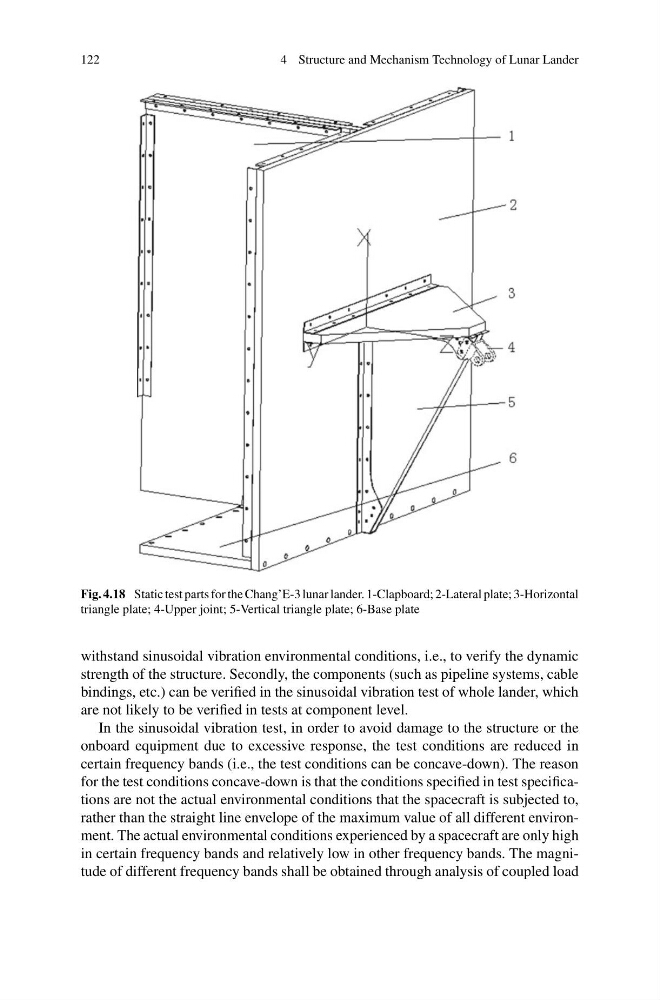
Fig. 4.18 Static test parts for the Chang’E-3 lunar lander. 1-Clapboard; 2-Lateral plate; 3-Horizontal
triangle plate; 4-Upper joint; 5-Vertical triangle plate; 6-Base plate
withstand sinusoidal vibration environmental conditions, i.e., to verify the dynamic
strength of the structure. Secondly, the components (such as pipeline systems, cable
bindings, etc.) can be verified in the sinusoidal vibration test of whole lander, which
are not likely to be verified in tests at component level.
In the sinusoidal vibration test, in order to avoid damage to the structure or the
onboard equipment due to excessive response, the test conditions are reduced in
certain frequency bands (i.e., the test conditions can be concave-down). The reason
for the test conditions concave-down is that the conditions specified in test specifications are not the actual environmental conditions that the spacecraft is subjected to,
rather than the straight line envelope of the maximum value of all different environment. The actual environmental conditions experienced by a spacecraft are only high
in certain frequency bands and relatively low in other frequency bands. The magnitude of different frequency bands shall be obtained through analysis of coupled load
4 Structure and Mechanism Technology of Lunar Lander
Fig. 4.18 Static test parts for the Chang’E-3 lunar lander. 1-Clapboard; 2-Lateral plate; 3-Horizontal
triangle plate; 4-Upper joint; 5-Vertical triangle plate; 6-Base plate
withstand sinusoidal vibration environmental conditions, i.e., to verify the dynamic
strength of the structure. Secondly, the components (such as pipeline systems, cable
bindings, etc.) can be verified in the sinusoidal vibration test of whole lander, which
are not likely to be verified in tests at component level.
In the sinusoidal vibration test, in order to avoid damage to the structure or the
onboard equipment due to excessive response, the test conditions are reduced in
certain frequency bands (i.e., the test conditions can be concave-down). The reason
for the test conditions concave-down is that the conditions specified in test specifications are not the actual environmental conditions that the spacecraft is subjected to,
rather than the straight line envelope of the maximum value of all different environment. The actual environmental conditions experienced by a spacecraft are only high
in certain frequency bands and relatively low in other frequency bands. The magnitude of different frequency bands shall be obtained through analysis of coupled load