

In a politically different approach, President Trump rejected the agreement and
reimposed sanctions under the so-called snapback provision of the previous
nuclear deal with Iran. In parallel with this increasingly hard line against Tehran,
Trump closed historic diplomatic agreements between Israel and the UAE,
7
setting the foundations for an amicable relationship between the two states. Israel,
which is a nuclear power, was never satisfied with the nuclear agreement signed
under Obama’s administration, as it has always feared the military ambition of the
Arab states.
The Israeli Aircraft Industry (IAI), the main defence corporation of the Jewish
state, builds a wide arsenal of weapons, including the Jericho ballistic missiles.
By adding an upper stage to the Jericho, IAI has developed a space rocket named
Shavit to launch the Air Force spy satellites built by IAI itself. But even launching
a satellite into orbit from Israel is a matter of geopolitics. Since the launch base
cannot be too close to the borders for security reasons, the launch pad is located
directly on the Mediterranean coast, 25 miles south of Tel Aviv. The Shavit flight
trajectory can only be westward, since an eastward or southward one would mean
overflying inhabited areas of neighbouring Arab countries, and the first stages
would fall down in Arab territory. However, this flight path entails a high energy
waste because the vehicle has to counteract the Earth’s rotation and lose payload
capacity. But geopolitics counts. From 1988 to 2020, ten Shavit missions took
place overflying the whole Mediterranean. The most recent launch was in July
2020, and it placed into orbit the spy satellite Ofek-16.
8
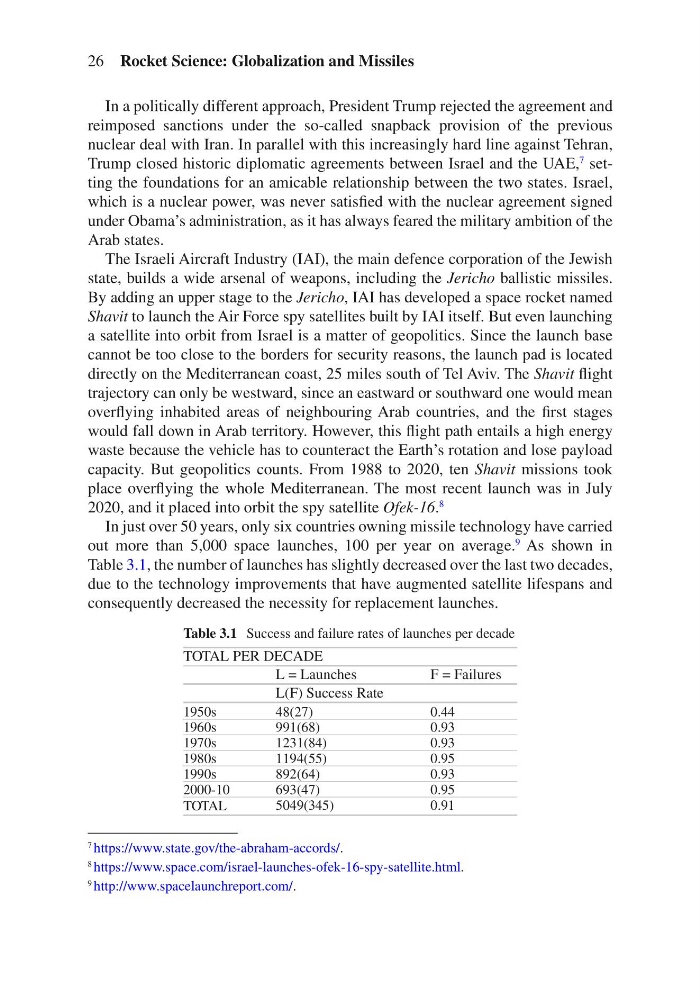
In just over 50 years, only six countries owning missile technology have carried
out more than 5,000 space launches, 100 per year on average.
9
As shown in
Table 3.1, the number of launches has slightly decreased over the last two decades,
due to the technology improvements that have augmented satellite lifespans and
consequently decreased the necessity for replacement launches.
7
https://www.state.gov/the-abraham-accords/.
8
https://www.space.com/israel-launches-ofek-16-spy-satellite.html.
9
http://www.spacelaunchreport.com/.
Table 3.1 Success and failure rates of launches per decade
TOTAL PER DECADE
L = Launches
F = Failures
L(F) Success Rate
1950s
48(27)
0.44
1960s
991(68)
0.93
1970s
1231(84)
0.93
1980s
1194(55)
0.95
1990s
892(64)
0.93
2000- 10
693(47)
0.95
TOTAL
5049(345)
0.91
26 Rocket Science: Globalization and Missiles
reimposed sanctions under the so-called snapback provision of the previous
nuclear deal with Iran. In parallel with this increasingly hard line against Tehran,
Trump closed historic diplomatic agreements between Israel and the UAE,
7
setting the foundations for an amicable relationship between the two states. Israel,
which is a nuclear power, was never satisfied with the nuclear agreement signed
under Obama’s administration, as it has always feared the military ambition of the
Arab states.
The Israeli Aircraft Industry (IAI), the main defence corporation of the Jewish
state, builds a wide arsenal of weapons, including the Jericho ballistic missiles.
By adding an upper stage to the Jericho, IAI has developed a space rocket named
Shavit to launch the Air Force spy satellites built by IAI itself. But even launching
a satellite into orbit from Israel is a matter of geopolitics. Since the launch base
cannot be too close to the borders for security reasons, the launch pad is located
directly on the Mediterranean coast, 25 miles south of Tel Aviv. The Shavit flight
trajectory can only be westward, since an eastward or southward one would mean
overflying inhabited areas of neighbouring Arab countries, and the first stages
would fall down in Arab territory. However, this flight path entails a high energy
waste because the vehicle has to counteract the Earth’s rotation and lose payload
capacity. But geopolitics counts. From 1988 to 2020, ten Shavit missions took
place overflying the whole Mediterranean. The most recent launch was in July
2020, and it placed into orbit the spy satellite Ofek-16.
8
In just over 50 years, only six countries owning missile technology have carried
out more than 5,000 space launches, 100 per year on average.
9
As shown in
Table 3.1, the number of launches has slightly decreased over the last two decades,
due to the technology improvements that have augmented satellite lifespans and
consequently decreased the necessity for replacement launches.
7
https://www.state.gov/the-abraham-accords/.
8
https://www.space.com/israel-launches-ofek-16-spy-satellite.html.
9
http://www.spacelaunchreport.com/.
Table 3.1 Success and failure rates of launches per decade
TOTAL PER DECADE
L = Launches
F = Failures
L(F) Success Rate
1950s
48(27)
0.44
1960s
991(68)
0.93
1970s
1231(84)
0.93
1980s
1194(55)
0.95
1990s
892(64)
0.93
2000- 10
693(47)
0.95
TOTAL
5049(345)
0.91
26 Rocket Science: Globalization and Missiles