

carried no scientific experiments. The payload slung below the balloon was a specially built square gondola fitted with instruments aimed to control and monitor
the behavior of the balloon in flight. Although these instruments were similar to
those used in conventional flights, the longer flights needed systems that had
higher reliability. It included:
• Flight control and data storage including redundant flight computers for
telemetry, ballast, and terminate.
• Communication systems for line of sight as well as long range satellite
communications.
• Other flight systems to support unique needs for the SPB flights including
differential pressure measurements, environmental measurements, tendon
loads and many more parameters.
• Small and lightweight camera systems with fixed focal length, a capability
for pan/tilt/zoom, and systems to obtain images from over the horizon.
• Reliable solar power and charging systems.
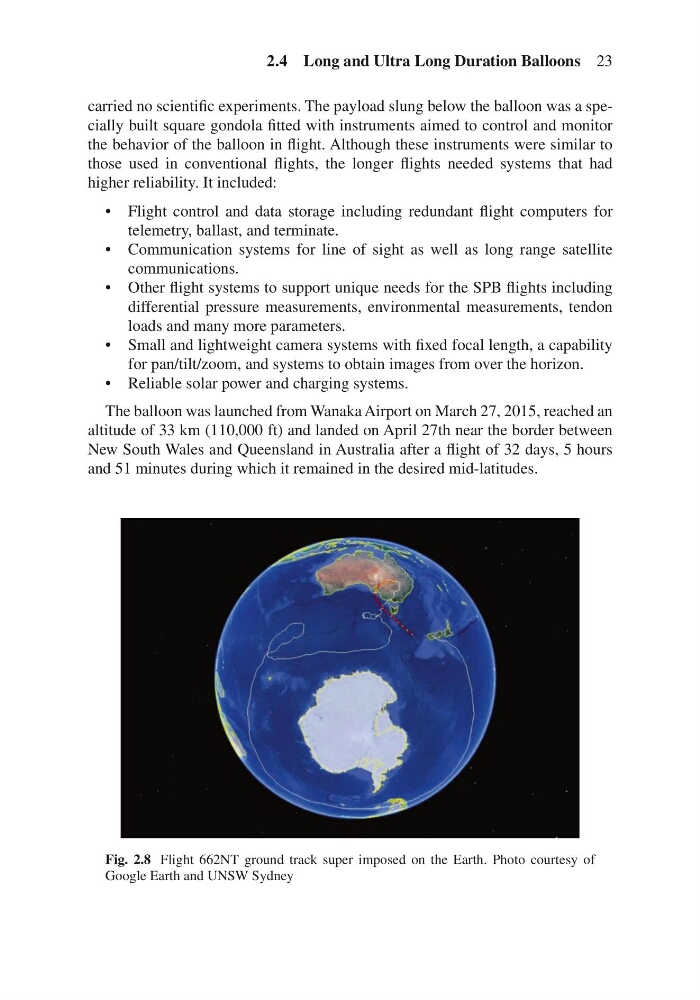
The balloon was launched from Wanaka Airport on March 27, 2015, reached an
altitude of 33 km (110,000 ft) and landed on April 27th near the border between
New South Wales and Queensland in Australia after a flight of 32 days, 5 hours
and 51 minutes during which it remained in the desired mid-latitudes.
Fig. 2.8 Flight 662NT ground track super imposed on the Earth. Photo courtesy of
Google Earth and UNSW Sydney
2.4 Long and Ultra Long Duration Balloons 23
the behavior of the balloon in flight. Although these instruments were similar to
those used in conventional flights, the longer flights needed systems that had
higher reliability. It included:
• Flight control and data storage including redundant flight computers for
telemetry, ballast, and terminate.
• Communication systems for line of sight as well as long range satellite
communications.
• Other flight systems to support unique needs for the SPB flights including
differential pressure measurements, environmental measurements, tendon
loads and many more parameters.
• Small and lightweight camera systems with fixed focal length, a capability
for pan/tilt/zoom, and systems to obtain images from over the horizon.
• Reliable solar power and charging systems.
The balloon was launched from Wanaka Airport on March 27, 2015, reached an
altitude of 33 km (110,000 ft) and landed on April 27th near the border between
New South Wales and Queensland in Australia after a flight of 32 days, 5 hours
and 51 minutes during which it remained in the desired mid-latitudes.
Fig. 2.8 Flight 662NT ground track super imposed on the Earth. Photo courtesy of
Google Earth and UNSW Sydney
2.4 Long and Ultra Long Duration Balloons 23