

2.4 LONG AND ULTRA LONG DURATION BALLOONS
2.4.1 Long Duration Balloons (LDB)
A Long Duration Balloon (LDB) mission will normally either traverse between
continents or circumnavigate the world. It may last up to three weeks and make
use of satellite-based electronic systems for command and data.
All throughout the 1990’s and into the 21st century, LDB support systems and
scientific payloads were refined with increased reliability, pre-mission testing, and
scientific data real-time downlink bandwidth plus on-board data capacity. In the
mid-1990’s, NSBF staff worked with Motorola to develop a transponder for the
LDB system to utilize the NASA Tracking and Data Relay Satellite System
(TDRSS) capabilities. This transponder improved uplink and downlink capability
and reliability. In the years since 1989, approximately 35 LDB flights have been
launched from McMurdo, Antarctica. The longest was over 40 days, and it made
three circuits around the southern continent. The NASA LDB has proven to be a
reliable and affordable vehicle for researchers doing state of the art science and
developing new sensor systems.
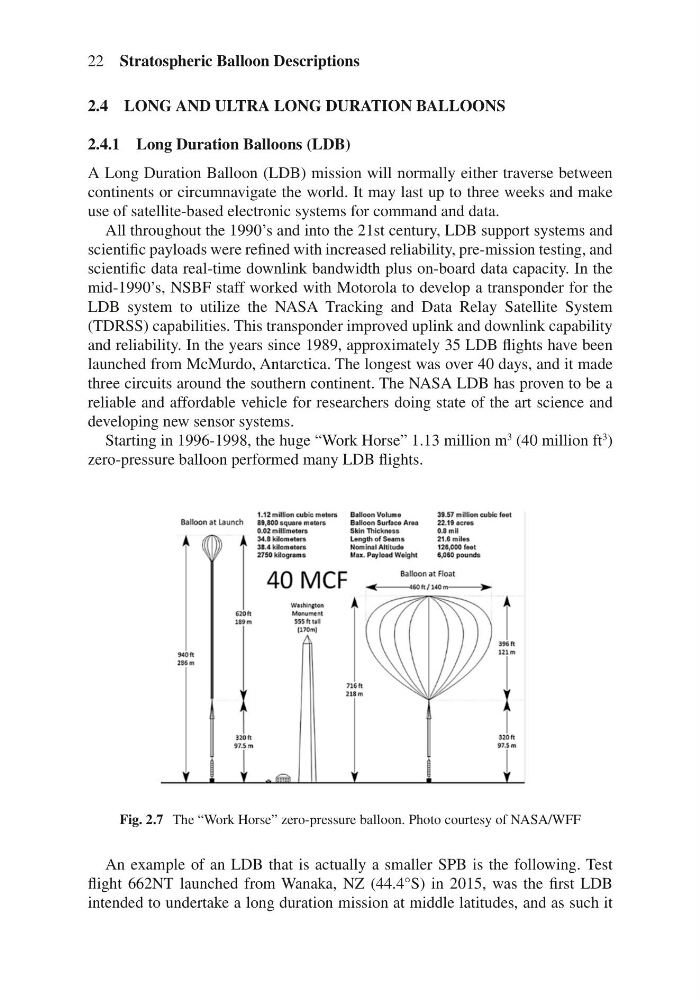
Starting in 1996-1998, the huge “Work Horse” 1.13 million m
3
(40 million ft
3
)
zero-pressure balloon performed many LDB flights.
An example of an LDB that is actually a smaller SPB is the following. Test
flight 662NT launched from Wanaka, NZ (44.4°S) in 2015, was the first LDB
intended to undertake a long duration mission at middle latitudes, and as such it
Fig. 2.7 The “Work Horse” zero-pressure balloon. Photo courtesy of NASA/WFF
22 Stratospheric Balloon Descriptions
2.4.1 Long Duration Balloons (LDB)
A Long Duration Balloon (LDB) mission will normally either traverse between
continents or circumnavigate the world. It may last up to three weeks and make
use of satellite-based electronic systems for command and data.
All throughout the 1990’s and into the 21st century, LDB support systems and
scientific payloads were refined with increased reliability, pre-mission testing, and
scientific data real-time downlink bandwidth plus on-board data capacity. In the
mid-1990’s, NSBF staff worked with Motorola to develop a transponder for the
LDB system to utilize the NASA Tracking and Data Relay Satellite System
(TDRSS) capabilities. This transponder improved uplink and downlink capability
and reliability. In the years since 1989, approximately 35 LDB flights have been
launched from McMurdo, Antarctica. The longest was over 40 days, and it made
three circuits around the southern continent. The NASA LDB has proven to be a
reliable and affordable vehicle for researchers doing state of the art science and
developing new sensor systems.
Starting in 1996-1998, the huge “Work Horse” 1.13 million m
3
(40 million ft
3
)
zero-pressure balloon performed many LDB flights.
An example of an LDB that is actually a smaller SPB is the following. Test
flight 662NT launched from Wanaka, NZ (44.4°S) in 2015, was the first LDB
intended to undertake a long duration mission at middle latitudes, and as such it
Fig. 2.7 The “Work Horse” zero-pressure balloon. Photo courtesy of NASA/WFF
22 Stratospheric Balloon Descriptions