

Details of the largest SPB flown during the test flights are as follows:
• Inflated volume ~18.8 million cubic feet.
• Number of gores = 280.
• Length of each gore ~492 feet.
• Inflated diameter ~376 feet.
• Inflated height ~233 feet.
• Shell film thickness ~1.5 mil (0.00015 in); much thinner than a ZPB.
• Final overall weight exceeded 2,268 kg (5,000 lb).
• Fitting diameter was 1.22 m (4 ft); previously was 1.46 m (4.8 ft).
• Number of gore width measurements was 6,440.
• Amount of load tape tendon in balloon ~41.8 km (26 mi).
• Amount of film visually inspected, re-rolled and dispensed for this balloon
exceeded 1.3 million square feet; over 30 acres of film!
• Minimum amount of walking just to seal balloon was 55 miles!
After a few more years of testing in New Zealand, the key lessons regarding the
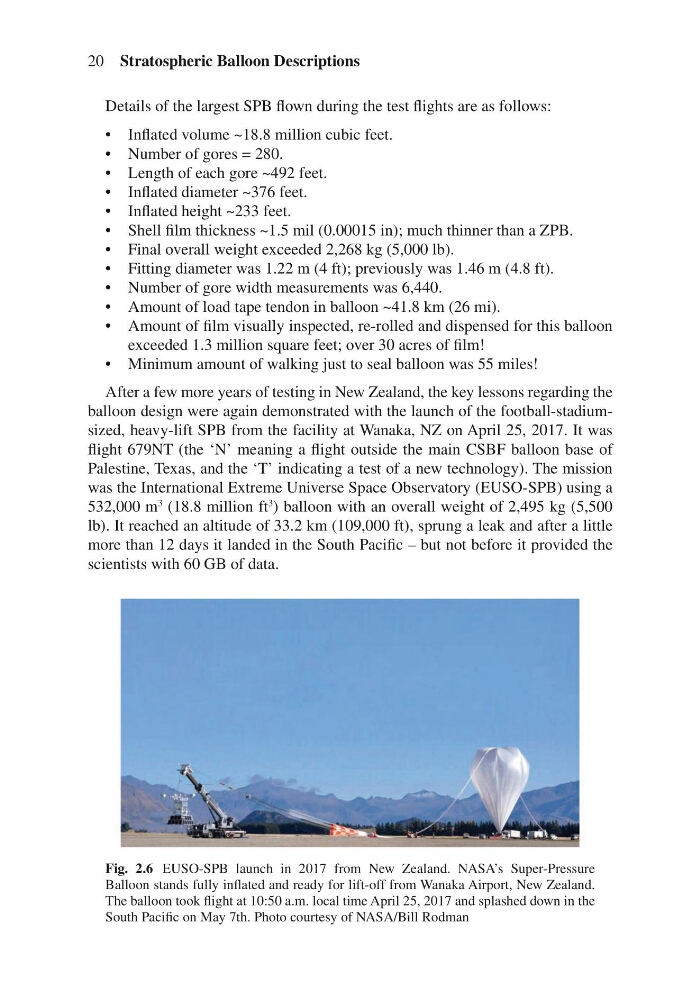
balloon design were again demonstrated with the launch of the football-stadiumsized, heavy-lift SPB from the facility at Wanaka, NZ on April 25, 2017. It was
flight 679NT (the ‘N’ meaning a flight outside the main CSBF balloon base of
Palestine, Texas, and the ‘T’ indicating a test of a new technology). The mission
was the International Extreme Universe Space Observatory (EUSO-SPB) using a
532,000 m
3
(18.8 million ft
3
) balloon with an overall weight of 2,495 kg (5,500
lb). It reached an altitude of 33.2 km (109,000 ft), sprung a leak and after a little
more than 12 days it landed in the South Pacific – but not before it provided the
scientists with 60 GB of data.
Fig. 2.6 EUSO-SPB launch in 2017 from New Zealand. NASA’s Super-Pressure
Balloon stands fully inflated and ready for lift-off from Wanaka Airport, New Zealand.
The balloon took flight at 10:50 a.m. local time April 25, 2017 and splashed down in the
South Pacific on May 7th. Photo courtesy of NASA/Bill Rodman
20 Stratospheric Balloon Descriptions
• Inflated volume ~18.8 million cubic feet.
• Number of gores = 280.
• Length of each gore ~492 feet.
• Inflated diameter ~376 feet.
• Inflated height ~233 feet.
• Shell film thickness ~1.5 mil (0.00015 in); much thinner than a ZPB.
• Final overall weight exceeded 2,268 kg (5,000 lb).
• Fitting diameter was 1.22 m (4 ft); previously was 1.46 m (4.8 ft).
• Number of gore width measurements was 6,440.
• Amount of load tape tendon in balloon ~41.8 km (26 mi).
• Amount of film visually inspected, re-rolled and dispensed for this balloon
exceeded 1.3 million square feet; over 30 acres of film!
• Minimum amount of walking just to seal balloon was 55 miles!
After a few more years of testing in New Zealand, the key lessons regarding the
balloon design were again demonstrated with the launch of the football-stadiumsized, heavy-lift SPB from the facility at Wanaka, NZ on April 25, 2017. It was
flight 679NT (the ‘N’ meaning a flight outside the main CSBF balloon base of
Palestine, Texas, and the ‘T’ indicating a test of a new technology). The mission
was the International Extreme Universe Space Observatory (EUSO-SPB) using a
532,000 m
3
(18.8 million ft
3
) balloon with an overall weight of 2,495 kg (5,500
lb). It reached an altitude of 33.2 km (109,000 ft), sprung a leak and after a little
more than 12 days it landed in the South Pacific – but not before it provided the
scientists with 60 GB of data.
Fig. 2.6 EUSO-SPB launch in 2017 from New Zealand. NASA’s Super-Pressure
Balloon stands fully inflated and ready for lift-off from Wanaka Airport, New Zealand.
The balloon took flight at 10:50 a.m. local time April 25, 2017 and splashed down in the
South Pacific on May 7th. Photo courtesy of NASA/Bill Rodman
20 Stratospheric Balloon Descriptions