

NASA chose two methods to reduce these very high strength requirements. The
first was to make each of the gore sections slightly lobed and reducing the local
radius of the film to around 1 m (3.28 ft). Reduced radius translates to reduced
strength requirements in the horizontal or hoop direction for the film. Secondly,
the tendons that run from top to bottom resolve the forces in that direction. Each
tendon can take about 7,000 newtons (~1,600 lb). That means the fittings on the
top and bottom of the balloon must resolve a total force of ~1,960,000 newtons
(~448,000 lb) for the 280 tendons used in the envelope.
See also the Raven special purpose SPB balloons described in Section 5.4.
2.3.4 Test Flights
There have been test flights of the Super-Pressure Balloon to explore the design,
deployment, and flight duration. These flights improved the balloon fabrication
techniques through new and innovative production processes. Advancements in
the launch operations techniques have also been achieved.
The project’s approach has focused on incremental gains in balloon volume and
payload capability. There are always challenges with both production and launch
operations as the size of a balloon increases. The incremental stepwise approach
to building bigger balloons was employed in an effort to effectively manage these
challenges and provide continuity for the process. Balloon volumes have steadily
increased over time. Coupled with the increased balloon volume are increases in
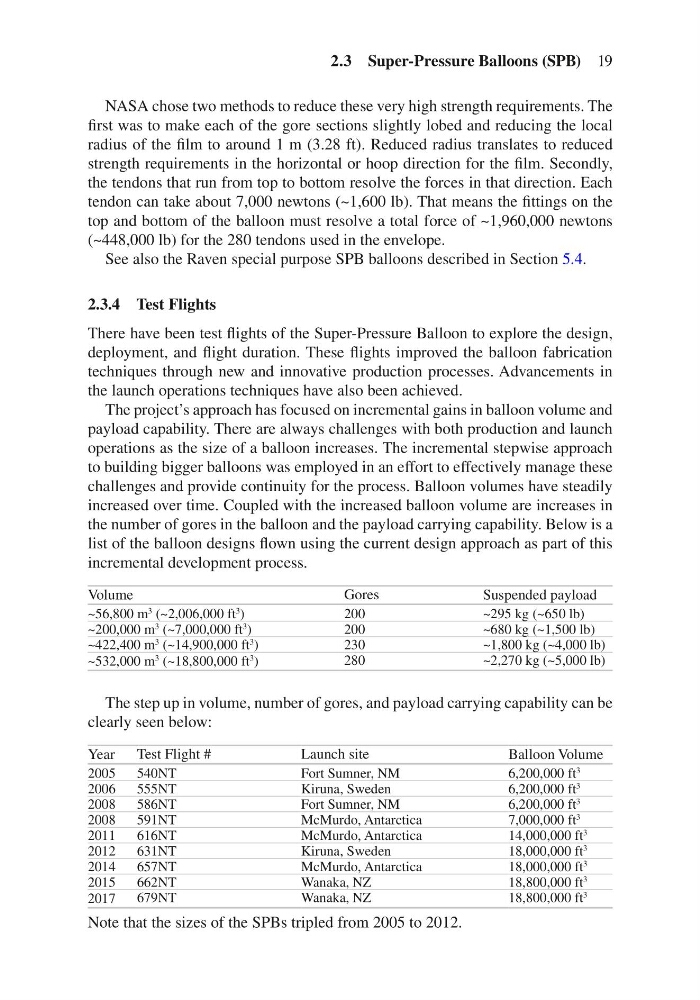
the number of gores in the balloon and the payload carrying capability. Below is a
list of the balloon designs flown using the current design approach as part of this
incremental development process.
Volume
Gores
Suspended payload
~56,800 m
3
(~2,006,000 ft
3
)
200
~295 kg (~650 lb)
~200,000 m
3
(~7,000,000 ft
3
)
200
~680 kg (~1,500 lb)
~422,400 m
3
(~14,900,000 ft
3
)
230
~1,800 kg (~4,000 lb)
~532,000 m
3
(~18,800,000 ft
3
)
280
~2,270 kg (~5,000 lb)
The step up in volume, number of gores, and payload carrying capability can be
clearly seen below:
Year
Test Flight #
Launch site
Balloon Volume
2005
540NT
Fort Sumner, NM
6,200,000 ft
3
2006
555NT
Kiruna, Sweden
6,200,000 ft
3
2008
586NT
Fort Sumner, NM
6,200,000 ft
3
2008
591NT
McMurdo, Antarctica
7,000,000 ft
3
2011
616NT
McMurdo, Antarctica
14,000,000 ft
3
2012
631NT
Kiruna, Sweden
18,000,000 ft
3
2014
657NT
McMurdo, Antarctica
18,000,000 ft
3
2015
662NT
Wanaka, NZ
18,800,000 ft
3
2017
679NT
Wanaka, NZ
18,800,000 ft
3
Note that the sizes of the SPBs tripled from 2005 to 2012.
2.3 Super-Pressure Balloons (SPB) 19
first was to make each of the gore sections slightly lobed and reducing the local
radius of the film to around 1 m (3.28 ft). Reduced radius translates to reduced
strength requirements in the horizontal or hoop direction for the film. Secondly,
the tendons that run from top to bottom resolve the forces in that direction. Each
tendon can take about 7,000 newtons (~1,600 lb). That means the fittings on the
top and bottom of the balloon must resolve a total force of ~1,960,000 newtons
(~448,000 lb) for the 280 tendons used in the envelope.
See also the Raven special purpose SPB balloons described in Section 5.4.
2.3.4 Test Flights
There have been test flights of the Super-Pressure Balloon to explore the design,
deployment, and flight duration. These flights improved the balloon fabrication
techniques through new and innovative production processes. Advancements in
the launch operations techniques have also been achieved.
The project’s approach has focused on incremental gains in balloon volume and
payload capability. There are always challenges with both production and launch
operations as the size of a balloon increases. The incremental stepwise approach
to building bigger balloons was employed in an effort to effectively manage these
challenges and provide continuity for the process. Balloon volumes have steadily
increased over time. Coupled with the increased balloon volume are increases in
the number of gores in the balloon and the payload carrying capability. Below is a
list of the balloon designs flown using the current design approach as part of this
incremental development process.
Volume
Gores
Suspended payload
~56,800 m
3
(~2,006,000 ft
3
)
200
~295 kg (~650 lb)
~200,000 m
3
(~7,000,000 ft
3
)
200
~680 kg (~1,500 lb)
~422,400 m
3
(~14,900,000 ft
3
)
230
~1,800 kg (~4,000 lb)
~532,000 m
3
(~18,800,000 ft
3
)
280
~2,270 kg (~5,000 lb)
The step up in volume, number of gores, and payload carrying capability can be
clearly seen below:
Year
Test Flight #
Launch site
Balloon Volume
2005
540NT
Fort Sumner, NM
6,200,000 ft
3
2006
555NT
Kiruna, Sweden
6,200,000 ft
3
2008
586NT
Fort Sumner, NM
6,200,000 ft
3
2008
591NT
McMurdo, Antarctica
7,000,000 ft
3
2011
616NT
McMurdo, Antarctica
14,000,000 ft
3
2012
631NT
Kiruna, Sweden
18,000,000 ft
3
2014
657NT
McMurdo, Antarctica
18,000,000 ft
3
2015
662NT
Wanaka, NZ
18,800,000 ft
3
2017
679NT
Wanaka, NZ
18,800,000 ft
3
Note that the sizes of the SPBs tripled from 2005 to 2012.
2.3 Super-Pressure Balloons (SPB) 19