

WMAP was launched in June 2001 and observed the oldest light in the universe. Patterns imprinted in this light, approximately 400,000 years after the Big
Bang, revealed details about the age of the universe, the era of first starlight, and
other key properties. WMAP and the previous Cosmic Background Explorer
(COBE) owed their existence in no small part to Wilkinson, whose research,
enthusiasm and tireless efforts played a major role in bringing these missions to
life. His numerous accolades include the Princeton President’s Award for
Distinguished Teaching, election to the National Academy of Sciences in 1983,
and the James Craig Watson Medal (2001).
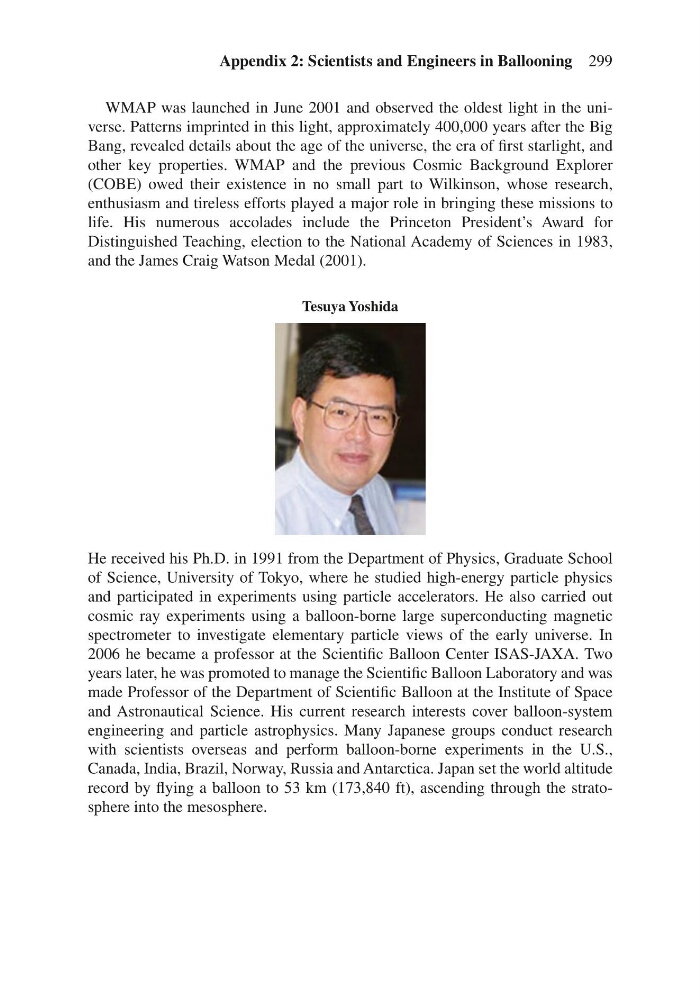
Tesuya Yoshida
He received his Ph.D. in 1991 from the Department of Physics, Graduate School
of Science, University of Tokyo, where he studied high-energy particle physics
and participated in experiments using particle accelerators. He also carried out
cosmic ray experiments using a balloon-borne large superconducting magnetic
spectrometer to investigate elementary particle views of the early universe. In
2006 he became a professor at the Scientific Balloon Center ISAS-JAXA. Two
years later, he was promoted to manage the Scientific Balloon Laboratory and was
made Professor of the Department of Scientific Balloon at the Institute of Space
and Astronautical Science. His current research interests cover balloon-system
engineering and particle astrophysics. Many Japanese groups conduct research
with scientists overseas and perform balloon-borne experiments in the U.S.,
Canada, India, Brazil, Norway, Russia and Antarctica. Japan set the world altitude
record by flying a balloon to 53 km (173,840 ft), ascending through the stratosphere into the mesosphere.
Appendix 2: Scientists and Engineers in Ballooning 299
Bang, revealed details about the age of the universe, the era of first starlight, and
other key properties. WMAP and the previous Cosmic Background Explorer
(COBE) owed their existence in no small part to Wilkinson, whose research,
enthusiasm and tireless efforts played a major role in bringing these missions to
life. His numerous accolades include the Princeton President’s Award for
Distinguished Teaching, election to the National Academy of Sciences in 1983,
and the James Craig Watson Medal (2001).
Tesuya Yoshida
He received his Ph.D. in 1991 from the Department of Physics, Graduate School
of Science, University of Tokyo, where he studied high-energy particle physics
and participated in experiments using particle accelerators. He also carried out
cosmic ray experiments using a balloon-borne large superconducting magnetic
spectrometer to investigate elementary particle views of the early universe. In
2006 he became a professor at the Scientific Balloon Center ISAS-JAXA. Two
years later, he was promoted to manage the Scientific Balloon Laboratory and was
made Professor of the Department of Scientific Balloon at the Institute of Space
and Astronautical Science. His current research interests cover balloon-system
engineering and particle astrophysics. Many Japanese groups conduct research
with scientists overseas and perform balloon-borne experiments in the U.S.,
Canada, India, Brazil, Norway, Russia and Antarctica. Japan set the world altitude
record by flying a balloon to 53 km (173,840 ft), ascending through the stratosphere into the mesosphere.
Appendix 2: Scientists and Engineers in Ballooning 299