

He has a B.S. in Electrical and Computer Engineering from Clemson University,
SC in 1980, an M.S. in Electrical and Computer Engineering from Ohio State
University in 1981, and a Ph.D. in Astronomy from the University of Arizona in
1988. His career took him from TRW Aerospace to NASA-JPL and Caltech and
finally, in 1991, to the University of Arizona where his is currently Professor of
Astronomy at the Steward Observatory. NASA chose his Galactic/Extragalactic
ULDB Spectroscopic Terahertz Observatory (GUSTO) team to build and launch
the balloon-borne instrument. It is planned as a long-duration balloon mission to
be launched from Antarctica in 2021. It will make a spectroscopic survey of the
Milky Way and Large Magellanic Cloud (LMC) to investigate the composition,
energetics and dynamics of the interstellar medium. The University of Arizona
will assemble the GUSTO instrument in a collaboration with the Massachusetts
Institute of Technology, Arizona State University, SRON Netherlands Institute for
Space Research, Virginia Diodes, and Ball Aerospace.
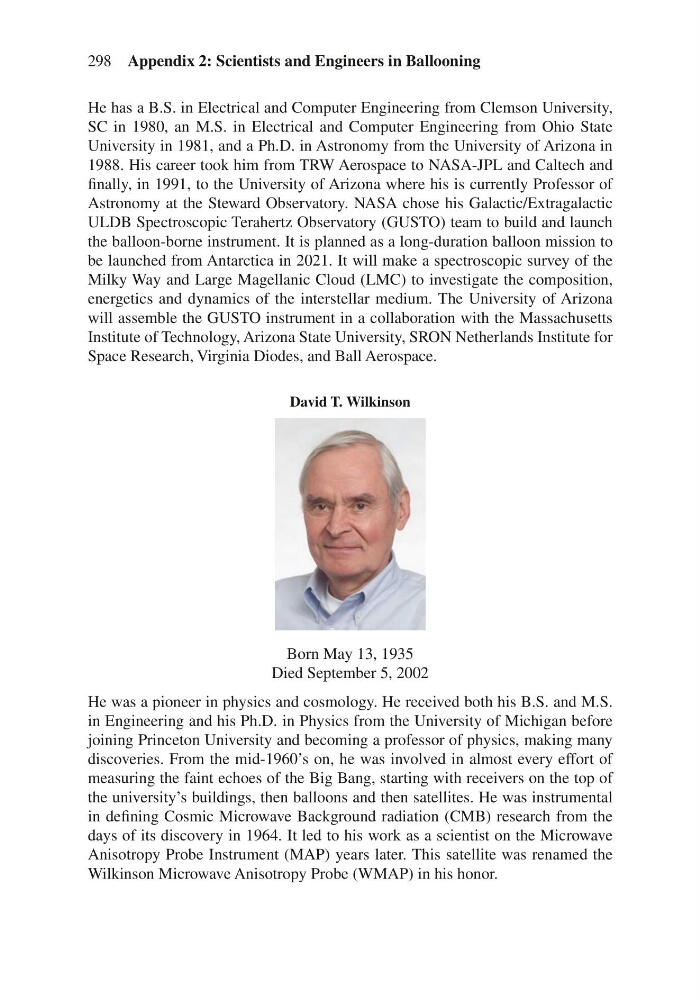
David T. Wilkinson
Born May 13, 1935
Died September 5, 2002
He was a pioneer in physics and cosmology. He received both his B.S. and M.S.
in Engineering and his Ph.D. in Physics from the University of Michigan before
joining Princeton University and becoming a professor of physics, making many
discoveries. From the mid-1960’s on, he was involved in almost every effort of
measuring the faint echoes of the Big Bang, starting with receivers on the top of
the university’s buildings, then balloons and then satellites. He was instrumental
in defining Cosmic Microwave Background radiation (CMB) research from the
days of its discovery in 1964. It led to his work as a scientist on the Microwave
Anisotropy Probe Instrument (MAP) years later. This satellite was renamed the
Wilkinson Microwave Anisotropy Probe (WMAP) in his honor.
298 Appendix 2: Scientists and Engineers in Ballooning
SC in 1980, an M.S. in Electrical and Computer Engineering from Ohio State
University in 1981, and a Ph.D. in Astronomy from the University of Arizona in
1988. His career took him from TRW Aerospace to NASA-JPL and Caltech and
finally, in 1991, to the University of Arizona where his is currently Professor of
Astronomy at the Steward Observatory. NASA chose his Galactic/Extragalactic
ULDB Spectroscopic Terahertz Observatory (GUSTO) team to build and launch
the balloon-borne instrument. It is planned as a long-duration balloon mission to
be launched from Antarctica in 2021. It will make a spectroscopic survey of the
Milky Way and Large Magellanic Cloud (LMC) to investigate the composition,
energetics and dynamics of the interstellar medium. The University of Arizona
will assemble the GUSTO instrument in a collaboration with the Massachusetts
Institute of Technology, Arizona State University, SRON Netherlands Institute for
Space Research, Virginia Diodes, and Ball Aerospace.
David T. Wilkinson
Born May 13, 1935
Died September 5, 2002
He was a pioneer in physics and cosmology. He received both his B.S. and M.S.
in Engineering and his Ph.D. in Physics from the University of Michigan before
joining Princeton University and becoming a professor of physics, making many
discoveries. From the mid-1960’s on, he was involved in almost every effort of
measuring the faint echoes of the Big Bang, starting with receivers on the top of
the university’s buildings, then balloons and then satellites. He was instrumental
in defining Cosmic Microwave Background radiation (CMB) research from the
days of its discovery in 1964. It led to his work as a scientist on the Microwave
Anisotropy Probe Instrument (MAP) years later. This satellite was renamed the
Wilkinson Microwave Anisotropy Probe (WMAP) in his honor.
298 Appendix 2: Scientists and Engineers in Ballooning