

Born January 29, 1936
He is a Dutch American astrophysicist and Professor Emeritus of Physics at the
Massachusetts Institute of Technology, where he was a member of the physics
faculty for 43 years beginning in 1966 until his retirement in 2009. Born in the
Hague in the Netherlands, he gained his Ph.D. in nuclear physics in 1965 at the
Delft University of Technology and joined MIT in 1966. His major astrophysics
contributions include discovering the first slowly rotating neutron star by using
balloons in the stratosphere. He conducted all-sky balloon surveys with George
W. Clark. Through the late 1970’s, there were about twenty successful balloon
flights. The balloon surveys led to the discovery of five new X-ray sources with
spectra that were very different from the X-ray sources discovered during rocket
observations. The X-ray flux of these sources was variable. One of them was GX
1+4, whose X-ray flux varied with a period of about 2.4 minutes. It was the first
known example of a slowly rotating neutron star.
Lewin was co-investigator on many satellites, and author of hundreds of papers
and many books. He has been awarded with many honors. He has been on many
TV presentations. Some of his educational lectures are on YouTube.
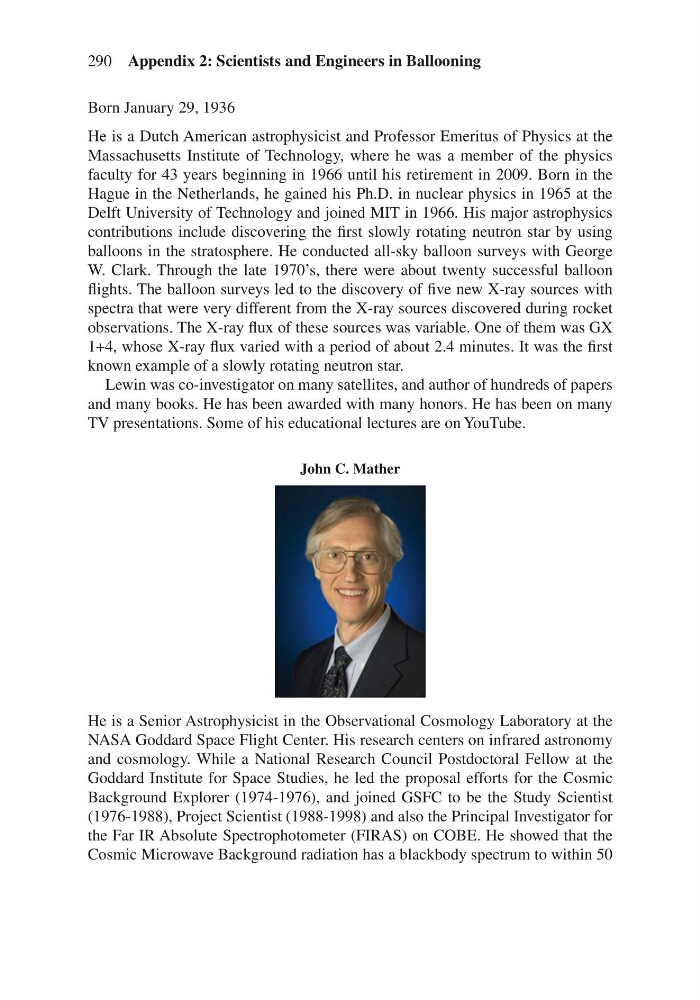
John C. Mather
He is a Senior Astrophysicist in the Observational Cosmology Laboratory at the
NASA Goddard Space Flight Center. His research centers on infrared astronomy
and cosmology. While a National Research Council Postdoctoral Fellow at the
Goddard Institute for Space Studies, he led the proposal efforts for the Cosmic
Background Explorer (1974-1976), and joined GSFC to be the Study Scientist
(1976-1988), Project Scientist (1988-1998) and also the Principal Investigator for
the Far IR Absolute Spectrophotometer (FIRAS) on COBE. He showed that the
Cosmic Microwave Background radiation has a blackbody spectrum to within 50
290 Appendix 2: Scientists and Engineers in Ballooning
He is a Dutch American astrophysicist and Professor Emeritus of Physics at the
Massachusetts Institute of Technology, where he was a member of the physics
faculty for 43 years beginning in 1966 until his retirement in 2009. Born in the
Hague in the Netherlands, he gained his Ph.D. in nuclear physics in 1965 at the
Delft University of Technology and joined MIT in 1966. His major astrophysics
contributions include discovering the first slowly rotating neutron star by using
balloons in the stratosphere. He conducted all-sky balloon surveys with George
W. Clark. Through the late 1970’s, there were about twenty successful balloon
flights. The balloon surveys led to the discovery of five new X-ray sources with
spectra that were very different from the X-ray sources discovered during rocket
observations. The X-ray flux of these sources was variable. One of them was GX
1+4, whose X-ray flux varied with a period of about 2.4 minutes. It was the first
known example of a slowly rotating neutron star.
Lewin was co-investigator on many satellites, and author of hundreds of papers
and many books. He has been awarded with many honors. He has been on many
TV presentations. Some of his educational lectures are on YouTube.
John C. Mather
He is a Senior Astrophysicist in the Observational Cosmology Laboratory at the
NASA Goddard Space Flight Center. His research centers on infrared astronomy
and cosmology. While a National Research Council Postdoctoral Fellow at the
Goddard Institute for Space Studies, he led the proposal efforts for the Cosmic
Background Explorer (1974-1976), and joined GSFC to be the Study Scientist
(1976-1988), Project Scientist (1988-1998) and also the Principal Investigator for
the Far IR Absolute Spectrophotometer (FIRAS) on COBE. He showed that the
Cosmic Microwave Background radiation has a blackbody spectrum to within 50
290 Appendix 2: Scientists and Engineers in Ballooning