

He was an astrophysicist and Marvin L. Goldberger Professor of Physics at the
California Institute of Technology in Pasadena, CA. He joined Caltech in 1993,
and was most recently Chair, Division of Physics, Mathematics and Astronomy.
In 1994, he led a team that proposed a space mission named FIRE to investigate
the Cosmic Microwave Background (CMB) as a follow up to the discoveries of the
COBE satellite. FIRE lost out to the WMAP team, but this freed Lange and his collaborators to focus on BOOMERANG, a balloon-borne experiment which, although
of more limited scope than a satellite mission, could be flown far more quickly and
for less money. Their efforts paid off with a long-duration Antarctic balloon flight
in 1998 and the announcement in May 2000 of remarkable results. BOOMERANG
provided the first high-resolution, high-signal-to-noise map of the CMB. This gave
a clear measurement of the first acoustic peak in the CMB power spectrum. This in
turn gave a robust determination of the geometry of the universe. This experiment,
widely recognized in cosmology as a watershed event, helped usher in the era of
precision cosmology, with precise constraints to several cosmological parameters
and strong evidence in support of inflation. The results were confirmed a few days
later by MAXIMA, a balloon experiment that Lange helped to get started, as well
as a string of subsequent suborbital experiments and then WMAP. Although
BOOMERANG was Lange’s most notable achievement, he amassed a record of
accomplishment as an instrumentalist, leader, mentor and communicator that
extended much further. His lifelong interest in the CMB was nurtured as an undergraduate at Princeton University by David Wilkinson, and he recalled fondly a
summer spent working with John Mather at the Goddard Space Flight Center.
In 2003, Lange was recognized with the California Scientist of the Year Award,
and in 2006 he and Paolo de Bernardis of the University La Sapienza in Rome
jointly received the award from the International Balzan Foundation “for their
contributions to cosmology, in particular the BOOMERANG Antarctic balloon
experiment.” In 2009 he was awarded the Dan David Prize (2009).
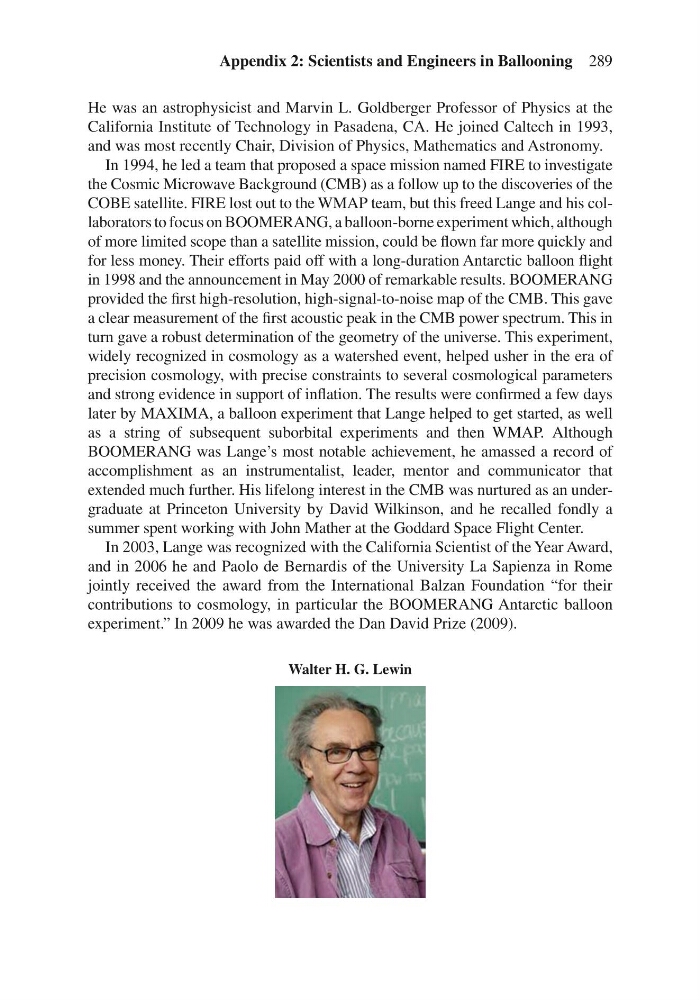
Walter H. G. Lewin
Appendix 2: Scientists and Engineers in Ballooning 289
California Institute of Technology in Pasadena, CA. He joined Caltech in 1993,
and was most recently Chair, Division of Physics, Mathematics and Astronomy.
In 1994, he led a team that proposed a space mission named FIRE to investigate
the Cosmic Microwave Background (CMB) as a follow up to the discoveries of the
COBE satellite. FIRE lost out to the WMAP team, but this freed Lange and his collaborators to focus on BOOMERANG, a balloon-borne experiment which, although
of more limited scope than a satellite mission, could be flown far more quickly and
for less money. Their efforts paid off with a long-duration Antarctic balloon flight
in 1998 and the announcement in May 2000 of remarkable results. BOOMERANG
provided the first high-resolution, high-signal-to-noise map of the CMB. This gave
a clear measurement of the first acoustic peak in the CMB power spectrum. This in
turn gave a robust determination of the geometry of the universe. This experiment,
widely recognized in cosmology as a watershed event, helped usher in the era of
precision cosmology, with precise constraints to several cosmological parameters
and strong evidence in support of inflation. The results were confirmed a few days
later by MAXIMA, a balloon experiment that Lange helped to get started, as well
as a string of subsequent suborbital experiments and then WMAP. Although
BOOMERANG was Lange’s most notable achievement, he amassed a record of
accomplishment as an instrumentalist, leader, mentor and communicator that
extended much further. His lifelong interest in the CMB was nurtured as an undergraduate at Princeton University by David Wilkinson, and he recalled fondly a
summer spent working with John Mather at the Goddard Space Flight Center.
In 2003, Lange was recognized with the California Scientist of the Year Award,
and in 2006 he and Paolo de Bernardis of the University La Sapienza in Rome
jointly received the award from the International Balzan Foundation “for their
contributions to cosmology, in particular the BOOMERANG Antarctic balloon
experiment.” In 2009 he was awarded the Dan David Prize (2009).
Walter H. G. Lewin
Appendix 2: Scientists and Engineers in Ballooning 289