

After an A.B. degree (Magna Cum Laude) in Physics from Dartmouth College,
she got her Ph.D. in Physics from the University of California, Berkeley. She is
currently the Benjamin M. Rosen Professor of Physics at the California Institute
of Technology. She has focused her research on experimental and observational
high-energy astrophysics. In her laboratories, and with collaborators around the
world she developed detectors and optics for focusing high energy X-rays. This
led to the High Energy Focusing Telescope (HEFT) balloon experiment, and in
due course to the first focusing X-ray telescope in orbit as the NASA NuSTAR
mission. She was Principal Investigator for both observatories. The High HEFT
was a balloon-borne experiment that utilized depth-graded multilayer optics and
cadmium zinc telluride pixel detectors to image astrophysical sources in the hard
X-ray (20-100 keV) band. Its maiden flight of 25 hours took place in May 2005,
launched from Fort Sumner, NM. Her interests are accreting black holes, neutron
stars, gamma-ray bursts and supernova remnants. Among her results are the first
image of a supernova remnant in radioactivity, the unambiguous measurement of
the spin of the supermassive black hole in NGC 1365 (also known as the Great
Barred Spiral Galaxy), and the discovery of the most luminous accreting pulsar
known. In 2015 the American Astronomical Society awarded her its Bruno Rossi
Prize and she was elected an honorary fellow of the Royal Astronomical Society.
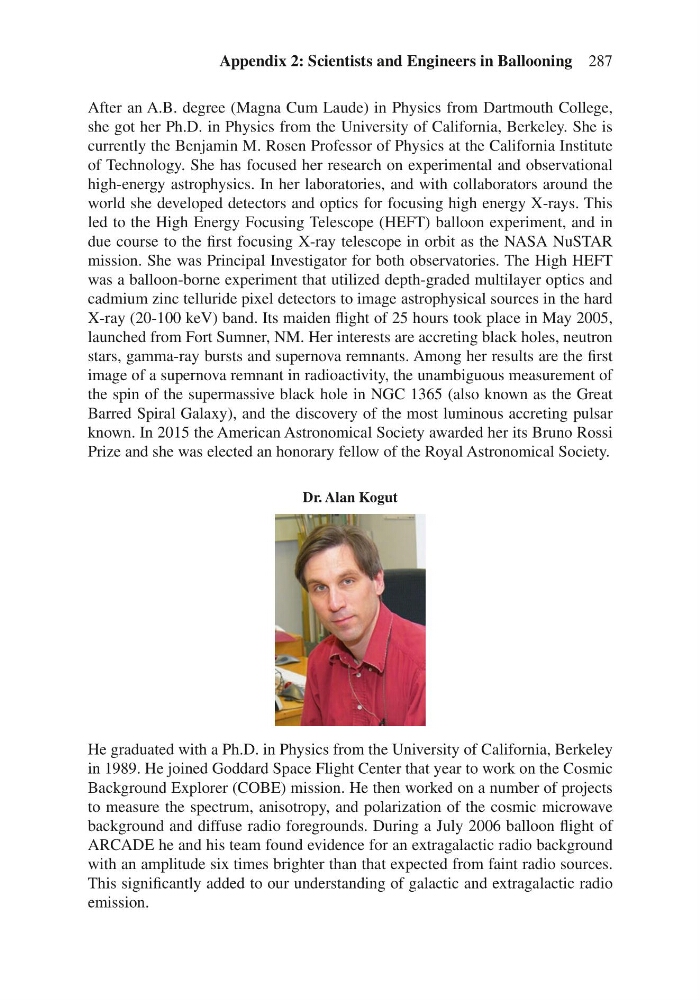
Dr. Alan Kogut
He graduated with a Ph.D. in Physics from the University of California, Berkeley
in 1989. He joined Goddard Space Flight Center that year to work on the Cosmic
Background Explorer (COBE) mission. He then worked on a number of projects
to measure the spectrum, anisotropy, and polarization of the cosmic microwave
background and diffuse radio foregrounds. During a July 2006 balloon flight of
ARCADE he and his team found evidence for an extragalactic radio background
with an amplitude six times brighter than that expected from faint radio sources.
This significantly added to our understanding of galactic and extragalactic radio
emission.
Appendix 2: Scientists and Engineers in Ballooning 287
she got her Ph.D. in Physics from the University of California, Berkeley. She is
currently the Benjamin M. Rosen Professor of Physics at the California Institute
of Technology. She has focused her research on experimental and observational
high-energy astrophysics. In her laboratories, and with collaborators around the
world she developed detectors and optics for focusing high energy X-rays. This
led to the High Energy Focusing Telescope (HEFT) balloon experiment, and in
due course to the first focusing X-ray telescope in orbit as the NASA NuSTAR
mission. She was Principal Investigator for both observatories. The High HEFT
was a balloon-borne experiment that utilized depth-graded multilayer optics and
cadmium zinc telluride pixel detectors to image astrophysical sources in the hard
X-ray (20-100 keV) band. Its maiden flight of 25 hours took place in May 2005,
launched from Fort Sumner, NM. Her interests are accreting black holes, neutron
stars, gamma-ray bursts and supernova remnants. Among her results are the first
image of a supernova remnant in radioactivity, the unambiguous measurement of
the spin of the supermassive black hole in NGC 1365 (also known as the Great
Barred Spiral Galaxy), and the discovery of the most luminous accreting pulsar
known. In 2015 the American Astronomical Society awarded her its Bruno Rossi
Prize and she was elected an honorary fellow of the Royal Astronomical Society.
Dr. Alan Kogut
He graduated with a Ph.D. in Physics from the University of California, Berkeley
in 1989. He joined Goddard Space Flight Center that year to work on the Cosmic
Background Explorer (COBE) mission. He then worked on a number of projects
to measure the spectrum, anisotropy, and polarization of the cosmic microwave
background and diffuse radio foregrounds. During a July 2006 balloon flight of
ARCADE he and his team found evidence for an extragalactic radio background
with an amplitude six times brighter than that expected from faint radio sources.
This significantly added to our understanding of galactic and extragalactic radio
emission.
Appendix 2: Scientists and Engineers in Ballooning 287