

spectrum from radio to gamma-rays as well as some on theory and computation.
From 1993 to 2001 he was Associate Professor of Computational Sciences and
Space Sciences at George Mason University, a research university near Fairfax
City in Virginia. Dr. Hertz then joined the NASA Office of Space Science as a
Senior Scientist and managed projects and programs that involved astrophysics,
heliophysics, and planetary science.
In 2012, he was named the NASA Director of the Astrophysics Division in the
Science Mission Directorate. He is responsible for NASA’s research programs and
missions necessary to discover how the universe works, to explore how the universe began and evolved into its present form, and to undertake a search for Earthlike planets orbiting other stars. In this position he oversees and funds the NASA
Balloon Program. He is a recipient of many NASA awards.
A.2.3 Former NASA/Contractor Managers
Some were helpful to me in providing information for the book and were, at one
time, key managers in the NASA Balloon Program. Others are key contributors to
the balloon missions described in this book. They are listed in alphabetical order.
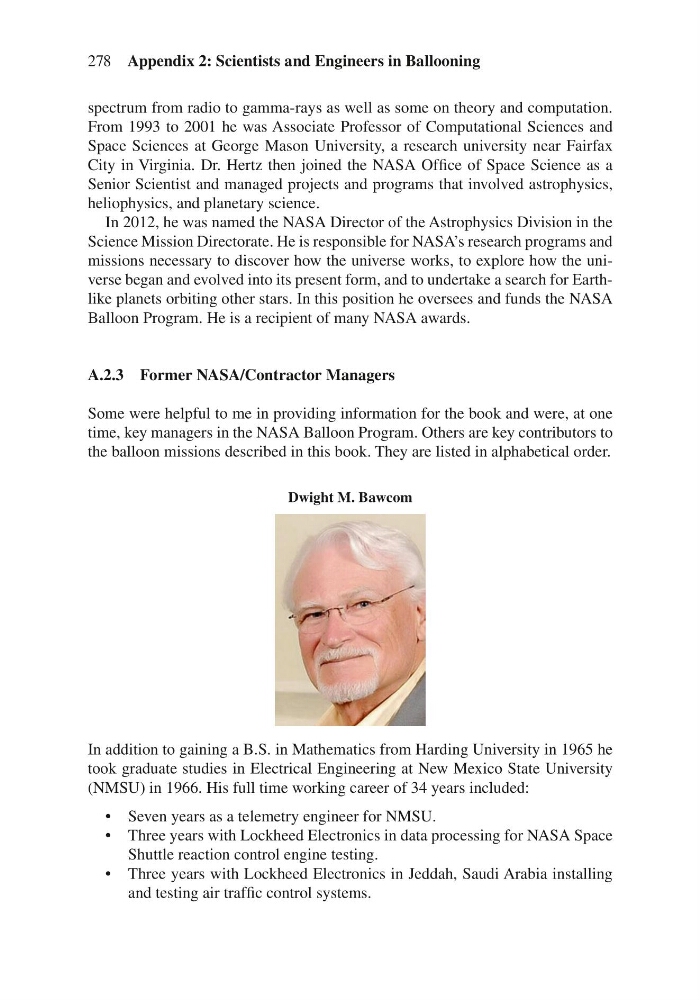
Dwight M. Bawcom
In addition to gaining a B.S. in Mathematics from Harding University in 1965 he
took graduate studies in Electrical Engineering at New Mexico State University
(NMSU) in 1966. His full time working career of 34 years included:
• Seven years as a telemetry engineer for NMSU.
• Three years with Lockheed Electronics in data processing for NASA Space
Shuttle reaction control engine testing.
• Three years with Lockheed Electronics in Jeddah, Saudi Arabia installing
and testing air traffic control systems.
278 Appendix 2: Scientists and Engineers in Ballooning
From 1993 to 2001 he was Associate Professor of Computational Sciences and
Space Sciences at George Mason University, a research university near Fairfax
City in Virginia. Dr. Hertz then joined the NASA Office of Space Science as a
Senior Scientist and managed projects and programs that involved astrophysics,
heliophysics, and planetary science.
In 2012, he was named the NASA Director of the Astrophysics Division in the
Science Mission Directorate. He is responsible for NASA’s research programs and
missions necessary to discover how the universe works, to explore how the universe began and evolved into its present form, and to undertake a search for Earthlike planets orbiting other stars. In this position he oversees and funds the NASA
Balloon Program. He is a recipient of many NASA awards.
A.2.3 Former NASA/Contractor Managers
Some were helpful to me in providing information for the book and were, at one
time, key managers in the NASA Balloon Program. Others are key contributors to
the balloon missions described in this book. They are listed in alphabetical order.
Dwight M. Bawcom
In addition to gaining a B.S. in Mathematics from Harding University in 1965 he
took graduate studies in Electrical Engineering at New Mexico State University
(NMSU) in 1966. His full time working career of 34 years included:
• Seven years as a telemetry engineer for NMSU.
• Three years with Lockheed Electronics in data processing for NASA Space
Shuttle reaction control engine testing.
• Three years with Lockheed Electronics in Jeddah, Saudi Arabia installing
and testing air traffic control systems.
278 Appendix 2: Scientists and Engineers in Ballooning