

the stratosphere. Battery powered radio transmitters on balloons provide ground
stations with data on wind speed and direction, air pressure and temperature, and
relative humidity. Meteorologists feed this into their weather models to generate
forecasts. Balloons are released twice a day at 92 upper-air sites across the U.S.,
and twice a day, every day of the year, balloons are released from 900 locations
worldwide. An effort is underway to automate the launch process. Although new
to the NWS this “autolaunch” technology has been utilized with success in some
of the harshest and remotest places in the world.
Other NOAA Programs
The Geophysical Monitoring for Climatic Change (GMCC) program was set up
by NOAA in 1972, and over the decades it evolved into what is now the Global
Monitoring Laboratory (GML). The initial focus was to maintain the long-term
measurements undertaken at NOAA’s four Atmospheric Baseline Observatories
and several regional sampling sites.
The four major sites are:
• Barrow AK.
• Mauna Loa, HI.
• American Samoa.
• South Pole, Antarctica.
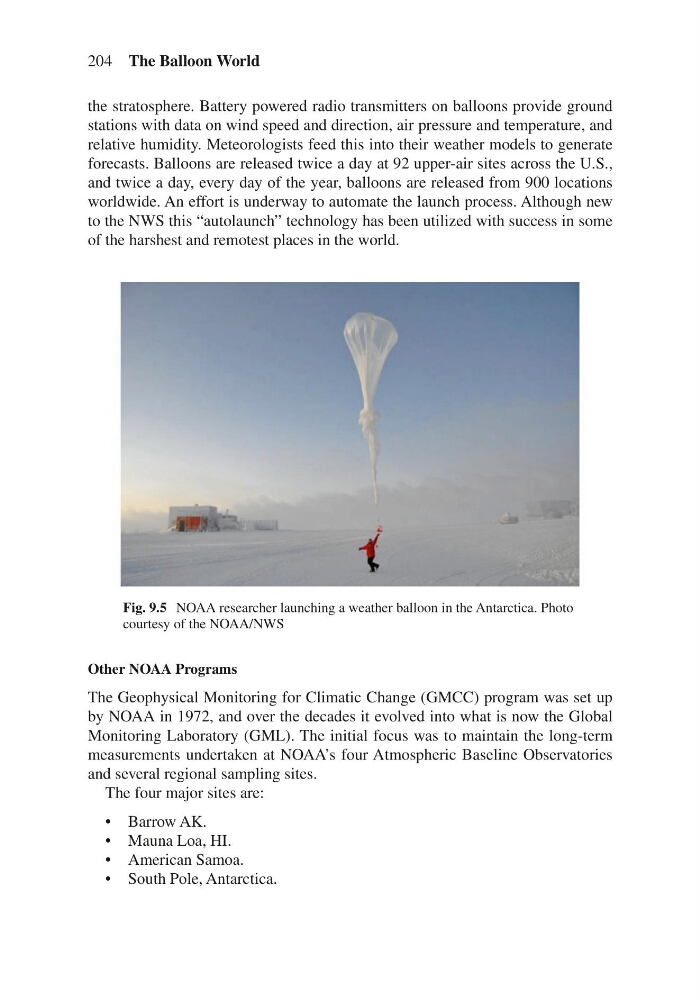
Fig. 9.5 NOAA researcher launching a weather balloon in the Antarctica. Photo
courtesy of the NOAA/NWS
204 The Balloon World
stations with data on wind speed and direction, air pressure and temperature, and
relative humidity. Meteorologists feed this into their weather models to generate
forecasts. Balloons are released twice a day at 92 upper-air sites across the U.S.,
and twice a day, every day of the year, balloons are released from 900 locations
worldwide. An effort is underway to automate the launch process. Although new
to the NWS this “autolaunch” technology has been utilized with success in some
of the harshest and remotest places in the world.
Other NOAA Programs
The Geophysical Monitoring for Climatic Change (GMCC) program was set up
by NOAA in 1972, and over the decades it evolved into what is now the Global
Monitoring Laboratory (GML). The initial focus was to maintain the long-term
measurements undertaken at NOAA’s four Atmospheric Baseline Observatories
and several regional sampling sites.
The four major sites are:
• Barrow AK.
• Mauna Loa, HI.
• American Samoa.
• South Pole, Antarctica.
Fig. 9.5 NOAA researcher launching a weather balloon in the Antarctica. Photo
courtesy of the NOAA/NWS
204 The Balloon World