

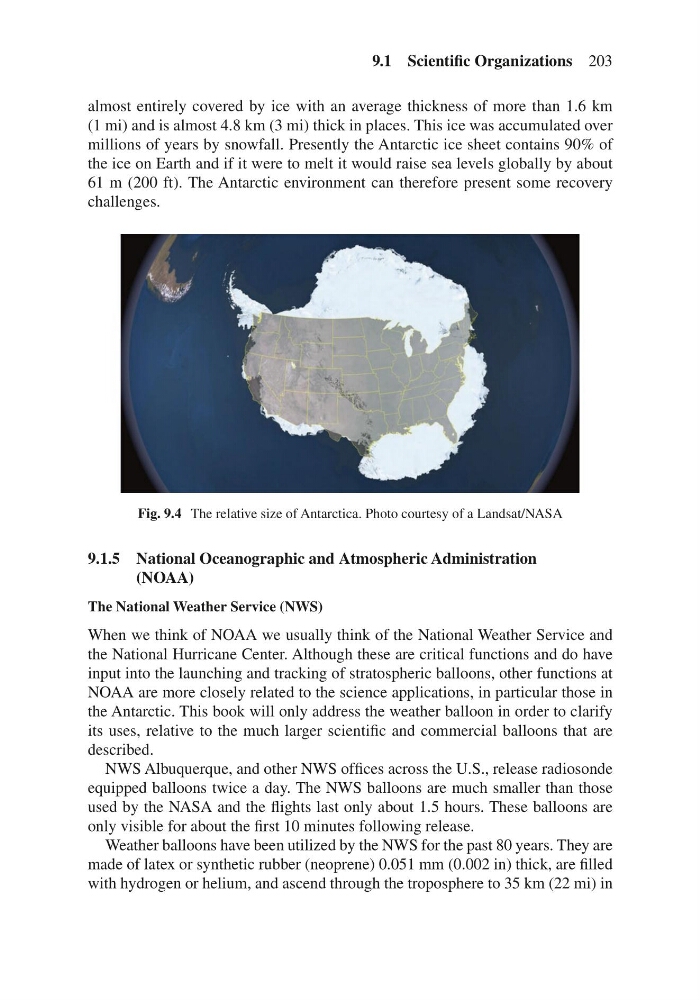
almost entirely covered by ice with an average thickness of more than 1.6 km
(1 mi) and is almost 4.8 km (3 mi) thick in places. This ice was accumulated over
millions of years by snowfall. Presently the Antarctic ice sheet contains 90% of
the ice on Earth and if it were to melt it would raise sea levels globally by about
61 m (200 ft). The Antarctic environment can therefore present some recovery
challenges.
9.1.5 National Oceanographic and Atmospheric Administration
(NOAA)
The National Weather Service (NWS)
When we think of NOAA we usually think of the National Weather Service and
the National Hurricane Center. Although these are critical functions and do have
input into the launching and tracking of stratospheric balloons, other functions at
NOAA are more closely related to the science applications, in particular those in
the Antarctic. This book will only address the weather balloon in order to clarify
its uses, relative to the much larger scientific and commercial balloons that are
described.
NWS Albuquerque, and other NWS offices across the U.S., release radiosonde
equipped balloons twice a day. The NWS balloons are much smaller than those
used by the NASA and the flights last only about 1.5 hours. These balloons are
only visible for about the first 10 minutes following release.
Weather balloons have been utilized by the NWS for the past 80 years. They are
made of latex or synthetic rubber (neoprene) 0.051 mm (0.002 in) thick, are filled
with hydrogen or helium, and ascend through the troposphere to 35 km (22 mi) in
Fig. 9.4 The relative size of Antarctica. Photo courtesy of a Landsat/NASA
9.1 Scientific Organizations 203
(1 mi) and is almost 4.8 km (3 mi) thick in places. This ice was accumulated over
millions of years by snowfall. Presently the Antarctic ice sheet contains 90% of
the ice on Earth and if it were to melt it would raise sea levels globally by about
61 m (200 ft). The Antarctic environment can therefore present some recovery
challenges.
9.1.5 National Oceanographic and Atmospheric Administration
(NOAA)
The National Weather Service (NWS)
When we think of NOAA we usually think of the National Weather Service and
the National Hurricane Center. Although these are critical functions and do have
input into the launching and tracking of stratospheric balloons, other functions at
NOAA are more closely related to the science applications, in particular those in
the Antarctic. This book will only address the weather balloon in order to clarify
its uses, relative to the much larger scientific and commercial balloons that are
described.
NWS Albuquerque, and other NWS offices across the U.S., release radiosonde
equipped balloons twice a day. The NWS balloons are much smaller than those
used by the NASA and the flights last only about 1.5 hours. These balloons are
only visible for about the first 10 minutes following release.
Weather balloons have been utilized by the NWS for the past 80 years. They are
made of latex or synthetic rubber (neoprene) 0.051 mm (0.002 in) thick, are filled
with hydrogen or helium, and ascend through the troposphere to 35 km (22 mi) in
Fig. 9.4 The relative size of Antarctica. Photo courtesy of a Landsat/NASA
9.1 Scientific Organizations 203