

on the telescope boom to ensure that they would continuously point at the Sun
during the long-duration flight. The third piggyback was the Turbulence and
Intermittency Long-Duration Atmospheric Experiment (TILDAE) experiment
provided by NCAR, ENS Lyon, and the Universities of Delaware and Berkeley. It
was to test a new paradigm for stratospheric observations. A sonic anemometer
was to measure the propagation time of sound waves to infer wind velocity and air
temperature at high temporal resolution in order to investigate the phenomenon of
“intermittent turbulence” in the stratosphere.
GRIPS was launched as flight 668N on January 19, 2016 from Williams Field,
McMurdo Station, Antarctica using the dynamic method and a Raven Aerostar
ZPB of 1.12 million m
3
(39.57 million ft
3
). It reached a float altitude of 39 km
(124,500 ft) and operated for a total flight duration of 11 days, 19 hours and 50
minutes. The mission was terminated on January 30, just too late to make a full
recovery. The recovery team was able to make only a single brief visit to extract
the data vaults onboard, delaying the rescue operations of the instrument to the
next summer. This was because as the end of season approached the priority for
aircraft in Antarctica was evacuating personnel from remote bases.
GRIPS was developed at the Space Sciences Laboratory of the University of
California, Berkeley, with the collaboration of NASA’s Goddard Space Flight
Center, Lawrence Berkeley National Laboratory, the University of California,
Santa Cruz, and Nagoya University, Japan. The Principal Investigator was Dr.
Pascal Saint-Hilaire at UC Berkeley.
For a 1:46 minute video of the launch and recovery of GRIPS, go to:
https://stratocat.com.ar/fichas- e/2016/MCM- 20160119.htm
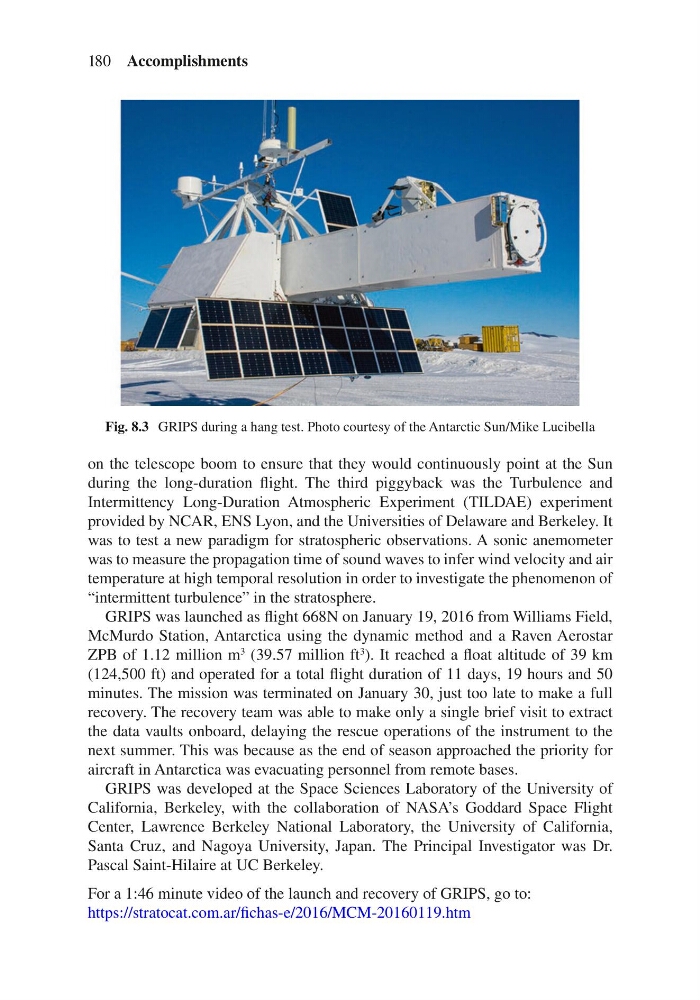
Fig. 8.3 GRIPS during a hang test. Photo courtesy of the Antarctic Sun/Mike Lucibella
180 Accomplishments
during the long-duration flight. The third piggyback was the Turbulence and
Intermittency Long-Duration Atmospheric Experiment (TILDAE) experiment
provided by NCAR, ENS Lyon, and the Universities of Delaware and Berkeley. It
was to test a new paradigm for stratospheric observations. A sonic anemometer
was to measure the propagation time of sound waves to infer wind velocity and air
temperature at high temporal resolution in order to investigate the phenomenon of
“intermittent turbulence” in the stratosphere.
GRIPS was launched as flight 668N on January 19, 2016 from Williams Field,
McMurdo Station, Antarctica using the dynamic method and a Raven Aerostar
ZPB of 1.12 million m
3
(39.57 million ft
3
). It reached a float altitude of 39 km
(124,500 ft) and operated for a total flight duration of 11 days, 19 hours and 50
minutes. The mission was terminated on January 30, just too late to make a full
recovery. The recovery team was able to make only a single brief visit to extract
the data vaults onboard, delaying the rescue operations of the instrument to the
next summer. This was because as the end of season approached the priority for
aircraft in Antarctica was evacuating personnel from remote bases.
GRIPS was developed at the Space Sciences Laboratory of the University of
California, Berkeley, with the collaboration of NASA’s Goddard Space Flight
Center, Lawrence Berkeley National Laboratory, the University of California,
Santa Cruz, and Nagoya University, Japan. The Principal Investigator was Dr.
Pascal Saint-Hilaire at UC Berkeley.
For a 1:46 minute video of the launch and recovery of GRIPS, go to:
https://stratocat.com.ar/fichas- e/2016/MCM- 20160119.htm
Fig. 8.3 GRIPS during a hang test. Photo courtesy of the Antarctic Sun/Mike Lucibella
180 Accomplishments