

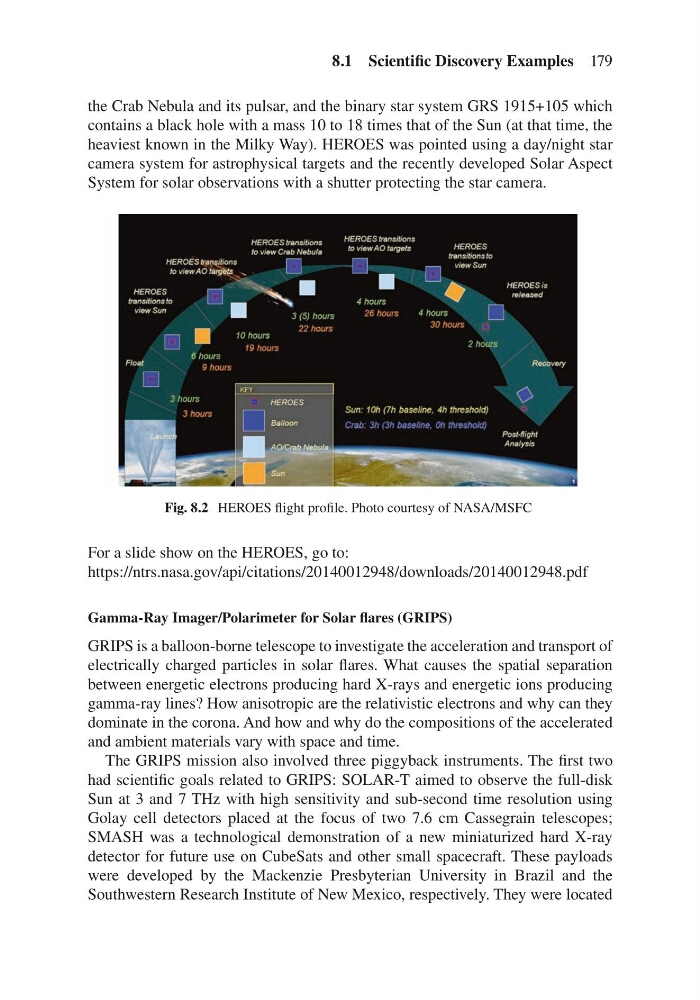
the Crab Nebula and its pulsar, and the binary star system GRS 1915+105 which
contains a black hole with a mass 10 to 18 times that of the Sun (at that time, the
heaviest known in the Milky Way). HEROES was pointed using a day/night star
camera system for astrophysical targets and the recently developed Solar Aspect
System for solar observations with a shutter protecting the star camera.
For a slide show on the HEROES, go to:
https://ntrs.nasa.gov/api/citations/20140012948/downloads/20140012948.pdf
Gamma-Ray Imager/Polarimeter for Solar flares (GRIPS)
GRIPS is a balloon-borne telescope to investigate the acceleration and transport of
electrically charged particles in solar flares. What causes the spatial separation
between energetic electrons producing hard X-rays and energetic ions producing
gamma-ray lines? How anisotropic are the relativistic electrons and why can they
dominate in the corona. And how and why do the compositions of the accelerated
and ambient materials vary with space and time.
The GRIPS mission also involved three piggyback instruments. The first two
had scientific goals related to GRIPS: SOLAR-T aimed to observe the full-disk
Sun at 3 and 7 THz with high sensitivity and sub-second time resolution using
Golay cell detectors placed at the focus of two 7.6 cm Cassegrain telescopes;
SMASH was a technological demonstration of a new miniaturized hard X-ray
detector for future use on CubeSats and other small spacecraft. These payloads
were developed by the Mackenzie Presbyterian University in Brazil and the
Southwestern Research Institute of New Mexico, respectively. They were located
Fig. 8.2 HEROES flight profile. Photo courtesy of NASA/MSFC
8.1 Scientific Discovery Examples 179
contains a black hole with a mass 10 to 18 times that of the Sun (at that time, the
heaviest known in the Milky Way). HEROES was pointed using a day/night star
camera system for astrophysical targets and the recently developed Solar Aspect
System for solar observations with a shutter protecting the star camera.
For a slide show on the HEROES, go to:
https://ntrs.nasa.gov/api/citations/20140012948/downloads/20140012948.pdf
Gamma-Ray Imager/Polarimeter for Solar flares (GRIPS)
GRIPS is a balloon-borne telescope to investigate the acceleration and transport of
electrically charged particles in solar flares. What causes the spatial separation
between energetic electrons producing hard X-rays and energetic ions producing
gamma-ray lines? How anisotropic are the relativistic electrons and why can they
dominate in the corona. And how and why do the compositions of the accelerated
and ambient materials vary with space and time.
The GRIPS mission also involved three piggyback instruments. The first two
had scientific goals related to GRIPS: SOLAR-T aimed to observe the full-disk
Sun at 3 and 7 THz with high sensitivity and sub-second time resolution using
Golay cell detectors placed at the focus of two 7.6 cm Cassegrain telescopes;
SMASH was a technological demonstration of a new miniaturized hard X-ray
detector for future use on CubeSats and other small spacecraft. These payloads
were developed by the Mackenzie Presbyterian University in Brazil and the
Southwestern Research Institute of New Mexico, respectively. They were located
Fig. 8.2 HEROES flight profile. Photo courtesy of NASA/MSFC
8.1 Scientific Discovery Examples 179