

The team expects the balloon will complete two or three loops around the South
Pole in about 21 to 28 days, following prevailing stratospheric winds. Once the
science mission is finished, operators will send flight termination commands that
separate the gondola from the balloon. The gondola is to land by parachute. The
telescope will hopefully be able to be refurbished in order to fly another mission.
For more information go to the JPL ASTHROS web site at;
https://www.jpl.nasa.gov/missions/asthros/
7.5.5 SuperBIT
An earlier version of the telescope known simply as Balloon Imaging Telescope
(BIT) was successfully launched by the French Space Agency (CNES) from the
Timmins Stratospheric Balloon Base in Ontario, Canada on September 18, 2015
by a Zodiac balloon with a volume of 400,000 m
3
(14 million ft
3
). In 12 hours it
took a pristine view of space, with pointing stability equivalent to the resolution of
the Hubble Space Telescope. Then it landed on the bank of a river in northern
Quebec and was recovered with minimal damage.
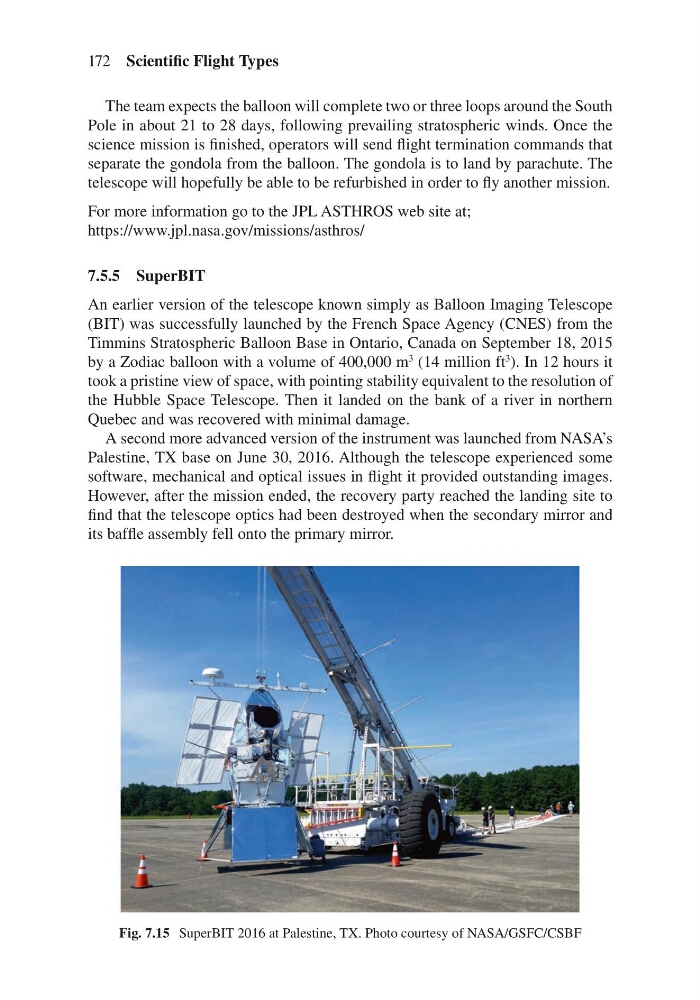
A second more advanced version of the instrument was launched from NASA’s
Palestine, TX base on June 30, 2016. Although the telescope experienced some
software, mechanical and optical issues in flight it provided outstanding images.
However, after the mission ended, the recovery party reached the landing site to
find that the telescope optics had been destroyed when the secondary mirror and
its baffle assembly fell onto the primary mirror.
Fig. 7.15 SuperBIT 2016 at Palestine, TX. Photo courtesy of NASA/GSFC/CSBF
172 Scientific Flight Types
Pole in about 21 to 28 days, following prevailing stratospheric winds. Once the
science mission is finished, operators will send flight termination commands that
separate the gondola from the balloon. The gondola is to land by parachute. The
telescope will hopefully be able to be refurbished in order to fly another mission.
For more information go to the JPL ASTHROS web site at;
https://www.jpl.nasa.gov/missions/asthros/
7.5.5 SuperBIT
An earlier version of the telescope known simply as Balloon Imaging Telescope
(BIT) was successfully launched by the French Space Agency (CNES) from the
Timmins Stratospheric Balloon Base in Ontario, Canada on September 18, 2015
by a Zodiac balloon with a volume of 400,000 m
3
(14 million ft
3
). In 12 hours it
took a pristine view of space, with pointing stability equivalent to the resolution of
the Hubble Space Telescope. Then it landed on the bank of a river in northern
Quebec and was recovered with minimal damage.
A second more advanced version of the instrument was launched from NASA’s
Palestine, TX base on June 30, 2016. Although the telescope experienced some
software, mechanical and optical issues in flight it provided outstanding images.
However, after the mission ended, the recovery party reached the landing site to
find that the telescope optics had been destroyed when the secondary mirror and
its baffle assembly fell onto the primary mirror.
Fig. 7.15 SuperBIT 2016 at Palestine, TX. Photo courtesy of NASA/GSFC/CSBF
172 Scientific Flight Types