

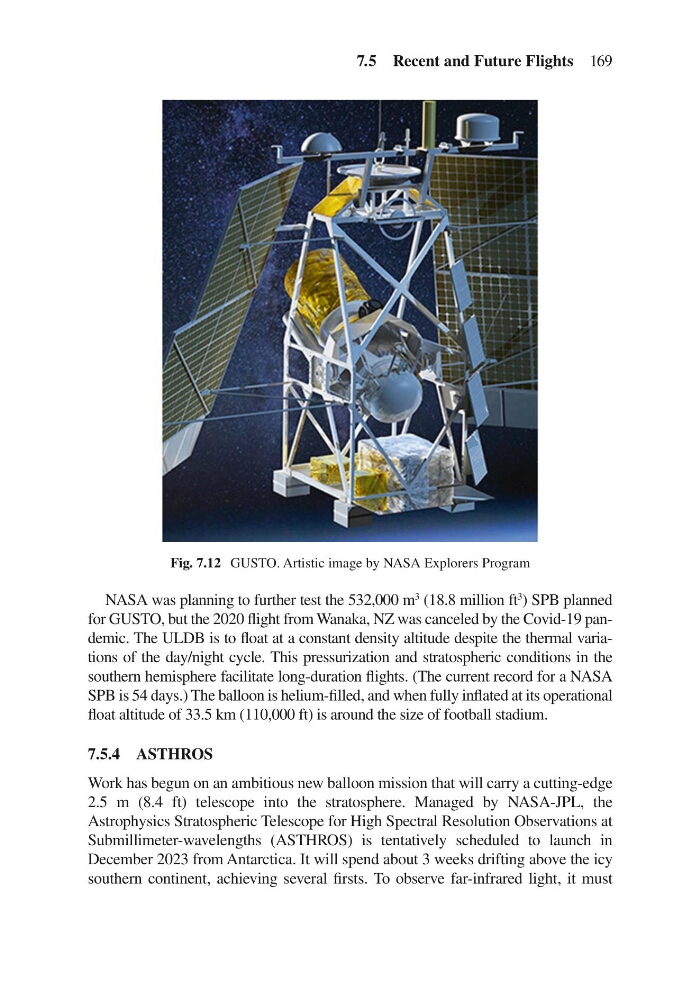
NASA was planning to further test the 532,000 m
3
(18.8 million ft
3
) SPB planned
for GUSTO, but the 2020 flight from Wanaka, NZ was canceled by the Covid-19 pandemic. The ULDB is to float at a constant density altitude despite the thermal variations of the day/night cycle. This pressurization and stratospheric conditions in the
southern hemisphere facilitate long-duration flights. (The current record for a NASA
SPB is 54 days.) The balloon is helium-filled, and when fully inflated at its operational
float altitude of 33.5 km (110,000 ft) is around the size of football stadium.
7.5.4 ASTHROS
Work has begun on an ambitious new balloon mission that will carry a cutting- edge
2.5 m (8.4 ft) telescope into the stratosphere. Managed by NASA-JPL, the
Astrophysics Stratospheric Telescope for High Spectral Resolution Observations at
Submillimeter-wavelengths (ASTHROS) is tentatively scheduled to launch in
December 2023 from Antarctica. It will spend about 3 weeks drifting above the icy
southern continent, achieving several firsts. To observe far-infrared light, it must
Fig. 7.12 GUSTO. Artistic image by NASA Explorers Program
7.5 Recent and Future Flights 169
3
(18.8 million ft
3
) SPB planned
for GUSTO, but the 2020 flight from Wanaka, NZ was canceled by the Covid-19 pandemic. The ULDB is to float at a constant density altitude despite the thermal variations of the day/night cycle. This pressurization and stratospheric conditions in the
southern hemisphere facilitate long-duration flights. (The current record for a NASA
SPB is 54 days.) The balloon is helium-filled, and when fully inflated at its operational
float altitude of 33.5 km (110,000 ft) is around the size of football stadium.
7.5.4 ASTHROS
Work has begun on an ambitious new balloon mission that will carry a cutting- edge
2.5 m (8.4 ft) telescope into the stratosphere. Managed by NASA-JPL, the
Astrophysics Stratospheric Telescope for High Spectral Resolution Observations at
Submillimeter-wavelengths (ASTHROS) is tentatively scheduled to launch in
December 2023 from Antarctica. It will spend about 3 weeks drifting above the icy
southern continent, achieving several firsts. To observe far-infrared light, it must
Fig. 7.12 GUSTO. Artistic image by NASA Explorers Program
7.5 Recent and Future Flights 169