

7.5.2 Compton Spectrometer and Imager (COSI)
The Compton Spectrometer and Imager (COSI) was a balloon-borne compact
Compton telescope to observe emissions from astrophysical sources in the soft
gamma-ray energy range (0.2-5 MeV). It served as a spectrometer, a wide-field
imager, and a polarimeter.
As the successor of the Nuclear Compton Telescope (NCT), which was the first
compact Compton telescope to image an astrophysical source, COSI was the first
instrument specifically designed for NASA’s 532,000 m
3
(18.8 million ft
3
) SPB. It
was lightweight with no consumables, observed autonomously, and provided realtime science data telemetry.
Basically, COSI consisted of twelve germanium detectors each measuring 8 ×
8 × 1.5 cm (~3 × 3 × 0.6 in) that were designed and developed at Lawrence
Berkeley National Laboratory. The detectors were stacked in a 2 × 2 × 3 configuration, and acted together to create 3D position sensitivity with an active volume
of 972 cm
3
(59 in
3
). The detector array was housed in an anodized aluminum
cryostat that a mechanical cryocooler maintained at an operating temperature of
83 K (–310°F). The temperature of the cryocooler’s body was stabilized using an
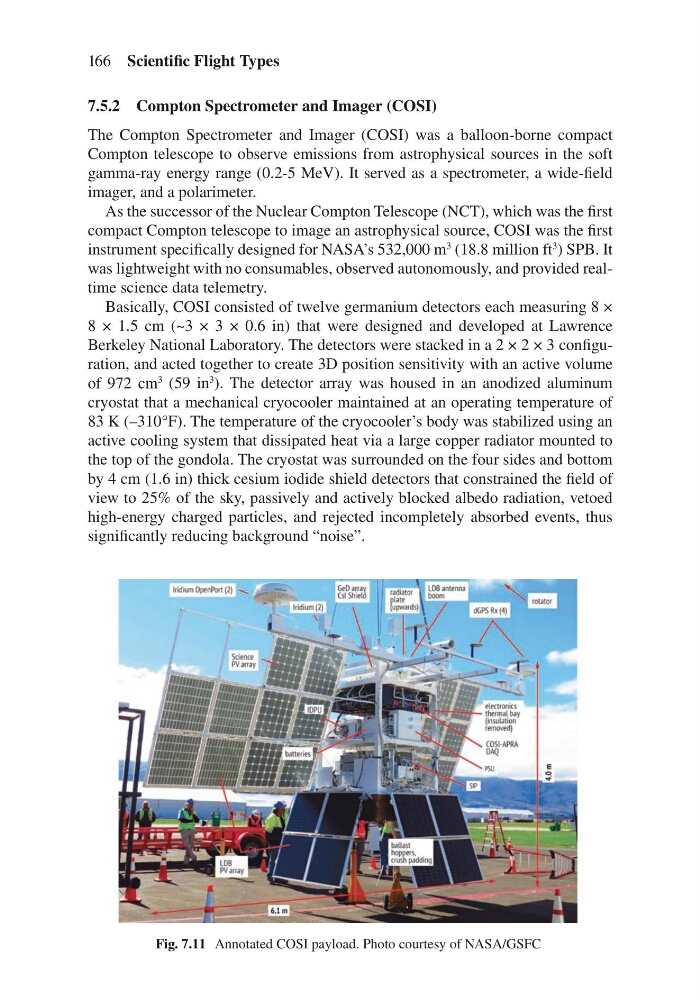
active cooling system that dissipated heat via a large copper radiator mounted to
the top of the gondola. The cryostat was surrounded on the four sides and bottom
by 4 cm (1.6 in) thick cesium iodide shield detectors that constrained the field of
view to 25% of the sky, passively and actively blocked albedo radiation, vetoed
high-energy charged particles, and rejected incompletely absorbed events, thus
significantly reducing background “noise”.
Fig. 7.11 Annotated COSI payload. Photo courtesy of NASA/GSFC
166 Scientific Flight Types
The Compton Spectrometer and Imager (COSI) was a balloon-borne compact
Compton telescope to observe emissions from astrophysical sources in the soft
gamma-ray energy range (0.2-5 MeV). It served as a spectrometer, a wide-field
imager, and a polarimeter.
As the successor of the Nuclear Compton Telescope (NCT), which was the first
compact Compton telescope to image an astrophysical source, COSI was the first
instrument specifically designed for NASA’s 532,000 m
3
(18.8 million ft
3
) SPB. It
was lightweight with no consumables, observed autonomously, and provided realtime science data telemetry.
Basically, COSI consisted of twelve germanium detectors each measuring 8 ×
8 × 1.5 cm (~3 × 3 × 0.6 in) that were designed and developed at Lawrence
Berkeley National Laboratory. The detectors were stacked in a 2 × 2 × 3 configuration, and acted together to create 3D position sensitivity with an active volume
of 972 cm
3
(59 in
3
). The detector array was housed in an anodized aluminum
cryostat that a mechanical cryocooler maintained at an operating temperature of
83 K (–310°F). The temperature of the cryocooler’s body was stabilized using an
active cooling system that dissipated heat via a large copper radiator mounted to
the top of the gondola. The cryostat was surrounded on the four sides and bottom
by 4 cm (1.6 in) thick cesium iodide shield detectors that constrained the field of
view to 25% of the sky, passively and actively blocked albedo radiation, vetoed
high-energy charged particles, and rejected incompletely absorbed events, thus
significantly reducing background “noise”.
Fig. 7.11 Annotated COSI payload. Photo courtesy of NASA/GSFC
166 Scientific Flight Types