

7.1.4 Polar Mesospheric Clouds (PMC)
The PMC-Turbo flight 684N was a balloon-borne experiment to study dynamics and
turbulence in the mesopause by observing polar mesospheric clouds (PMC) as tracers. The Winzen ZPB with a volume of 1.124 million m
3
(39.57 million ft
3
) and a
thickness of just 20 μm (0.0008 in) was launched from the European Space Range,
Kiruna, Sweden by the dynamic method on July 8th, 2018. A set of seven NASA
funded cameras obtained images of PMC (also called noctilucent clouds) at the very
high resolution of 3-8 m/pixel to resolve turbulent structures at scales of less than
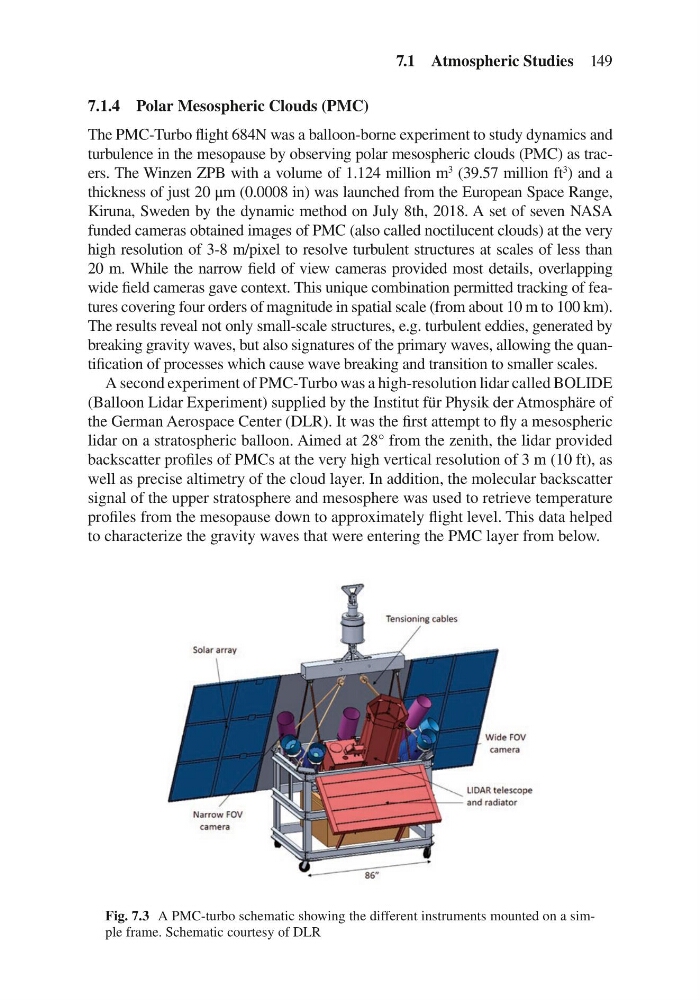
20 m. While the narrow field of view cameras provided most details, overlapping
wide field cameras gave context. This unique combination permitted tracking of features covering four orders of magnitude in spatial scale (from about 10 m to 100 km).
The results reveal not only small-scale structures, e.g. turbulent eddies, generated by
breaking gravity waves, but also signatures of the primary waves, allowing the quantification of processes which cause wave breaking and transition to smaller scales.
A second experiment of PMC-Turbo was a high-resolution lidar called BOLIDE
(Balloon Lidar Experiment) supplied by the Institut für Physik der Atmosphäre of
the German Aerospace Center (DLR). It was the first attempt to fly a mesospheric
lidar on a stratospheric balloon. Aimed at 28° from the zenith, the lidar provided
backscatter profiles of PMCs at the very high vertical resolution of 3 m (10 ft), as
well as precise altimetry of the cloud layer. In addition, the molecular backscatter
signal of the upper stratosphere and mesosphere was used to retrieve temperature
profiles from the mesopause down to approximately flight level. This data helped
to characterize the gravity waves that were entering the PMC layer from below.
Fig. 7.3 A PMC-turbo schematic showing the different instruments mounted on a simple frame. Schematic courtesy of DLR
7.1 Atmospheric Studies 149
The PMC-Turbo flight 684N was a balloon-borne experiment to study dynamics and
turbulence in the mesopause by observing polar mesospheric clouds (PMC) as tracers. The Winzen ZPB with a volume of 1.124 million m
3
(39.57 million ft
3
) and a
thickness of just 20 μm (0.0008 in) was launched from the European Space Range,
Kiruna, Sweden by the dynamic method on July 8th, 2018. A set of seven NASA
funded cameras obtained images of PMC (also called noctilucent clouds) at the very
high resolution of 3-8 m/pixel to resolve turbulent structures at scales of less than
20 m. While the narrow field of view cameras provided most details, overlapping
wide field cameras gave context. This unique combination permitted tracking of features covering four orders of magnitude in spatial scale (from about 10 m to 100 km).
The results reveal not only small-scale structures, e.g. turbulent eddies, generated by
breaking gravity waves, but also signatures of the primary waves, allowing the quantification of processes which cause wave breaking and transition to smaller scales.
A second experiment of PMC-Turbo was a high-resolution lidar called BOLIDE
(Balloon Lidar Experiment) supplied by the Institut für Physik der Atmosphäre of
the German Aerospace Center (DLR). It was the first attempt to fly a mesospheric
lidar on a stratospheric balloon. Aimed at 28° from the zenith, the lidar provided
backscatter profiles of PMCs at the very high vertical resolution of 3 m (10 ft), as
well as precise altimetry of the cloud layer. In addition, the molecular backscatter
signal of the upper stratosphere and mesosphere was used to retrieve temperature
profiles from the mesopause down to approximately flight level. This data helped
to characterize the gravity waves that were entering the PMC layer from below.
Fig. 7.3 A PMC-turbo schematic showing the different instruments mounted on a simple frame. Schematic courtesy of DLR
7.1 Atmospheric Studies 149