

atmosphere and how long, and in what conditions can airborne microbes survive.
In recent years, aerobiology researchers have also begun to explore whether the
atmosphere might hold entire ecosystems of airborne microbes, and whether the
interactions between species enable microbes to evolve while in the air.
The Exposing Microorganisms in the Stratosphere (E-MIST) experiment led by
the NASA Ames Research Center in California tested a new hardware system, procedure and instrument for studying bacteria in the stratosphere. This mission used a
system developed at the NASA Kennedy Space Center, FL. A radiation- tolerant
strain of bacteria called Bacillus pumilus SAFR-032 was carried inside the E-MIST
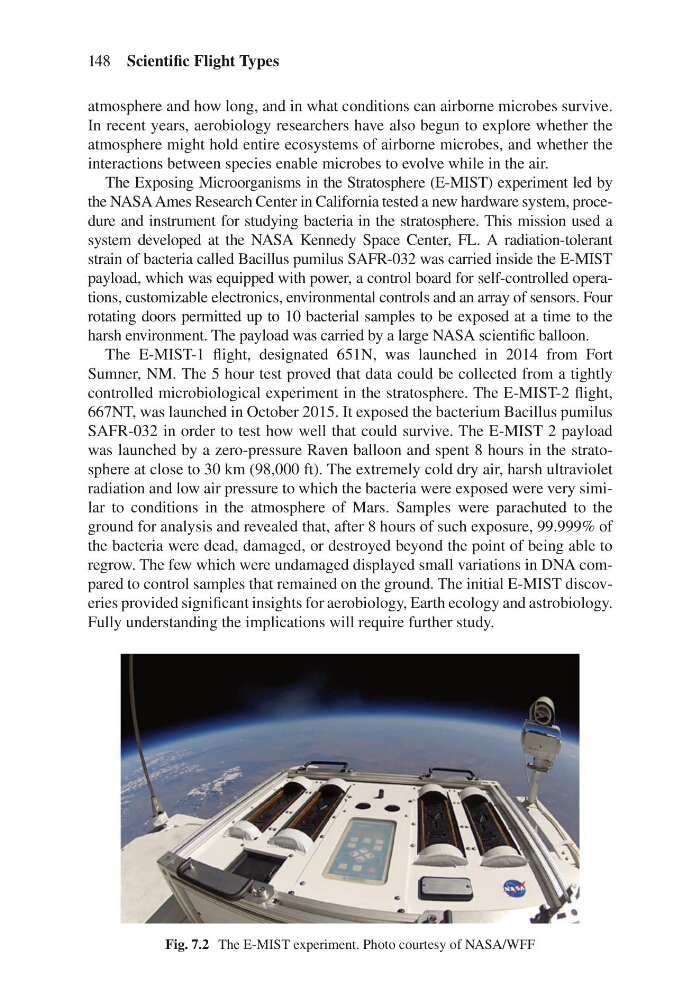
payload, which was equipped with power, a control board for self- controlled operations, customizable electronics, environmental controls and an array of sensors. Four
rotating doors permitted up to 10 bacterial samples to be exposed at a time to the
harsh environment. The payload was carried by a large NASA scientific balloon.
The E-MIST-1 flight, designated 651N, was launched in 2014 from Fort
Sumner, NM. The 5 hour test proved that data could be collected from a tightly
controlled microbiological experiment in the stratosphere. The E-MIST-2 flight,
667NT, was launched in October 2015. It exposed the bacterium Bacillus pumilus
SAFR-032 in order to test how well that could survive. The E-MIST 2 payload
was launched by a zero-pressure Raven balloon and spent 8 hours in the stratosphere at close to 30 km (98,000 ft). The extremely cold dry air, harsh ultraviolet
radiation and low air pressure to which the bacteria were exposed were very similar to conditions in the atmosphere of Mars. Samples were parachuted to the
ground for analysis and revealed that, after 8 hours of such exposure, 99.999% of
the bacteria were dead, damaged, or destroyed beyond the point of being able to
regrow. The few which were undamaged displayed small variations in DNA compared to control samples that remained on the ground. The initial E-MIST discoveries provided significant insights for aerobiology, Earth ecology and astrobiology.
Fully understanding the implications will require further study.
Fig. 7.2 The E-MIST experiment. Photo courtesy of NASA/WFF
148 Scientific Flight Types
In recent years, aerobiology researchers have also begun to explore whether the
atmosphere might hold entire ecosystems of airborne microbes, and whether the
interactions between species enable microbes to evolve while in the air.
The Exposing Microorganisms in the Stratosphere (E-MIST) experiment led by
the NASA Ames Research Center in California tested a new hardware system, procedure and instrument for studying bacteria in the stratosphere. This mission used a
system developed at the NASA Kennedy Space Center, FL. A radiation- tolerant
strain of bacteria called Bacillus pumilus SAFR-032 was carried inside the E-MIST
payload, which was equipped with power, a control board for self- controlled operations, customizable electronics, environmental controls and an array of sensors. Four
rotating doors permitted up to 10 bacterial samples to be exposed at a time to the
harsh environment. The payload was carried by a large NASA scientific balloon.
The E-MIST-1 flight, designated 651N, was launched in 2014 from Fort
Sumner, NM. The 5 hour test proved that data could be collected from a tightly
controlled microbiological experiment in the stratosphere. The E-MIST-2 flight,
667NT, was launched in October 2015. It exposed the bacterium Bacillus pumilus
SAFR-032 in order to test how well that could survive. The E-MIST 2 payload
was launched by a zero-pressure Raven balloon and spent 8 hours in the stratosphere at close to 30 km (98,000 ft). The extremely cold dry air, harsh ultraviolet
radiation and low air pressure to which the bacteria were exposed were very similar to conditions in the atmosphere of Mars. Samples were parachuted to the
ground for analysis and revealed that, after 8 hours of such exposure, 99.999% of
the bacteria were dead, damaged, or destroyed beyond the point of being able to
regrow. The few which were undamaged displayed small variations in DNA compared to control samples that remained on the ground. The initial E-MIST discoveries provided significant insights for aerobiology, Earth ecology and astrobiology.
Fully understanding the implications will require further study.
Fig. 7.2 The E-MIST experiment. Photo courtesy of NASA/WFF
148 Scientific Flight Types