

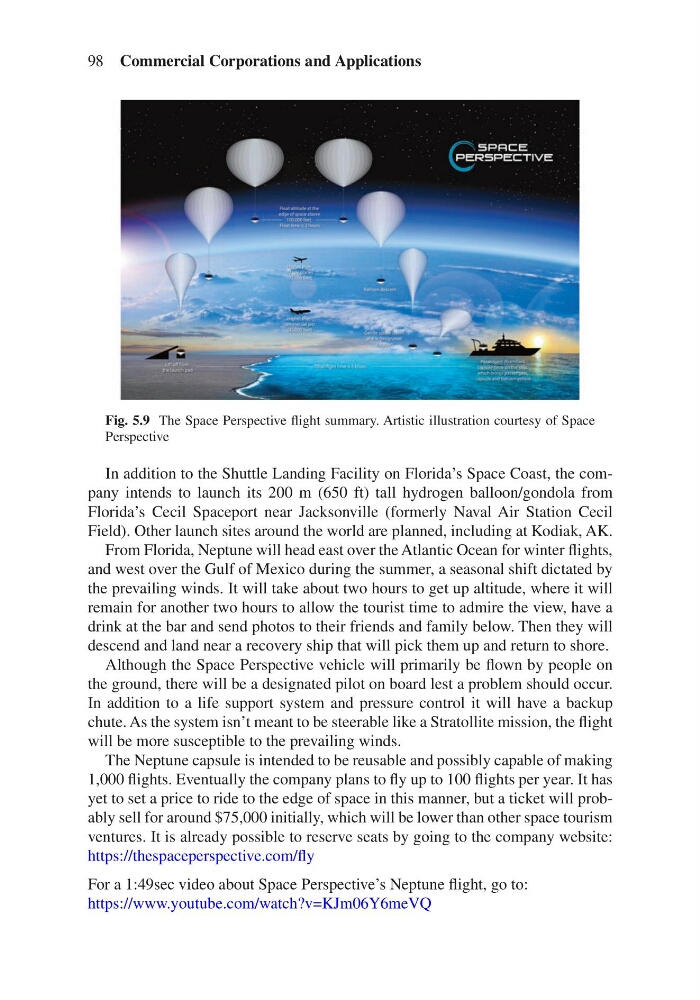
In addition to the Shuttle Landing Facility on Florida’s Space Coast, the company intends to launch its 200 m (650 ft) tall hydrogen balloon/gondola from
Florida’s Cecil Spaceport near Jacksonville (formerly Naval Air Station Cecil
Field). Other launch sites around the world are planned, including at Kodiak, AK.
From Florida, Neptune will head east over the Atlantic Ocean for winter flights,
and west over the Gulf of Mexico during the summer, a seasonal shift dictated by
the prevailing winds. It will take about two hours to get up altitude, where it will
remain for another two hours to allow the tourist time to admire the view, have a
drink at the bar and send photos to their friends and family below. Then they will
descend and land near a recovery ship that will pick them up and return to shore.
Although the Space Perspective vehicle will primarily be flown by people on
the ground, there will be a designated pilot on board lest a problem should occur.
In addition to a life support system and pressure control it will have a backup
chute. As the system isn’t meant to be steerable like a Stratollite mission, the flight
will be more susceptible to the prevailing winds.
The Neptune capsule is intended to be reusable and possibly capable of making
1,000 flights. Eventually the company plans to fly up to 100 flights per year. It has
yet to set a price to ride to the edge of space in this manner, but a ticket will probably sell for around $75,000 initially, which will be lower than other space tourism
ventures. It is already possible to reserve seats by going to the company website:
https://thespaceperspective.com/fly
For a 1:49sec video about Space Perspective’s Neptune flight, go to:
https://www.youtube.com/watch?v=KJm06Y6meVQ
Fig. 5.9 The Space Perspective flight summary. Artistic illustration courtesy of Space
Perspective
98 Commercial Corporations and Applications
Florida’s Cecil Spaceport near Jacksonville (formerly Naval Air Station Cecil
Field). Other launch sites around the world are planned, including at Kodiak, AK.
From Florida, Neptune will head east over the Atlantic Ocean for winter flights,
and west over the Gulf of Mexico during the summer, a seasonal shift dictated by
the prevailing winds. It will take about two hours to get up altitude, where it will
remain for another two hours to allow the tourist time to admire the view, have a
drink at the bar and send photos to their friends and family below. Then they will
descend and land near a recovery ship that will pick them up and return to shore.
Although the Space Perspective vehicle will primarily be flown by people on
the ground, there will be a designated pilot on board lest a problem should occur.
In addition to a life support system and pressure control it will have a backup
chute. As the system isn’t meant to be steerable like a Stratollite mission, the flight
will be more susceptible to the prevailing winds.
The Neptune capsule is intended to be reusable and possibly capable of making
1,000 flights. Eventually the company plans to fly up to 100 flights per year. It has
yet to set a price to ride to the edge of space in this manner, but a ticket will probably sell for around $75,000 initially, which will be lower than other space tourism
ventures. It is already possible to reserve seats by going to the company website:
https://thespaceperspective.com/fly
For a 1:49sec video about Space Perspective’s Neptune flight, go to:
https://www.youtube.com/watch?v=KJm06Y6meVQ
Fig. 5.9 The Space Perspective flight summary. Artistic illustration courtesy of Space
Perspective
98 Commercial Corporations and Applications