

Space Perspective has scheduled the test flight for early 2021, taking off from
the Shuttle Landing Facility at the NASA Kennedy Space Center, FL. This
uncrewed test will carry research payloads. The company hopes that in a few years
it will be taking space tourists on sightseeing jaunts lasting 6 hours. Former astronaut Jeff Hoffman anticipates the experience as one where the relaxed passengers,
looking down on the Earth have the time and quietude to contemplate their truly
awesome adventure.
Space tourism that carries people to the edge of space and back has been slow
to start, with companies like Blue Origin and Virgin Galactic still a ways off from
commercial operations. Those vehicles rely on rockets and will go much higher,
with a peak altitude in the range 80-100 km (50-62 mi).
The Fédération Aéronautique Internationale (FAI) qualifies people whose
flights exceed the von Kármán line at 100 km (62 mi) as Astronauts. The U.S.
military and commercial astronauts who travel above 80 km (50 mi) are issued
Astronaut Wings. Perhaps the Neptune participants should be called “Stratonauts”.
See the 2014 book of that title written by yours truly.
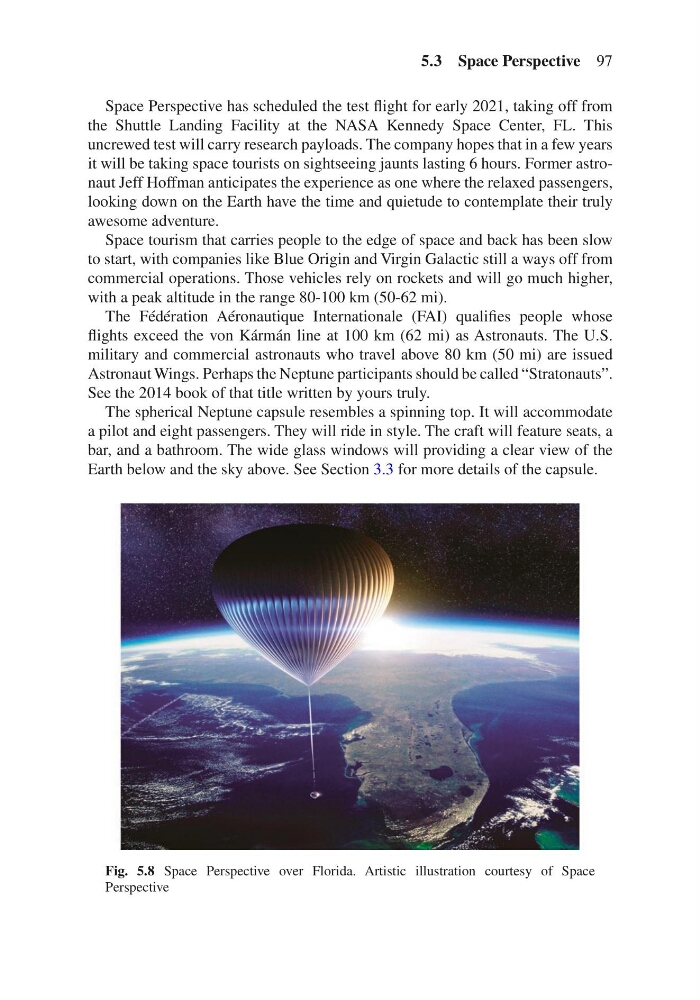
The spherical Neptune capsule resembles a spinning top. It will accommodate
a pilot and eight passengers. They will ride in style. The craft will feature seats, a
bar, and a bathroom. The wide glass windows will providing a clear view of the
Earth below and the sky above. See Section 3.3 for more details of the capsule.
Fig. 5.8 Space Perspective over Florida. Artistic illustration courtesy of Space
Perspective
5.3 Space Perspective 97
the Shuttle Landing Facility at the NASA Kennedy Space Center, FL. This
uncrewed test will carry research payloads. The company hopes that in a few years
it will be taking space tourists on sightseeing jaunts lasting 6 hours. Former astronaut Jeff Hoffman anticipates the experience as one where the relaxed passengers,
looking down on the Earth have the time and quietude to contemplate their truly
awesome adventure.
Space tourism that carries people to the edge of space and back has been slow
to start, with companies like Blue Origin and Virgin Galactic still a ways off from
commercial operations. Those vehicles rely on rockets and will go much higher,
with a peak altitude in the range 80-100 km (50-62 mi).
The Fédération Aéronautique Internationale (FAI) qualifies people whose
flights exceed the von Kármán line at 100 km (62 mi) as Astronauts. The U.S.
military and commercial astronauts who travel above 80 km (50 mi) are issued
Astronaut Wings. Perhaps the Neptune participants should be called “Stratonauts”.
See the 2014 book of that title written by yours truly.
The spherical Neptune capsule resembles a spinning top. It will accommodate
a pilot and eight passengers. They will ride in style. The craft will feature seats, a
bar, and a bathroom. The wide glass windows will providing a clear view of the
Earth below and the sky above. See Section 3.3 for more details of the capsule.
Fig. 5.8 Space Perspective over Florida. Artistic illustration courtesy of Space
Perspective
5.3 Space Perspective 97