

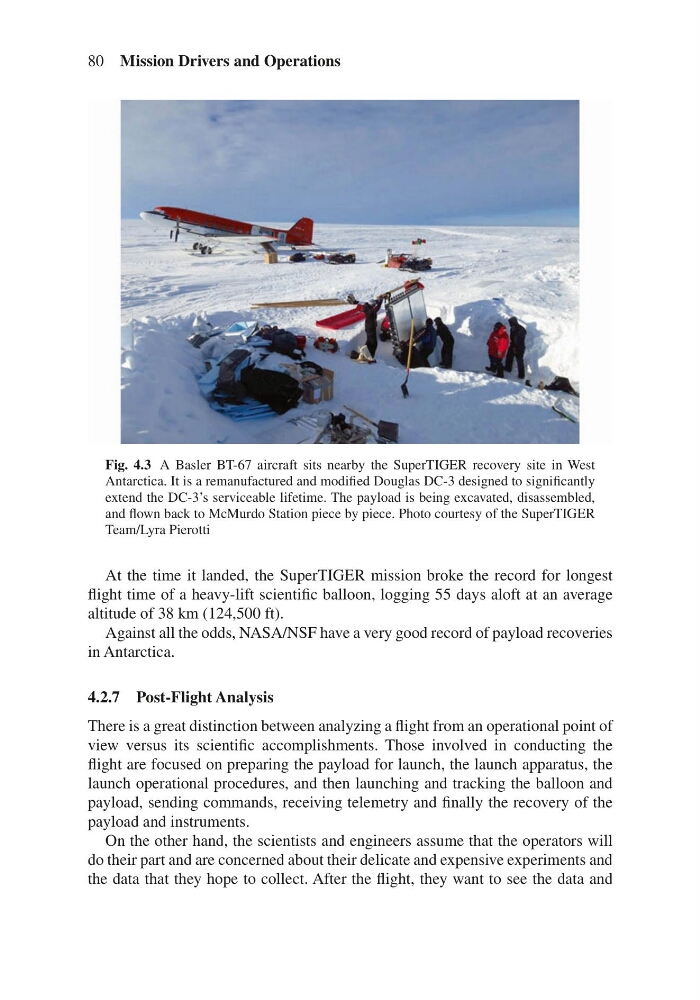
At the time it landed, the SuperTIGER mission broke the record for longest
flight time of a heavy-lift scientific balloon, logging 55 days aloft at an average
altitude of 38 km (124,500 ft).
Against all the odds, NASA/NSF have a very good record of payload recoveries
in Antarctica.
4.2.7 Post-Flight Analysis
There is a great distinction between analyzing a flight from an operational point of
view versus its scientific accomplishments. Those involved in conducting the
flight are focused on preparing the payload for launch, the launch apparatus, the
launch operational procedures, and then launching and tracking the balloon and
payload, sending commands, receiving telemetry and finally the recovery of the
payload and instruments.
On the other hand, the scientists and engineers assume that the operators will
do their part and are concerned about their delicate and expensive experiments and
the data that they hope to collect. After the flight, they want to see the data and
Fig. 4.3 A Basler BT-67 aircraft sits nearby the SuperTIGER recovery site in West
Antarctica. It is a remanufactured and modified Douglas DC-3 designed to significantly
extend the DC-3’s serviceable lifetime. The payload is being excavated, disassembled,
and flown back to McMurdo Station piece by piece. Photo courtesy of the SuperTIGER
Team/Lyra Pierotti
80 Mission Drivers and Operations
flight time of a heavy-lift scientific balloon, logging 55 days aloft at an average
altitude of 38 km (124,500 ft).
Against all the odds, NASA/NSF have a very good record of payload recoveries
in Antarctica.
4.2.7 Post-Flight Analysis
There is a great distinction between analyzing a flight from an operational point of
view versus its scientific accomplishments. Those involved in conducting the
flight are focused on preparing the payload for launch, the launch apparatus, the
launch operational procedures, and then launching and tracking the balloon and
payload, sending commands, receiving telemetry and finally the recovery of the
payload and instruments.
On the other hand, the scientists and engineers assume that the operators will
do their part and are concerned about their delicate and expensive experiments and
the data that they hope to collect. After the flight, they want to see the data and
Fig. 4.3 A Basler BT-67 aircraft sits nearby the SuperTIGER recovery site in West
Antarctica. It is a remanufactured and modified Douglas DC-3 designed to significantly
extend the DC-3’s serviceable lifetime. The payload is being excavated, disassembled,
and flown back to McMurdo Station piece by piece. Photo courtesy of the SuperTIGER
Team/Lyra Pierotti
80 Mission Drivers and Operations