

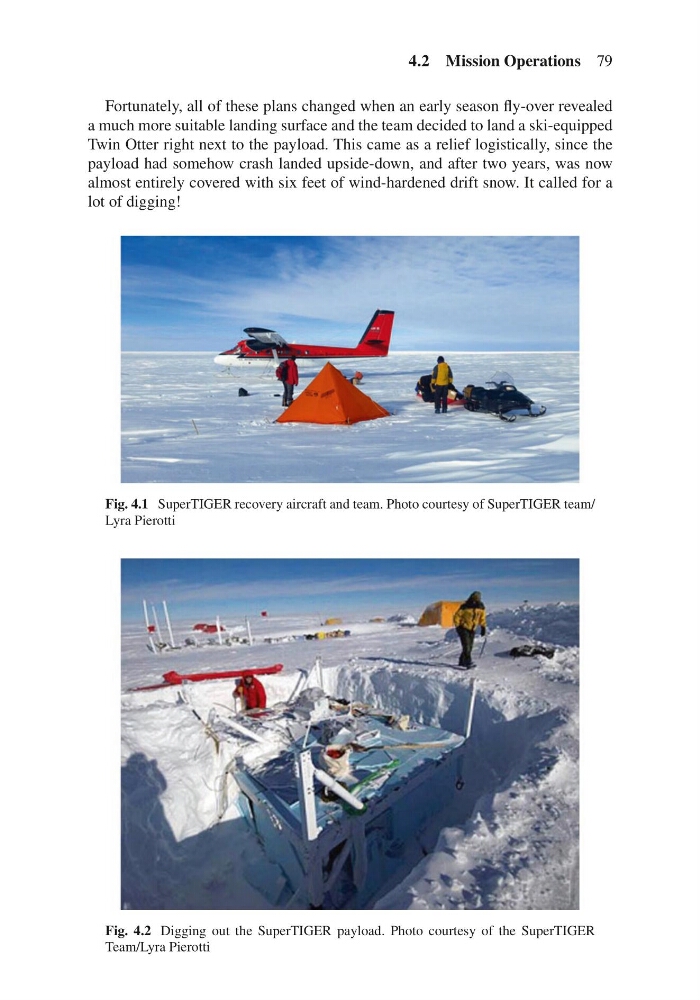
Fortunately, all of these plans changed when an early season fly-over revealed
a much more suitable landing surface and the team decided to land a ski-equipped
Twin Otter right next to the payload. This came as a relief logistically, since the
payload had somehow crash landed upside-down, and after two years, was now
almost entirely covered with six feet of wind-hardened drift snow. It called for a
lot of digging!
Fig. 4.1 SuperTIGER recovery aircraft and team. Photo courtesy of SuperTIGER team/
Lyra Pierotti
Fig. 4.2 Digging out the SuperTIGER payload. Photo courtesy of the SuperTIGER
Team/Lyra Pierotti
4.2 Mission Operations 79
a much more suitable landing surface and the team decided to land a ski-equipped
Twin Otter right next to the payload. This came as a relief logistically, since the
payload had somehow crash landed upside-down, and after two years, was now
almost entirely covered with six feet of wind-hardened drift snow. It called for a
lot of digging!
Fig. 4.1 SuperTIGER recovery aircraft and team. Photo courtesy of SuperTIGER team/
Lyra Pierotti
Fig. 4.2 Digging out the SuperTIGER payload. Photo courtesy of the SuperTIGER
Team/Lyra Pierotti
4.2 Mission Operations 79