

146
Historically, the world’s biggest coastal cities have been able to prevent tidal
flooding through engineering methods and land use planning (Nicholls and
Cazenave 2010). A case study from the central Philippines also provides evidence
that it is indeed possible for island communities to adapt to changes in sea levels of
less than 1 metre, even if they happen quickly as a consequence of earthquake
induced land subsidence (Jamero et al. 2016). Essentially, the 2013 Bohol
Earthquake in the Philippines caused a number of small islands to immediately
subside by up to 1 metre, which means that they are now flooded during high tides.
The strategies implemented by these communities, mainly on a self-funded basis,
are designed to accommodate the effects of tidal flooding, including building stilted
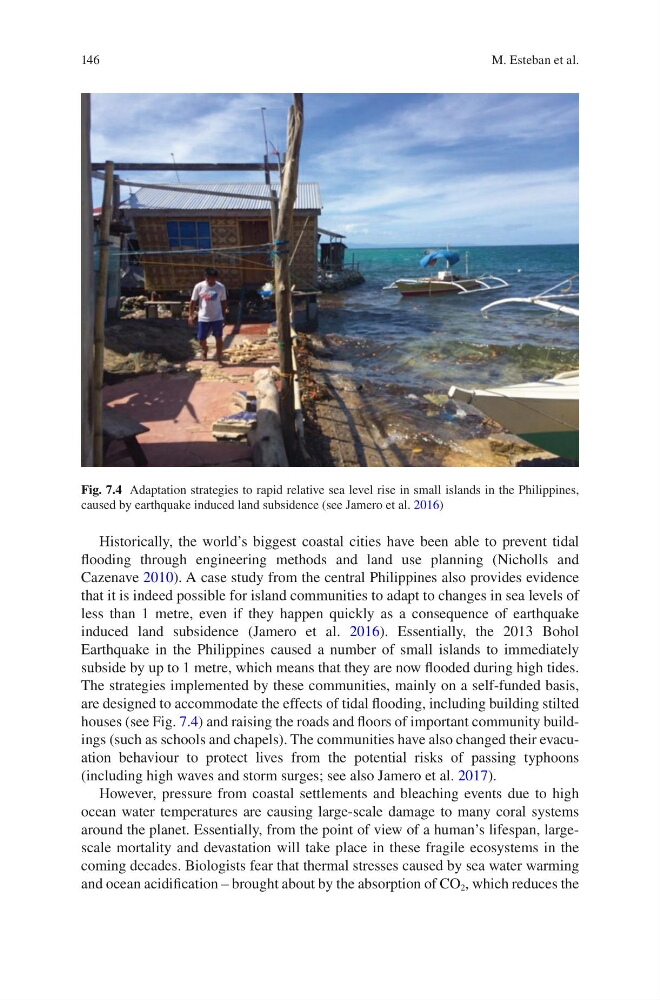
houses (see Fig. 7.4) and raising the roads and floors of important community buildings (such as schools and chapels). The communities have also changed their evacuation behaviour to protect lives from the potential risks of passing typhoons
(including high waves and storm surges; see also Jamero et al. 2017).
However, pressure from coastal settlements and bleaching events due to high
ocean water temperatures are causing large-scale damage to many coral systems
around the planet. Essentially, from the point of view of a human’s lifespan, largescale mortality and devastation will take place in these fragile ecosystems in the
coming decades. Biologists fear that thermal stresses caused by sea water warming
and ocean acidification – brought about by the absorption of CO 2 , which reduces the
Fig. 7.4 Adaptation strategies to rapid relative sea level rise in small islands in the Philippines,
caused by earthquake induced land subsidence (see Jamero et al. 2016)
M. Esteban et al.
Historically, the world’s biggest coastal cities have been able to prevent tidal
flooding through engineering methods and land use planning (Nicholls and
Cazenave 2010). A case study from the central Philippines also provides evidence
that it is indeed possible for island communities to adapt to changes in sea levels of
less than 1 metre, even if they happen quickly as a consequence of earthquake
induced land subsidence (Jamero et al. 2016). Essentially, the 2013 Bohol
Earthquake in the Philippines caused a number of small islands to immediately
subside by up to 1 metre, which means that they are now flooded during high tides.
The strategies implemented by these communities, mainly on a self-funded basis,
are designed to accommodate the effects of tidal flooding, including building stilted
houses (see Fig. 7.4) and raising the roads and floors of important community buildings (such as schools and chapels). The communities have also changed their evacuation behaviour to protect lives from the potential risks of passing typhoons
(including high waves and storm surges; see also Jamero et al. 2017).
However, pressure from coastal settlements and bleaching events due to high
ocean water temperatures are causing large-scale damage to many coral systems
around the planet. Essentially, from the point of view of a human’s lifespan, largescale mortality and devastation will take place in these fragile ecosystems in the
coming decades. Biologists fear that thermal stresses caused by sea water warming
and ocean acidification – brought about by the absorption of CO 2 , which reduces the
Fig. 7.4 Adaptation strategies to rapid relative sea level rise in small islands in the Philippines,
caused by earthquake induced land subsidence (see Jamero et al. 2016)
M. Esteban et al.