

145
7.3.2 Island Communities
While environmental factors such as the natural survival of islands are important in
predicting the sustainability of the communities living in them, recent studies about
the impacts of sea-level rise have highlighting social factors, such as human adaptation, as a greater determinant (Perch-Nielsen et al. 2008; Gibbons and Nicholls
2005). However, given the lack of climate projections at the local level, time-scales
are also important in understanding the impacts of climate change and the ways that
communities can adapt to them. In particular, when considering the survival of
island communities, differentiating between short-term (decades) and long-term
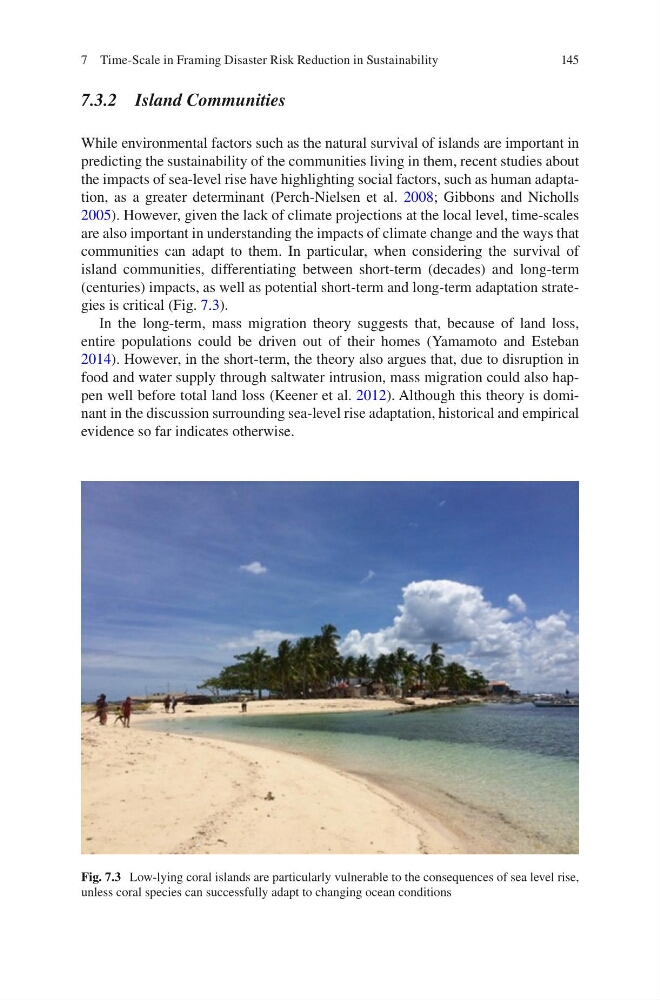
(centuries) impacts, as well as potential short-term and long-term adaptation strategies is critical (Fig. 7.3).
In the long-term, mass migration theory suggests that, because of land loss,
entire populations could be driven out of their homes (Yamamoto and Esteban
2014). However, in the short-term, the theory also argues that, due to disruption in
food and water supply through saltwater intrusion, mass migration could also happen well before total land loss (Keener et al. 2012). Although this theory is dominant in the discussion surrounding sea-level rise adaptation, historical and empirical
evidence so far indicates otherwise.
Fig. 7.3 Low-lying coral islands are particularly vulnerable to the consequences of sea level rise,
unless coral species can successfully adapt to changing ocean conditions
7 Time-Scale in Framing Disaster Risk Reduction in Sustainability
7.3.2 Island Communities
While environmental factors such as the natural survival of islands are important in
predicting the sustainability of the communities living in them, recent studies about
the impacts of sea-level rise have highlighting social factors, such as human adaptation, as a greater determinant (Perch-Nielsen et al. 2008; Gibbons and Nicholls
2005). However, given the lack of climate projections at the local level, time-scales
are also important in understanding the impacts of climate change and the ways that
communities can adapt to them. In particular, when considering the survival of
island communities, differentiating between short-term (decades) and long-term
(centuries) impacts, as well as potential short-term and long-term adaptation strategies is critical (Fig. 7.3).
In the long-term, mass migration theory suggests that, because of land loss,
entire populations could be driven out of their homes (Yamamoto and Esteban
2014). However, in the short-term, the theory also argues that, due to disruption in
food and water supply through saltwater intrusion, mass migration could also happen well before total land loss (Keener et al. 2012). Although this theory is dominant in the discussion surrounding sea-level rise adaptation, historical and empirical
evidence so far indicates otherwise.
Fig. 7.3 Low-lying coral islands are particularly vulnerable to the consequences of sea level rise,
unless coral species can successfully adapt to changing ocean conditions
7 Time-Scale in Framing Disaster Risk Reduction in Sustainability