

104
connections and mutual obligations), and cultural capital (prestige) (Bourdieu
1984). In Bourdieu’s theory, the notion of capital is used more as a metaphor or
description of processes as individuals or groups gain or lose different types of capital through interactions. Following the approach of Wilson and Bourdieu, this study
considers the notion of multifunctionality as a metaphor for analyzing the qualitative changes in rural systems.
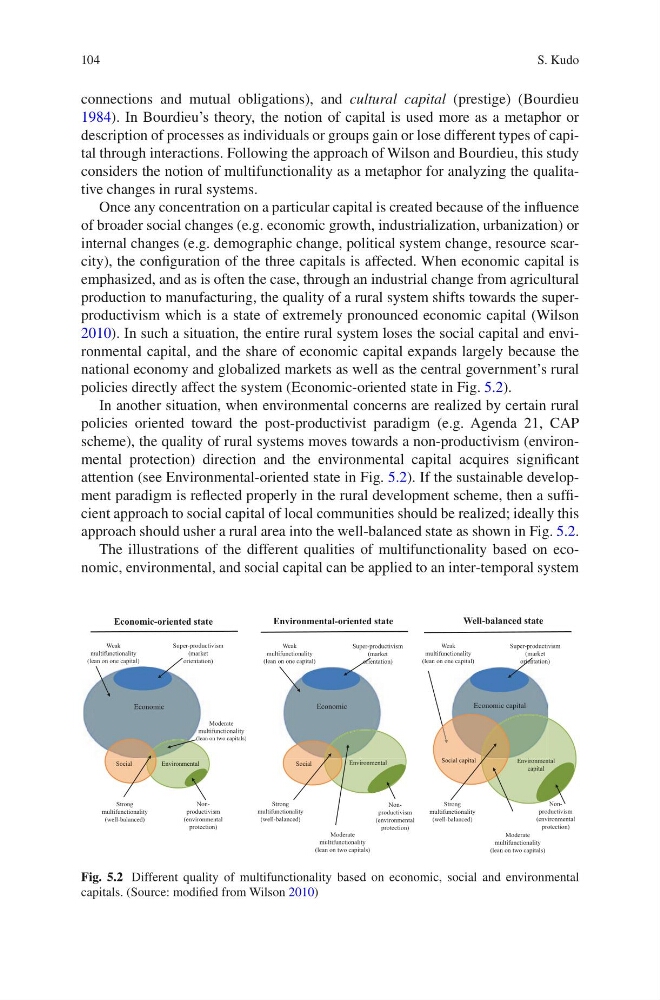
Once any concentration on a particular capital is created because of the influence
of broader social changes (e.g. economic growth, industrialization, urbanization) or
internal changes (e.g. demographic change, political system change, resource scarcity), the configuration of the three capitals is affected. When economic capital is
emphasized, and as is often the case, through an industrial change from agricultural
production to manufacturing, the quality of a rural system shifts towards the superproductivism which is a state of extremely pronounced economic capital (Wilson
2010). In such a situation, the entire rural system loses the social capital and environmental capital, and the share of economic capital expands largely because the
national economy and globalized markets as well as the central government’s rural
policies directly affect the system (Economic-oriented state in Fig. 5.2).
In another situation, when environmental concerns are realized by certain rural
policies oriented toward the post-productivist paradigm (e.g. Agenda 21, CAP
scheme), the quality of rural systems moves towards a non-productivism (environmental protection) direction and the environmental capital acquires significant
attention (see Environmental-oriented state in Fig. 5.2). If the sustainable development paradigm is reflected properly in the rural development scheme, then a sufficient approach to social capital of local communities should be realized; ideally this
approach should usher a rural area into the well-balanced state as shown in Fig. 5.2.
The illustrations of the different qualities of multifunctionality based on economic, environmental, and social capital can be applied to an inter-temporal system
Super-productivism
(market
orientation)
Strong
multifunctionality
(well-balanced)
Nonproductivism
(environmental
protection)
Weak
multifunctionality
(lean on one capital)
Moderate
multifunctionality
(lean on two capitals)
Weak
multifunctionality
(lean on one capital)
Weak
multifunctionality
(lean on one capital)
Strong
multifunctionality
(well-balanced)
Strong
multifunctionality
(well-balanced)
Super-productivism
(market
orientation)
Nonproductivism
(environmental
protection)
Nonproductivism
(environmental
protection)
Moderate
multifunctionality
(lean on two capitals)
Super-productivism
(market
orientation)
Moderate
multifunctionality
(lean on two capitals)
Economic
Economic
Economic capital
Social capital
Social
Social
Environmental
Environmental
Economic-oriented state
Environmental-oriented state
Well-balanced state
Environmental
capital
Fig. 5.2 Different quality of multifunctionality based on economic, social and environmental
capitals. (Source: modified from Wilson 2010)
S. Kudo
connections and mutual obligations), and cultural capital (prestige) (Bourdieu
1984). In Bourdieu’s theory, the notion of capital is used more as a metaphor or
description of processes as individuals or groups gain or lose different types of capital through interactions. Following the approach of Wilson and Bourdieu, this study
considers the notion of multifunctionality as a metaphor for analyzing the qualitative changes in rural systems.
Once any concentration on a particular capital is created because of the influence
of broader social changes (e.g. economic growth, industrialization, urbanization) or
internal changes (e.g. demographic change, political system change, resource scarcity), the configuration of the three capitals is affected. When economic capital is
emphasized, and as is often the case, through an industrial change from agricultural
production to manufacturing, the quality of a rural system shifts towards the superproductivism which is a state of extremely pronounced economic capital (Wilson
2010). In such a situation, the entire rural system loses the social capital and environmental capital, and the share of economic capital expands largely because the
national economy and globalized markets as well as the central government’s rural
policies directly affect the system (Economic-oriented state in Fig. 5.2).
In another situation, when environmental concerns are realized by certain rural
policies oriented toward the post-productivist paradigm (e.g. Agenda 21, CAP
scheme), the quality of rural systems moves towards a non-productivism (environmental protection) direction and the environmental capital acquires significant
attention (see Environmental-oriented state in Fig. 5.2). If the sustainable development paradigm is reflected properly in the rural development scheme, then a sufficient approach to social capital of local communities should be realized; ideally this
approach should usher a rural area into the well-balanced state as shown in Fig. 5.2.
The illustrations of the different qualities of multifunctionality based on economic, environmental, and social capital can be applied to an inter-temporal system
Super-productivism
(market
orientation)
Strong
multifunctionality
(well-balanced)
Nonproductivism
(environmental
protection)
Weak
multifunctionality
(lean on one capital)
Moderate
multifunctionality
(lean on two capitals)
Weak
multifunctionality
(lean on one capital)
Weak
multifunctionality
(lean on one capital)
Strong
multifunctionality
(well-balanced)
Strong
multifunctionality
(well-balanced)
Super-productivism
(market
orientation)
Nonproductivism
(environmental
protection)
Nonproductivism
(environmental
protection)
Moderate
multifunctionality
(lean on two capitals)
Super-productivism
(market
orientation)
Moderate
multifunctionality
(lean on two capitals)
Economic
Economic
Economic capital
Social capital
Social
Social
Environmental
Environmental
Economic-oriented state
Environmental-oriented state
Well-balanced state
Environmental
capital
Fig. 5.2 Different quality of multifunctionality based on economic, social and environmental
capitals. (Source: modified from Wilson 2010)
S. Kudo