

42
outside the car. In addition, they are compatible with new technologies such as a
driving support system including automatic braking and automatic driving systems
because they are electrical drive vehicles, and therefore, they can be driven safely
and comfortably.
Since a variety of models are coming out, it is fun to be able to choose according
to lifestyle. Some owners are saying, “An EV is sufficient because I mainly use if
for shopping in the neighborhood.” Still others are saying, “Sometimes I go on long
drives, so a PHV is better.”
In rural cities, cars are the main means of transportation. Because cars are indispensable even for commuting and a bit of shopping, the trend has been toward one
person owning one car, but it is a waste that only one driver is on board a minivan
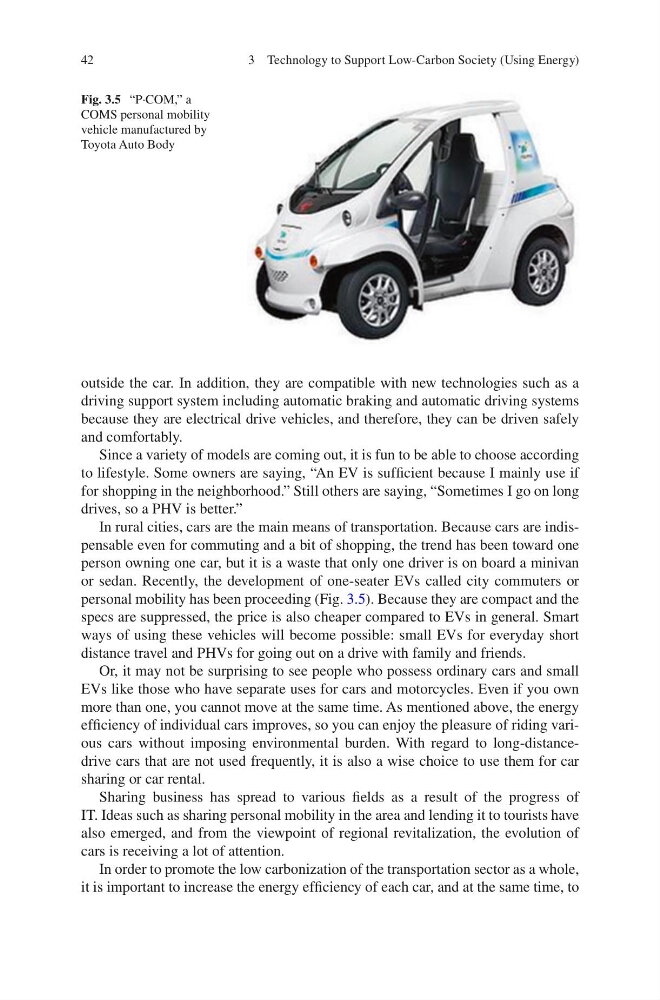
or sedan. Recently, the development of one-seater EVs called city commuters or
personal mobility has been proceeding (Fig. 3.5). Because they are compact and the
specs are suppressed, the price is also cheaper compared to EVs in general. Smart
ways of using these vehicles will become possible: small EVs for everyday short
distance travel and PHVs for going out on a drive with family and friends.
Or, it may not be surprising to see people who possess ordinary cars and small
EVs like those who have separate uses for cars and motorcycles. Even if you own
more than one, you cannot move at the same time. As mentioned above, the energy
efficiency of individual cars improves, so you can enjoy the pleasure of riding various cars without imposing environmental burden. With regard to long-distancedrive cars that are not used frequently, it is also a wise choice to use them for car
sharing or car rental.
Sharing business has spread to various fields as a result of the progress of
IT. Ideas such as sharing personal mobility in the area and lending it to tourists have
also emerged, and from the viewpoint of regional revitalization, the evolution of
cars is receiving a lot of attention.
In order to promote the low carbonization of the transportation sector as a whole,
it is important to increase the energy efficiency of each car, and at the same time, to
Fig. 3.5 “P·COM,” a
COMS personal mobility
vehicle manufactured by
Toyota Auto Body
3 Technology to Support Low-Carbon Society (Using Energy)
outside the car. In addition, they are compatible with new technologies such as a
driving support system including automatic braking and automatic driving systems
because they are electrical drive vehicles, and therefore, they can be driven safely
and comfortably.
Since a variety of models are coming out, it is fun to be able to choose according
to lifestyle. Some owners are saying, “An EV is sufficient because I mainly use if
for shopping in the neighborhood.” Still others are saying, “Sometimes I go on long
drives, so a PHV is better.”
In rural cities, cars are the main means of transportation. Because cars are indispensable even for commuting and a bit of shopping, the trend has been toward one
person owning one car, but it is a waste that only one driver is on board a minivan
or sedan. Recently, the development of one-seater EVs called city commuters or
personal mobility has been proceeding (Fig. 3.5). Because they are compact and the
specs are suppressed, the price is also cheaper compared to EVs in general. Smart
ways of using these vehicles will become possible: small EVs for everyday short
distance travel and PHVs for going out on a drive with family and friends.
Or, it may not be surprising to see people who possess ordinary cars and small
EVs like those who have separate uses for cars and motorcycles. Even if you own
more than one, you cannot move at the same time. As mentioned above, the energy
efficiency of individual cars improves, so you can enjoy the pleasure of riding various cars without imposing environmental burden. With regard to long-distancedrive cars that are not used frequently, it is also a wise choice to use them for car
sharing or car rental.
Sharing business has spread to various fields as a result of the progress of
IT. Ideas such as sharing personal mobility in the area and lending it to tourists have
also emerged, and from the viewpoint of regional revitalization, the evolution of
cars is receiving a lot of attention.
In order to promote the low carbonization of the transportation sector as a whole,
it is important to increase the energy efficiency of each car, and at the same time, to
Fig. 3.5 “P·COM,” a
COMS personal mobility
vehicle manufactured by
Toyota Auto Body
3 Technology to Support Low-Carbon Society (Using Energy)