

8
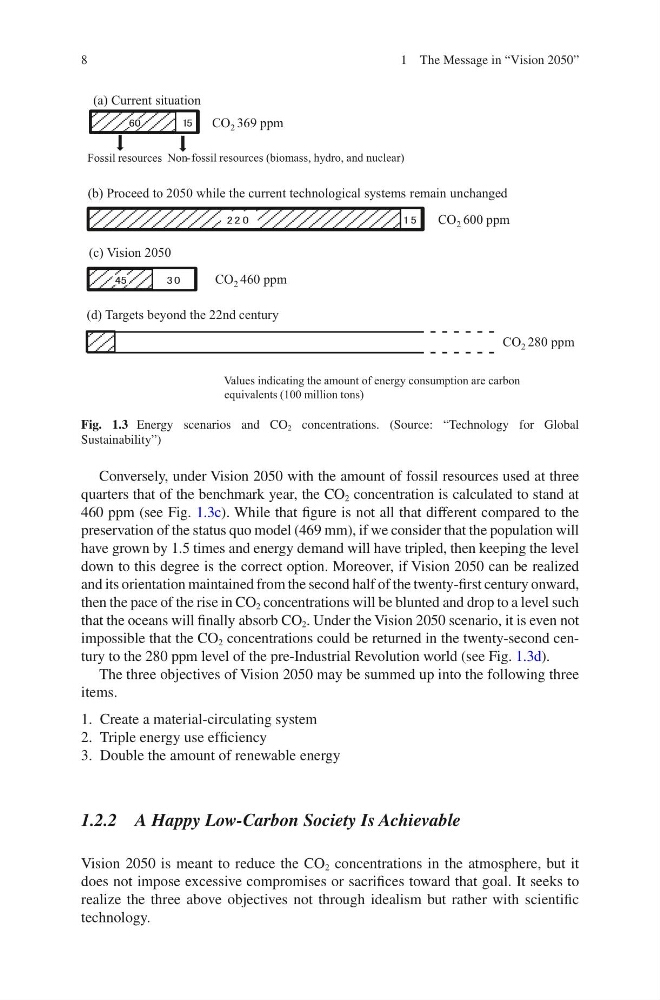
Conversely, under Vision 2050 with the amount of fossil resources used at three
quarters that of the benchmark year, the CO 2 concentration is calculated to stand at
460 ppm (see Fig. 1.3c). While that figure is not all that different compared to the
preservation of the status quo model (469 mm), if we consider that the population will
have grown by 1.5 times and energy demand will have tripled, then keeping the level
down to this degree is the correct option. Moreover, if Vision 2050 can be realized
and its orientation maintained from the second half of the twenty-first century onward,
then the pace of the rise in CO 2 concentrations will be blunted and drop to a level such
that the oceans will finally absorb CO 2 . Under the Vision 2050 scenario, it is even not
impossible that the CO 2 concentrations could be returned in the twenty- second century to the 280 ppm level of the pre-Industrial Revolution world (see Fig. 1.3d).
The three objectives of Vision 2050 may be summed up into the following three
items.
1. Create a material-circulating system
2. Triple energy use efficiency
3. Double the amount of renewable energy
1.2.2 A Happy Low-Carbon Society Is Achievable
Vision 2050 is meant to reduce the CO 2 concentrations in the atmosphere, but it
does not impose excessive compromises or sacrifices toward that goal. It seeks to
realize the three above objectives not through idealism but rather with scientific
technology.
(a) Current situation
(b) Proceed to 2050 while the current technological systems remain unchanged
(d) Targets beyond the 22nd century
(c) Vision 2050
Fossil resources Non-fossil resources (biomass, hydro, and nuclear)
Values indicating the amount of energy consumption are carbon
equivalents (100 million tons)
CO 2 369 ppm
CO 2 600 ppm
CO 2 460 ppm
CO 2 280 ppm
Fig. 1.3 Energy scenarios and CO 2 concentrations. (Source: “Technology for Global
Sustainability”)
1 The Message in “Vision 2050”
Conversely, under Vision 2050 with the amount of fossil resources used at three
quarters that of the benchmark year, the CO 2 concentration is calculated to stand at
460 ppm (see Fig. 1.3c). While that figure is not all that different compared to the
preservation of the status quo model (469 mm), if we consider that the population will
have grown by 1.5 times and energy demand will have tripled, then keeping the level
down to this degree is the correct option. Moreover, if Vision 2050 can be realized
and its orientation maintained from the second half of the twenty-first century onward,
then the pace of the rise in CO 2 concentrations will be blunted and drop to a level such
that the oceans will finally absorb CO 2 . Under the Vision 2050 scenario, it is even not
impossible that the CO 2 concentrations could be returned in the twenty- second century to the 280 ppm level of the pre-Industrial Revolution world (see Fig. 1.3d).
The three objectives of Vision 2050 may be summed up into the following three
items.
1. Create a material-circulating system
2. Triple energy use efficiency
3. Double the amount of renewable energy
1.2.2 A Happy Low-Carbon Society Is Achievable
Vision 2050 is meant to reduce the CO 2 concentrations in the atmosphere, but it
does not impose excessive compromises or sacrifices toward that goal. It seeks to
realize the three above objectives not through idealism but rather with scientific
technology.
(a) Current situation
(b) Proceed to 2050 while the current technological systems remain unchanged
(d) Targets beyond the 22nd century
(c) Vision 2050
Fossil resources Non-fossil resources (biomass, hydro, and nuclear)
Values indicating the amount of energy consumption are carbon
equivalents (100 million tons)
CO 2 369 ppm
CO 2 600 ppm
CO 2 460 ppm
CO 2 280 ppm
Fig. 1.3 Energy scenarios and CO 2 concentrations. (Source: “Technology for Global
Sustainability”)
1 The Message in “Vision 2050”