

93
1. Use of future electric power that reduces CO 2 emissions by 80%.
2. Because of the increase in recycled steel, the production volume of the Electric
Furnace Method will be double the current volume.
3. The Electric Furnace Method will achieve energy saving by 20%.
4. The production rate by the Blast Furnace Method will be significantly reduced.
5. Steel export volume will be significantly reduced.
Based on the above, we calculated two case examples. It should be noted that the
steel produced by the current Electric Furnace Method cannot be used for certain
products such as thin automobile plates and large-diameter pipes. Currently, development is underway to produce iron and steel materials with properties suitable for
such purposes.
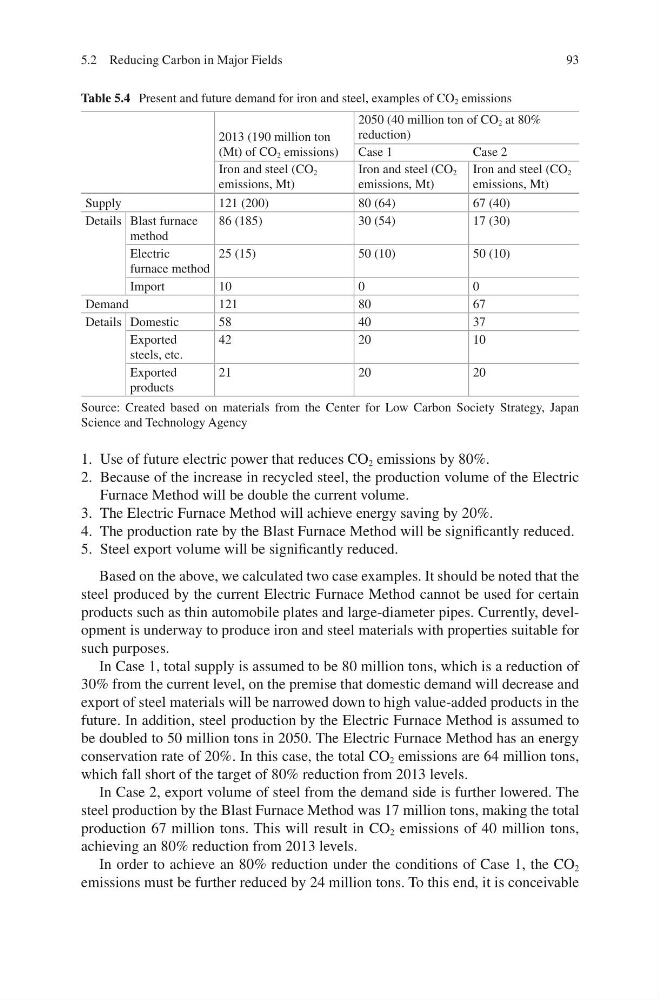
In Case 1, total supply is assumed to be 80 million tons, which is a reduction of
30% from the current level, on the premise that domestic demand will decrease and
export of steel materials will be narrowed down to high value-added products in the
future. In addition, steel production by the Electric Furnace Method is assumed to
be doubled to 50 million tons in 2050. The Electric Furnace Method has an energy
conservation rate of 20%. In this case, the total CO 2 emissions are 64 million tons,
which fall short of the target of 80% reduction from 2013 levels.
In Case 2, export volume of steel from the demand side is further lowered. The
steel production by the Blast Furnace Method was 17 million tons, making the total
production 67 million tons. This will result in CO 2 emissions of 40 million tons,
achieving an 80% reduction from 2013 levels.
In order to achieve an 80% reduction under the conditions of Case 1, the CO 2
emissions must be further reduced by 24 million tons. To this end, it is conceivable
Table 5.4 Present and future demand for iron and steel, examples of CO 2 emissions
2013 (190 million ton
(Mt) of CO 2 emissions)
2050 (40 million ton of CO 2 at 80%
reduction)
Case 1
Case 2
Iron and steel (CO 2
emissions, Mt)
Iron and steel (CO 2
emissions, Mt)
Iron and steel (CO 2
emissions, Mt)
Supply
121 (200)
80 (64)
67 (40)
Details Blast furnace
method
86 (185)
30 (54)
17 (30)
Electric
furnace method
25 (15)
50 (10)
50 (10)
Import
10
0
0
Demand
121
80
67
Details Domestic
58
40
37
Exported
steels, etc.
42
20
10
Exported
products
21
20
20
Source: Created based on materials from the Center for Low Carbon Society Strategy, Japan
Science and Technology Agency
5.2 Reducing Carbon in Major Fields
1. Use of future electric power that reduces CO 2 emissions by 80%.
2. Because of the increase in recycled steel, the production volume of the Electric
Furnace Method will be double the current volume.
3. The Electric Furnace Method will achieve energy saving by 20%.
4. The production rate by the Blast Furnace Method will be significantly reduced.
5. Steel export volume will be significantly reduced.
Based on the above, we calculated two case examples. It should be noted that the
steel produced by the current Electric Furnace Method cannot be used for certain
products such as thin automobile plates and large-diameter pipes. Currently, development is underway to produce iron and steel materials with properties suitable for
such purposes.
In Case 1, total supply is assumed to be 80 million tons, which is a reduction of
30% from the current level, on the premise that domestic demand will decrease and
export of steel materials will be narrowed down to high value-added products in the
future. In addition, steel production by the Electric Furnace Method is assumed to
be doubled to 50 million tons in 2050. The Electric Furnace Method has an energy
conservation rate of 20%. In this case, the total CO 2 emissions are 64 million tons,
which fall short of the target of 80% reduction from 2013 levels.
In Case 2, export volume of steel from the demand side is further lowered. The
steel production by the Blast Furnace Method was 17 million tons, making the total
production 67 million tons. This will result in CO 2 emissions of 40 million tons,
achieving an 80% reduction from 2013 levels.
In order to achieve an 80% reduction under the conditions of Case 1, the CO 2
emissions must be further reduced by 24 million tons. To this end, it is conceivable
Table 5.4 Present and future demand for iron and steel, examples of CO 2 emissions
2013 (190 million ton
(Mt) of CO 2 emissions)
2050 (40 million ton of CO 2 at 80%
reduction)
Case 1
Case 2
Iron and steel (CO 2
emissions, Mt)
Iron and steel (CO 2
emissions, Mt)
Iron and steel (CO 2
emissions, Mt)
Supply
121 (200)
80 (64)
67 (40)
Details Blast furnace
method
86 (185)
30 (54)
17 (30)
Electric
furnace method
25 (15)
50 (10)
50 (10)
Import
10
0
0
Demand
121
80
67
Details Domestic
58
40
37
Exported
steels, etc.
42
20
10
Exported
products
21
20
20
Source: Created based on materials from the Center for Low Carbon Society Strategy, Japan
Science and Technology Agency
5.2 Reducing Carbon in Major Fields