

2.1 Limits on the Dark Dipole Scale d M /Λ 2
31
Λ
2
√ α D d
e
M
∼ > 1.2 TeV
2
,
(2.44)
and the first generation of quarks at the LHC from CMS [30] with luminosity of 35.9
fb
−1 (the ATLAS result [31] is with smaller luminosity and less stringent):
Λ
2
√
α D d
q
M
∼ > 4.3 TeV
2
.
(2.45)
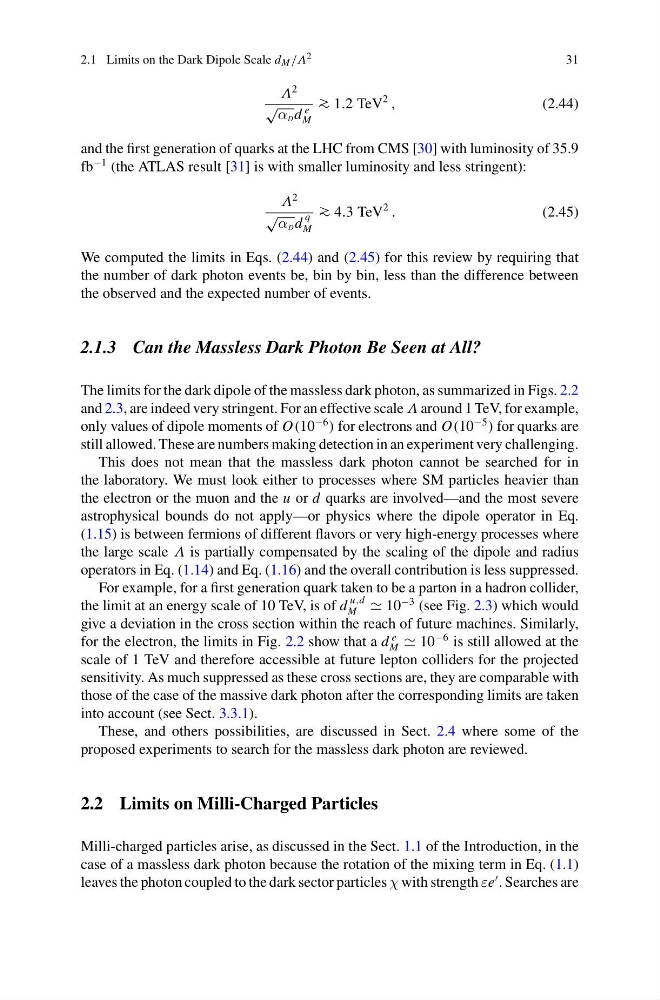
We computed the limits in Eqs. (2.44) and (2.45) for this review by requiring that
the number of dark photon events be, bin by bin, less than the difference between
the observed and the expected number of events.
2.1.3 Can the Massless Dark Photon Be Seen at All?
The limits for the dark dipole of the massless dark photon, as summarized in Figs. 2.2
and 2.3, are indeed very stringent. For an effective scale Λ around 1 TeV, for example,
only values of dipole moments of O(10
−6
) for electrons and O(10
−5
) for quarks are
still allowed. These are numbers making detection in an experiment very challenging.
This does not mean that the massless dark photon cannot be searched for in
the laboratory. We must look either to processes where SM particles heavier than
the electron or the muon and the u or d quarks are involved—and the most severe
astrophysical bounds do not apply—or physics where the dipole operator in Eq.
(1.15) is between fermions of different flavors or very high-energy processes where
the large scale Λ is partially compensated by the scaling of the dipole and radius
operators in Eq. (1.14) and Eq. (1.16) and the overall contribution is less suppressed.
For example, for a first generation quark taken to be a parton in a hadron collider,
the limit at an energy scale of 10 TeV, is of d
u,d
M 10
−3 (see Fig. 2.3) which would
give a deviation in the cross section within the reach of future machines. Similarly,
for the electron, the limits in Fig. 2.2 show that a d
e
M 10
−6 is still allowed at the
scale of 1 TeV and therefore accessible at future lepton colliders for the projected
sensitivity. As much suppressed as these cross sections are, they are comparable with
those of the case of the massive dark photon after the corresponding limits are taken
into account (see Sect. 3.3.1).
These, and others possibilities, are discussed in Sect. 2.4 where some of the
proposed experiments to search for the massless dark photon are reviewed.
2.2 Limits on Milli-Charged Particles
Milli-charged particles arise, as discussed in the Sect. 1.1 of the Introduction, in the
case of a massless dark photon because the rotation of the mixing term in Eq. (1.1)
leaves the photon coupled to the dark sector particles χ with strength εe
. Searches are
31
Λ
2
√ α D d
e
M
∼ > 1.2 TeV
2
,
(2.44)
and the first generation of quarks at the LHC from CMS [30] with luminosity of 35.9
fb
−1 (the ATLAS result [31] is with smaller luminosity and less stringent):
Λ
2
√
α D d
q
M
∼ > 4.3 TeV
2
.
(2.45)
We computed the limits in Eqs. (2.44) and (2.45) for this review by requiring that
the number of dark photon events be, bin by bin, less than the difference between
the observed and the expected number of events.
2.1.3 Can the Massless Dark Photon Be Seen at All?
The limits for the dark dipole of the massless dark photon, as summarized in Figs. 2.2
and 2.3, are indeed very stringent. For an effective scale Λ around 1 TeV, for example,
only values of dipole moments of O(10
−6
) for electrons and O(10
−5
) for quarks are
still allowed. These are numbers making detection in an experiment very challenging.
This does not mean that the massless dark photon cannot be searched for in
the laboratory. We must look either to processes where SM particles heavier than
the electron or the muon and the u or d quarks are involved—and the most severe
astrophysical bounds do not apply—or physics where the dipole operator in Eq.
(1.15) is between fermions of different flavors or very high-energy processes where
the large scale Λ is partially compensated by the scaling of the dipole and radius
operators in Eq. (1.14) and Eq. (1.16) and the overall contribution is less suppressed.
For example, for a first generation quark taken to be a parton in a hadron collider,
the limit at an energy scale of 10 TeV, is of d
u,d
M 10
−3 (see Fig. 2.3) which would
give a deviation in the cross section within the reach of future machines. Similarly,
for the electron, the limits in Fig. 2.2 show that a d
e
M 10
−6 is still allowed at the
scale of 1 TeV and therefore accessible at future lepton colliders for the projected
sensitivity. As much suppressed as these cross sections are, they are comparable with
those of the case of the massive dark photon after the corresponding limits are taken
into account (see Sect. 3.3.1).
These, and others possibilities, are discussed in Sect. 2.4 where some of the
proposed experiments to search for the massless dark photon are reviewed.
2.2 Limits on Milli-Charged Particles
Milli-charged particles arise, as discussed in the Sect. 1.1 of the Introduction, in the
case of a massless dark photon because the rotation of the mixing term in Eq. (1.1)
leaves the photon coupled to the dark sector particles χ with strength εe
. Searches are