

30
2 Phenomenology of the Massless Dark Photon
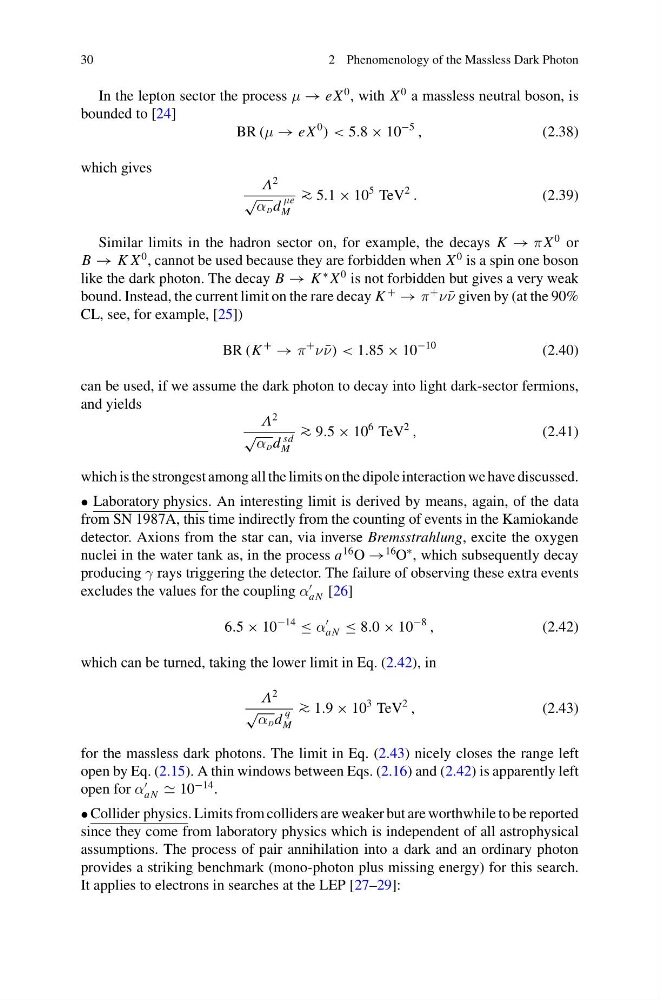
In the lepton sector the process μ → eX
0 , with X
0 a massless neutral boson, is
bounded to [24]
BR (μ → eX
0
) < 5.8 × 10
−5
,
(2.38)
which gives
Λ
2
√ α D d
μe
M
∼ > 5.1 × 10
5 TeV
2
.
(2.39)
Similar limits in the hadron sector on, for example, the decays K → π X
0 or
B → K X
0 , cannot be used because they are forbidden when X
0 is a spin one boson
like the dark photon. The decay B → K
∗ X
0 is not forbidden but gives a very weak
bound. Instead, the current limit on the rare decay K
+
→ π
+
ν ¯
ν given by (at the 90%
CL, see, for example, [25])
BR (K
+
→ π
+
ν ¯
ν) < 1.85 × 10
−10
(2.40)
can be used, if we assume the dark photon to decay into light dark-sector fermions,
and yields
Λ
2
√
α D d
sd
M
∼ > 9.5 × 10
6 TeV
2
,
(2.41)
which is the strongest among all the limits on the dipole interaction we have discussed.
• Laboratory physics. An interesting limit is derived by means, again, of the data
from SN 1987A, this time indirectly from the counting of events in the Kamiokande
detector. Axions from the star can, via inverse Bremsstrahlung, excite the oxygen
nuclei in the water tank as, in the process a
16 O →
16
O
∗ , which subsequently decay
producing γ rays triggering the detector. The failure of observing these extra events
excludes the values for the coupling α
aN [26]
6.5 × 10
−14
≤ α
aN ≤ 8.0 × 10
−8
,
(2.42)
which can be turned, taking the lower limit in Eq. (2.42), in
Λ
2
√
α D d
q
M
∼ > 1.9 × 10
3 TeV
2
,
(2.43)
for the massless dark photons. The limit in Eq. (2.43) nicely closes the range left
open by Eq. (2.15). A thin windows between Eqs. (2.16) and (2.42) is apparently left
open for α
aN 10
−14 .
• Collider physics. Limits from colliders are weaker but are worthwhile to be reported
since they come from laboratory physics which is independent of all astrophysical
assumptions. The process of pair annihilation into a dark and an ordinary photon
provides a striking benchmark (mono-photon plus missing energy) for this search.
It applies to electrons in searches at the LEP [27–29]:
2 Phenomenology of the Massless Dark Photon
In the lepton sector the process μ → eX
0 , with X
0 a massless neutral boson, is
bounded to [24]
BR (μ → eX
0
) < 5.8 × 10
−5
,
(2.38)
which gives
Λ
2
√ α D d
μe
M
∼ > 5.1 × 10
5 TeV
2
.
(2.39)
Similar limits in the hadron sector on, for example, the decays K → π X
0 or
B → K X
0 , cannot be used because they are forbidden when X
0 is a spin one boson
like the dark photon. The decay B → K
∗ X
0 is not forbidden but gives a very weak
bound. Instead, the current limit on the rare decay K
+
→ π
+
ν ¯
ν given by (at the 90%
CL, see, for example, [25])
BR (K
+
→ π
+
ν ¯
ν) < 1.85 × 10
−10
(2.40)
can be used, if we assume the dark photon to decay into light dark-sector fermions,
and yields
Λ
2
√
α D d
sd
M
∼ > 9.5 × 10
6 TeV
2
,
(2.41)
which is the strongest among all the limits on the dipole interaction we have discussed.
• Laboratory physics. An interesting limit is derived by means, again, of the data
from SN 1987A, this time indirectly from the counting of events in the Kamiokande
detector. Axions from the star can, via inverse Bremsstrahlung, excite the oxygen
nuclei in the water tank as, in the process a
16 O →
16
O
∗ , which subsequently decay
producing γ rays triggering the detector. The failure of observing these extra events
excludes the values for the coupling α
aN [26]
6.5 × 10
−14
≤ α
aN ≤ 8.0 × 10
−8
,
(2.42)
which can be turned, taking the lower limit in Eq. (2.42), in
Λ
2
√
α D d
q
M
∼ > 1.9 × 10
3 TeV
2
,
(2.43)
for the massless dark photons. The limit in Eq. (2.43) nicely closes the range left
open by Eq. (2.15). A thin windows between Eqs. (2.16) and (2.42) is apparently left
open for α
aN 10
−14 .
• Collider physics. Limits from colliders are weaker but are worthwhile to be reported
since they come from laboratory physics which is independent of all astrophysical
assumptions. The process of pair annihilation into a dark and an ordinary photon
provides a striking benchmark (mono-photon plus missing energy) for this search.
It applies to electrons in searches at the LEP [27–29]: