

10
1 Introduction
1.3 Dark Matter and the Dark Photon
Dark matter is part of the dark sector. The interplay between the dark photon and
dark matter opens new windows on its physics and gives further constraints. Whereas
in most scenarios dark matter is one of the fermion (or scalar) states in this sector,
there also exists the possibility that dark matter could be a very light vector boson
like the massive dark photon itself.
1.3.1 Massless Dark Photon and Galaxy Dynamics
Models of self-interacting dark matter charged under Abelian or non-Abelian gauge
groups and interacting through the exchange of massless as well as massive particles
have a long history.
1
The most obvious obstacle to having dark matter in the dark sector interacting via
a long-range force as the one carried by the massless dark photon comes from the
essentially collisionless dynamics of galaxies and the ellipticity of their dark-matter
halo.
The most severe observational limits come from the present dark matter density distribution in collapsed dark matter structures, rather than effects in the early
Universe or the early stages of structure formation [48, 49, 59].
Bounds have been derived from the dynamics in merging clusters, such as the
Bullet Cluster [65], the tidal disruption of dwarf satellites along their orbits in
the host halo, and kinetic energy exchanges among dark matter particles in virialized halos. The latter turns out to be the most constraining bound, noticing that
self-interactions tend to isotropize dark matter velocity distributions, while there
are galaxies whose gravitational potentials show a triaxial structure with significant velocity anisotropy; limits have been computed, with subsequent refinements,
via estimating an isotropization timescale (through hard scattering and cumulative
effects of many interactions, also taking into account Debye screening) and comparison to the estimated age of the object [49], or following more closely the evolution of
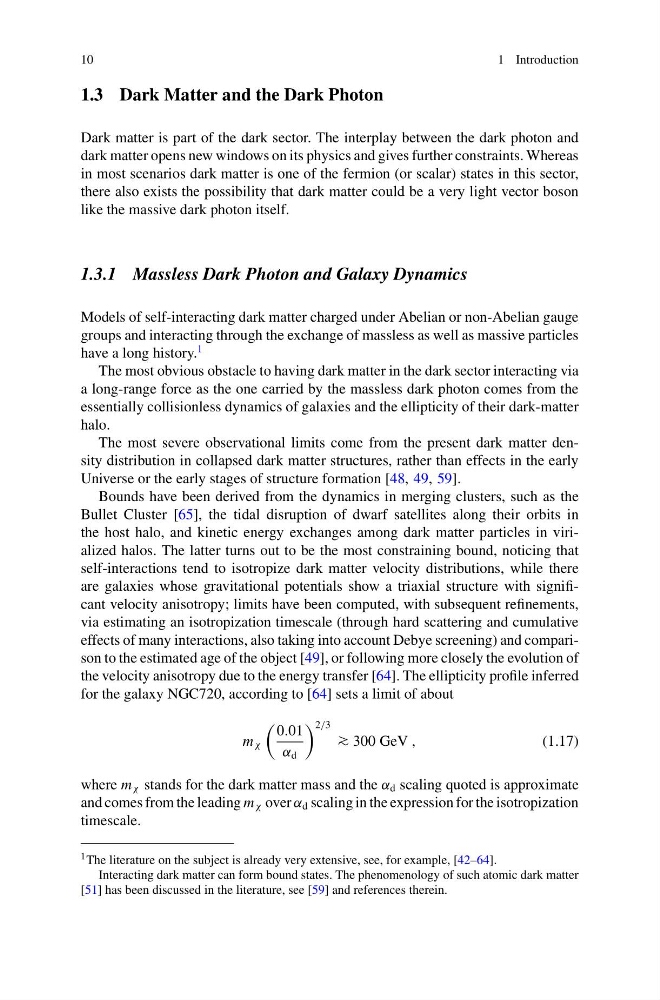
the velocity anisotropy due to the energy transfer [64]. The ellipticity profile inferred
for the galaxy NGC720, according to [64] sets a limit of about
m χ
0.01
α d
2/3
∼ > 300 GeV ,
(1.17)
where m χ stands for the dark matter mass and the α d scaling quoted is approximate
and comes from the leading m χ over α d scaling in the expression for the isotropization
timescale.
1 The literature on the subject is already very extensive, see, for example, [42–64].
Interacting dark matter can form bound states. The phenomenology of such atomic dark matter
[51] has been discussed in the literature, see [59] and references therein.
1 Introduction
1.3 Dark Matter and the Dark Photon
Dark matter is part of the dark sector. The interplay between the dark photon and
dark matter opens new windows on its physics and gives further constraints. Whereas
in most scenarios dark matter is one of the fermion (or scalar) states in this sector,
there also exists the possibility that dark matter could be a very light vector boson
like the massive dark photon itself.
1.3.1 Massless Dark Photon and Galaxy Dynamics
Models of self-interacting dark matter charged under Abelian or non-Abelian gauge
groups and interacting through the exchange of massless as well as massive particles
have a long history.
1
The most obvious obstacle to having dark matter in the dark sector interacting via
a long-range force as the one carried by the massless dark photon comes from the
essentially collisionless dynamics of galaxies and the ellipticity of their dark-matter
halo.
The most severe observational limits come from the present dark matter density distribution in collapsed dark matter structures, rather than effects in the early
Universe or the early stages of structure formation [48, 49, 59].
Bounds have been derived from the dynamics in merging clusters, such as the
Bullet Cluster [65], the tidal disruption of dwarf satellites along their orbits in
the host halo, and kinetic energy exchanges among dark matter particles in virialized halos. The latter turns out to be the most constraining bound, noticing that
self-interactions tend to isotropize dark matter velocity distributions, while there
are galaxies whose gravitational potentials show a triaxial structure with significant velocity anisotropy; limits have been computed, with subsequent refinements,
via estimating an isotropization timescale (through hard scattering and cumulative
effects of many interactions, also taking into account Debye screening) and comparison to the estimated age of the object [49], or following more closely the evolution of
the velocity anisotropy due to the energy transfer [64]. The ellipticity profile inferred
for the galaxy NGC720, according to [64] sets a limit of about
m χ
0.01
α d
2/3
∼ > 300 GeV ,
(1.17)
where m χ stands for the dark matter mass and the α d scaling quoted is approximate
and comes from the leading m χ over α d scaling in the expression for the isotropization
timescale.
1 The literature on the subject is already very extensive, see, for example, [42–64].
Interacting dark matter can form bound states. The phenomenology of such atomic dark matter
[51] has been discussed in the literature, see [59] and references therein.