

1.2 UV Models
9
moment and that proportional to the coefficient D E is the electric dipole moment.
The indices i and j in the fermion fields keep track of the flavor and thus allow for
flavor off-diagonal transitions.
The dimension-five operators in Eq. (1.14) are best seen as operators of dimension
six with the gauge group SU (2) L taken as the unbroken symmetry of the Lagrangian
and the SM fermion grouped, like in the SM, into doublets ψ L and singlets ψ R . In
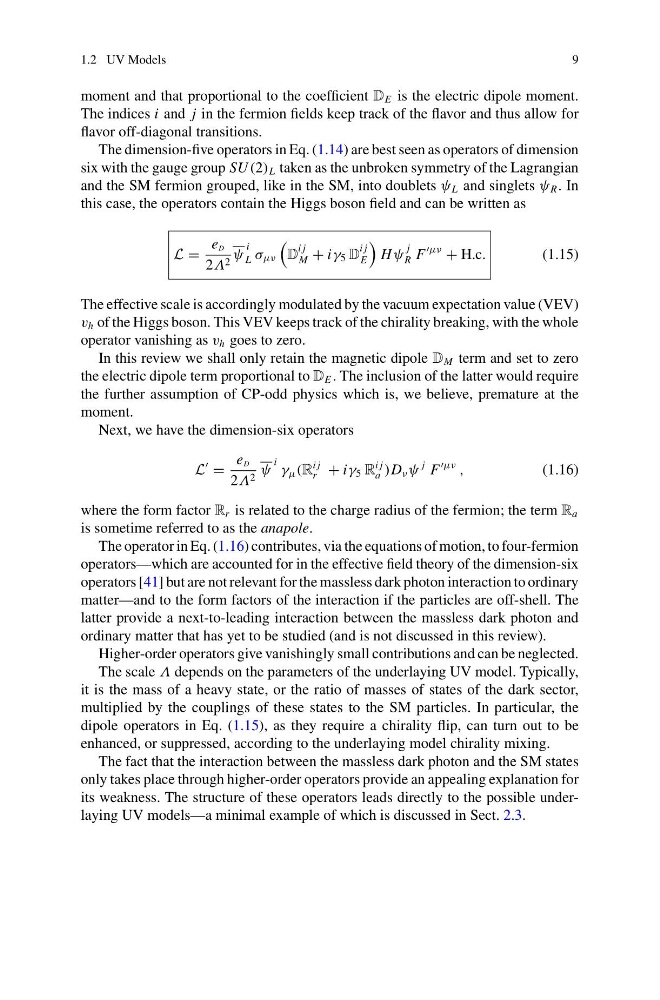
this case, the operators contain the Higgs boson field and can be written as
L =
e D
2Λ 2 ψ
i
L σ μν
D
i j
M + iγ 5 D
i j
E
H ψ
j
R F
μν
+ H.c.
(1.15)
The effective scale is accordingly modulated by the vacuum expectation value (VEV)
v h of the Higgs boson. This VEV keeps track of the chirality breaking, with the whole
operator vanishing as v h goes to zero.
In this review we shall only retain the magnetic dipole D M term and set to zero
the electric dipole term proportional to D E . The inclusion of the latter would require
the further assumption of CP-odd physics which is, we believe, premature at the
moment.
Next, we have the dimension-six operators
L
=
e D
2Λ 2 ψ
i γ μ (R
i j
r + iγ 5 R
i j
a )D ν ψ
j F
μν
,
(1.16)
where the form factor R r is related to the charge radius of the fermion; the term R a
is sometime referred to as the anapole.
The operator in Eq. (1.16) contributes, via the equations of motion, to four-fermion
operators—which are accounted for in the effective field theory of the dimension-six
operators [41] but are not relevant for the massless dark photon interaction to ordinary
matter—and to the form factors of the interaction if the particles are off-shell. The
latter provide a next-to-leading interaction between the massless dark photon and
ordinary matter that has yet to be studied (and is not discussed in this review).
Higher-order operators give vanishingly small contributions and can be neglected.
The scale Λ depends on the parameters of the underlaying UV model. Typically,
it is the mass of a heavy state, or the ratio of masses of states of the dark sector,
multiplied by the couplings of these states to the SM particles. In particular, the
dipole operators in Eq. (1.15), as they require a chirality flip, can turn out to be
enhanced, or suppressed, according to the underlaying model chirality mixing.
The fact that the interaction between the massless dark photon and the SM states
only takes place through higher-order operators provide an appealing explanation for
its weakness. The structure of these operators leads directly to the possible underlaying UV models—a minimal example of which is discussed in Sect. 2.3.
9
moment and that proportional to the coefficient D E is the electric dipole moment.
The indices i and j in the fermion fields keep track of the flavor and thus allow for
flavor off-diagonal transitions.
The dimension-five operators in Eq. (1.14) are best seen as operators of dimension
six with the gauge group SU (2) L taken as the unbroken symmetry of the Lagrangian
and the SM fermion grouped, like in the SM, into doublets ψ L and singlets ψ R . In
this case, the operators contain the Higgs boson field and can be written as
L =
e D
2Λ 2 ψ
i
L σ μν
D
i j
M + iγ 5 D
i j
E
H ψ
j
R F
μν
+ H.c.
(1.15)
The effective scale is accordingly modulated by the vacuum expectation value (VEV)
v h of the Higgs boson. This VEV keeps track of the chirality breaking, with the whole
operator vanishing as v h goes to zero.
In this review we shall only retain the magnetic dipole D M term and set to zero
the electric dipole term proportional to D E . The inclusion of the latter would require
the further assumption of CP-odd physics which is, we believe, premature at the
moment.
Next, we have the dimension-six operators
L
=
e D
2Λ 2 ψ
i γ μ (R
i j
r + iγ 5 R
i j
a )D ν ψ
j F
μν
,
(1.16)
where the form factor R r is related to the charge radius of the fermion; the term R a
is sometime referred to as the anapole.
The operator in Eq. (1.16) contributes, via the equations of motion, to four-fermion
operators—which are accounted for in the effective field theory of the dimension-six
operators [41] but are not relevant for the massless dark photon interaction to ordinary
matter—and to the form factors of the interaction if the particles are off-shell. The
latter provide a next-to-leading interaction between the massless dark photon and
ordinary matter that has yet to be studied (and is not discussed in this review).
Higher-order operators give vanishingly small contributions and can be neglected.
The scale Λ depends on the parameters of the underlaying UV model. Typically,
it is the mass of a heavy state, or the ratio of masses of states of the dark sector,
multiplied by the couplings of these states to the SM particles. In particular, the
dipole operators in Eq. (1.15), as they require a chirality flip, can turn out to be
enhanced, or suppressed, according to the underlaying model chirality mixing.
The fact that the interaction between the massless dark photon and the SM states
only takes place through higher-order operators provide an appealing explanation for
its weakness. The structure of these operators leads directly to the possible underlaying UV models—a minimal example of which is discussed in Sect. 2.3.