

29
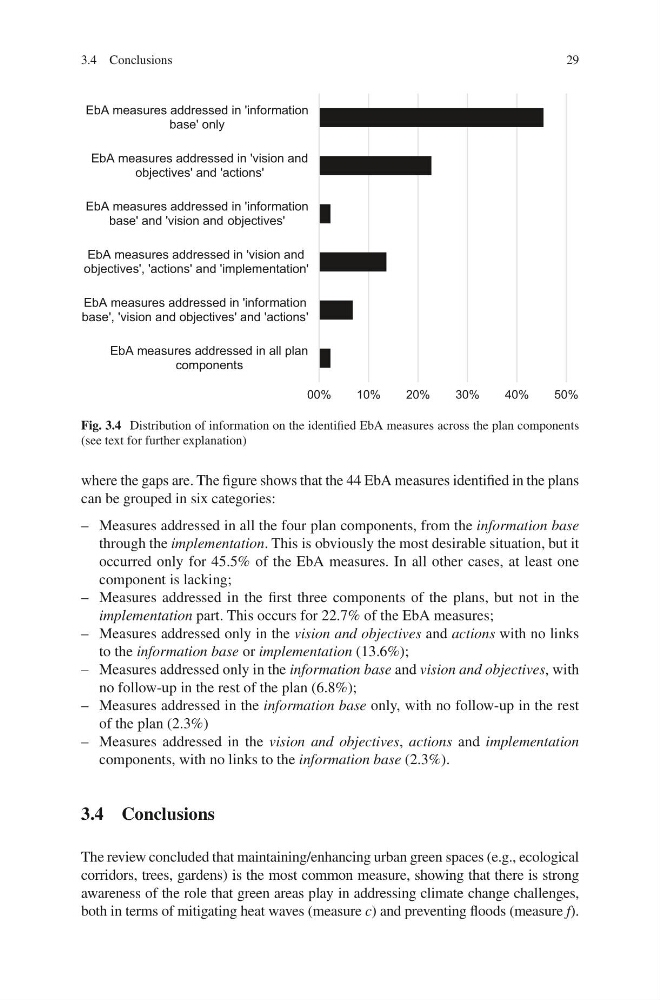
where the gaps are. The figure shows that the 44 EbA measures identified in the plans
can be grouped in six categories:
– Measures addressed in all the four plan components, from the information base
through the implementation. This is obviously the most desirable situation, but it
occurred only for 45.5% of the EbA measures. In all other cases, at least one
component is lacking;
– Measures addressed in the first three components of the plans, but not in the
implementation part. This occurs for 22.7% of the EbA measures;
– Measures addressed only in the vision and objectives and actions with no links
to the information base or implementation (13.6%);
– Measures addressed only in the information base and vision and objectives, with
no follow-up in the rest of the plan (6.8%);
– Measures addressed in the information base only, with no follow-up in the rest
of the plan (2.3%)
– Measures addressed in the vision and objectives, actions and implementation
components, with no links to the information base (2.3%).
3.4 Conclusions
The review concluded that maintaining/enhancing urban green spaces (e.g., ecological
corridors, trees, gardens) is the most common measure, showing that there is strong
awareness of the role that green areas play in addressing climate change challenges,
both in terms of mitigating heat waves (measure c) and preventing floods (measure f).
00%
10%
20%
30%
40%
50%
EbA measures addressed in all plan
components
EbA measures addressed in 'information
base', 'vision and objectives' and 'actions'
EbA measures addressed in 'vision and
objectives', 'actions' and 'implementation'
EbA measures addressed in 'information
base' and 'vision and objectives'
EbA measures addressed in 'vision and
objectives' and 'actions'
EbA measures addressed in 'information
base' only
Fig. 3.4 Distribution of information on the identified EbA measures across the plan components
(see text for further explanation)
3.4 Conclusions
where the gaps are. The figure shows that the 44 EbA measures identified in the plans
can be grouped in six categories:
– Measures addressed in all the four plan components, from the information base
through the implementation. This is obviously the most desirable situation, but it
occurred only for 45.5% of the EbA measures. In all other cases, at least one
component is lacking;
– Measures addressed in the first three components of the plans, but not in the
implementation part. This occurs for 22.7% of the EbA measures;
– Measures addressed only in the vision and objectives and actions with no links
to the information base or implementation (13.6%);
– Measures addressed only in the information base and vision and objectives, with
no follow-up in the rest of the plan (6.8%);
– Measures addressed in the information base only, with no follow-up in the rest
of the plan (2.3%)
– Measures addressed in the vision and objectives, actions and implementation
components, with no links to the information base (2.3%).
3.4 Conclusions
The review concluded that maintaining/enhancing urban green spaces (e.g., ecological
corridors, trees, gardens) is the most common measure, showing that there is strong
awareness of the role that green areas play in addressing climate change challenges,
both in terms of mitigating heat waves (measure c) and preventing floods (measure f).
00%
10%
20%
30%
40%
50%
EbA measures addressed in all plan
components
EbA measures addressed in 'information
base', 'vision and objectives' and 'actions'
EbA measures addressed in 'vision and
objectives', 'actions' and 'implementation'
EbA measures addressed in 'information
base' and 'vision and objectives'
EbA measures addressed in 'vision and
objectives' and 'actions'
EbA measures addressed in 'information
base' only
Fig. 3.4 Distribution of information on the identified EbA measures across the plan components
(see text for further explanation)
3.4 Conclusions