

11
2.2.3 Analysing Planning Actions
We investigated three action properties, namely typology, target area, and implementation tool. The typology describes the type of intervention on urban ecosystems, i.e. conservation, restoration, enhancement, or new ecosystem. The target area
describes the scale of the planning action and the spatial distribution of the interventions within the city, i.e. widespread over the whole territory, targeting specific
areas, or limited to specific sites. The implementation tool describes the type of
legal instruments provided to implement the action, i.e. regulatory tools, designbased tools, incentive-based tools, land acquisition programs, or other tools
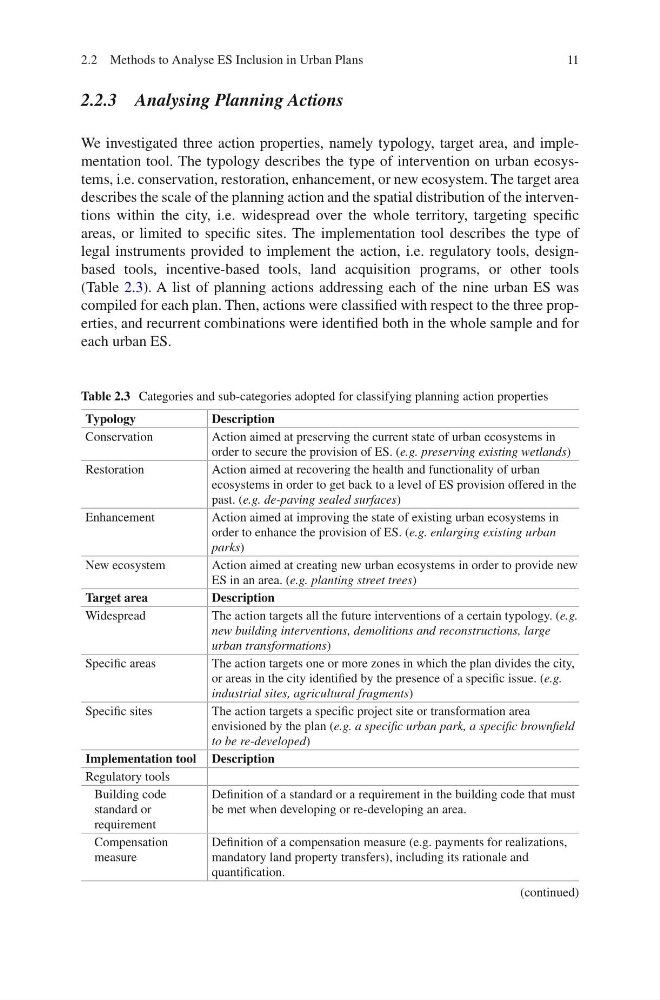
(Table 2.3). A list of planning actions addressing each of the nine urban ES was
compiled for each plan. Then, actions were classified with respect to the three properties, and recurrent combinations were identified both in the whole sample and for
each urban ES.
Table 2.3 Categories and sub-categories adopted for classifying planning action properties
Typology
Description
Conservation
Action aimed at preserving the current state of urban ecosystems in
order to secure the provision of ES. (e.g. preserving existing wetlands)
Restoration
Action aimed at recovering the health and functionality of urban
ecosystems in order to get back to a level of ES provision offered in the
past. (e.g. de-paving sealed surfaces)
Enhancement
Action aimed at improving the state of existing urban ecosystems in
order to enhance the provision of ES. (e.g. enlarging existing urban
parks)
New ecosystem
Action aimed at creating new urban ecosystems in order to provide new
ES in an area. (e.g. planting street trees)
Target area
Description
Widespread
The action targets all the future interventions of a certain typology. (e.g.
new building interventions, demolitions and reconstructions, large
urban transformations)
Specific areas
The action targets one or more zones in which the plan divides the city,
or areas in the city identified by the presence of a specific issue. (e.g.
industrial sites, agricultural fragments)
Specific sites
The action targets a specific project site or transformation area
envisioned by the plan (e.g. a specific urban park, a specific brownfield
to be re-developed)
Implementation tool Description
Regulatory tools
Building code
standard or
requirement
Definition of a standard or a requirement in the building code that must
be met when developing or re-developing an area.
Compensation
measure
Definition of a compensation measure (e.g. payments for realizations,
mandatory land property transfers), including its rationale and
quantification.
(continued)
2.2 Methods to Analyse ES Inclusion in Urban Plans
2.2.3 Analysing Planning Actions
We investigated three action properties, namely typology, target area, and implementation tool. The typology describes the type of intervention on urban ecosystems, i.e. conservation, restoration, enhancement, or new ecosystem. The target area
describes the scale of the planning action and the spatial distribution of the interventions within the city, i.e. widespread over the whole territory, targeting specific
areas, or limited to specific sites. The implementation tool describes the type of
legal instruments provided to implement the action, i.e. regulatory tools, designbased tools, incentive-based tools, land acquisition programs, or other tools
(Table 2.3). A list of planning actions addressing each of the nine urban ES was
compiled for each plan. Then, actions were classified with respect to the three properties, and recurrent combinations were identified both in the whole sample and for
each urban ES.
Table 2.3 Categories and sub-categories adopted for classifying planning action properties
Typology
Description
Conservation
Action aimed at preserving the current state of urban ecosystems in
order to secure the provision of ES. (e.g. preserving existing wetlands)
Restoration
Action aimed at recovering the health and functionality of urban
ecosystems in order to get back to a level of ES provision offered in the
past. (e.g. de-paving sealed surfaces)
Enhancement
Action aimed at improving the state of existing urban ecosystems in
order to enhance the provision of ES. (e.g. enlarging existing urban
parks)
New ecosystem
Action aimed at creating new urban ecosystems in order to provide new
ES in an area. (e.g. planting street trees)
Target area
Description
Widespread
The action targets all the future interventions of a certain typology. (e.g.
new building interventions, demolitions and reconstructions, large
urban transformations)
Specific areas
The action targets one or more zones in which the plan divides the city,
or areas in the city identified by the presence of a specific issue. (e.g.
industrial sites, agricultural fragments)
Specific sites
The action targets a specific project site or transformation area
envisioned by the plan (e.g. a specific urban park, a specific brownfield
to be re-developed)
Implementation tool Description
Regulatory tools
Building code
standard or
requirement
Definition of a standard or a requirement in the building code that must
be met when developing or re-developing an area.
Compensation
measure
Definition of a compensation measure (e.g. payments for realizations,
mandatory land property transfers), including its rationale and
quantification.
(continued)
2.2 Methods to Analyse ES Inclusion in Urban Plans