

3 Materials and Processing of TSV
57
(a)
scallops
(b)
(c)
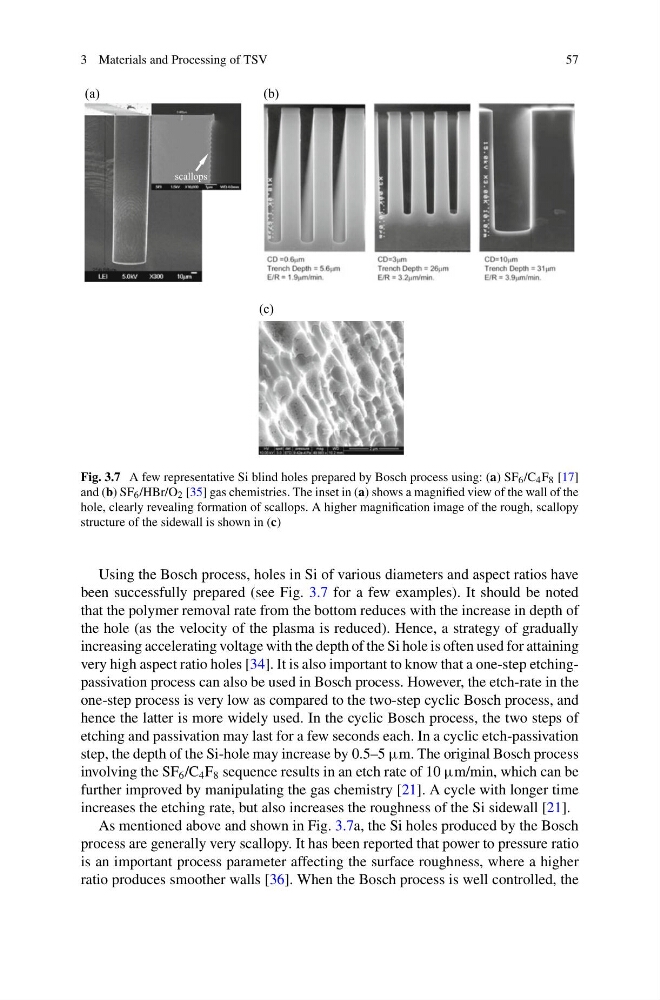
Fig. 3.7 A few representative Si blind holes prepared by Bosch process using: (a) SF 6 /C 4 F 8 [17]
and (b) SF 6 /HBr/O 2 [35] gas chemistries. The inset in (a) shows a magnified view of the wall of the
hole, clearly revealing formation of scallops. A higher magnification image of the rough, scallopy
structure of the sidewall is shown in (c)
Using the Bosch process, holes in Si of various diameters and aspect ratios have
been successfully prepared (see Fig. 3.7 for a few examples). It should be noted
that the polymer removal rate from the bottom reduces with the increase in depth of
the hole (as the velocity of the plasma is reduced). Hence, a strategy of gradually
increasing accelerating voltage with the depth of the Si hole is often used for attaining
very high aspect ratio holes [34]. It is also important to know that a one-step etchingpassivation process can also be used in Bosch process. However, the etch-rate in the
one-step process is very low as compared to the two-step cyclic Bosch process, and
hence the latter is more widely used. In the cyclic Bosch process, the two steps of
etching and passivation may last for a few seconds each. In a cyclic etch-passivation
step, the depth of the Si-hole may increase by 0.5–5 µm. The original Bosch process
involving the SF 6 /C 4 F 8 sequence results in an etch rate of 10 µm/min, which can be
further improved by manipulating the gas chemistry [21]. A cycle with longer time
increases the etching rate, but also increases the roughness of the Si sidewall [21].
As mentioned above and shown in Fig. 3.7a, the Si holes produced by the Bosch
process are generally very scallopy. It has been reported that power to pressure ratio
is an important process parameter affecting the surface roughness, where a higher
ratio produces smoother walls [36]. When the Bosch process is well controlled, the
57
(a)
scallops
(b)
(c)
Fig. 3.7 A few representative Si blind holes prepared by Bosch process using: (a) SF 6 /C 4 F 8 [17]
and (b) SF 6 /HBr/O 2 [35] gas chemistries. The inset in (a) shows a magnified view of the wall of the
hole, clearly revealing formation of scallops. A higher magnification image of the rough, scallopy
structure of the sidewall is shown in (c)
Using the Bosch process, holes in Si of various diameters and aspect ratios have
been successfully prepared (see Fig. 3.7 for a few examples). It should be noted
that the polymer removal rate from the bottom reduces with the increase in depth of
the hole (as the velocity of the plasma is reduced). Hence, a strategy of gradually
increasing accelerating voltage with the depth of the Si hole is often used for attaining
very high aspect ratio holes [34]. It is also important to know that a one-step etchingpassivation process can also be used in Bosch process. However, the etch-rate in the
one-step process is very low as compared to the two-step cyclic Bosch process, and
hence the latter is more widely used. In the cyclic Bosch process, the two steps of
etching and passivation may last for a few seconds each. In a cyclic etch-passivation
step, the depth of the Si-hole may increase by 0.5–5 µm. The original Bosch process
involving the SF 6 /C 4 F 8 sequence results in an etch rate of 10 µm/min, which can be
further improved by manipulating the gas chemistry [21]. A cycle with longer time
increases the etching rate, but also increases the roughness of the Si sidewall [21].
As mentioned above and shown in Fig. 3.7a, the Si holes produced by the Bosch
process are generally very scallopy. It has been reported that power to pressure ratio
is an important process parameter affecting the surface roughness, where a higher
ratio produces smoother walls [36]. When the Bosch process is well controlled, the