

54
P. Kumar et al.
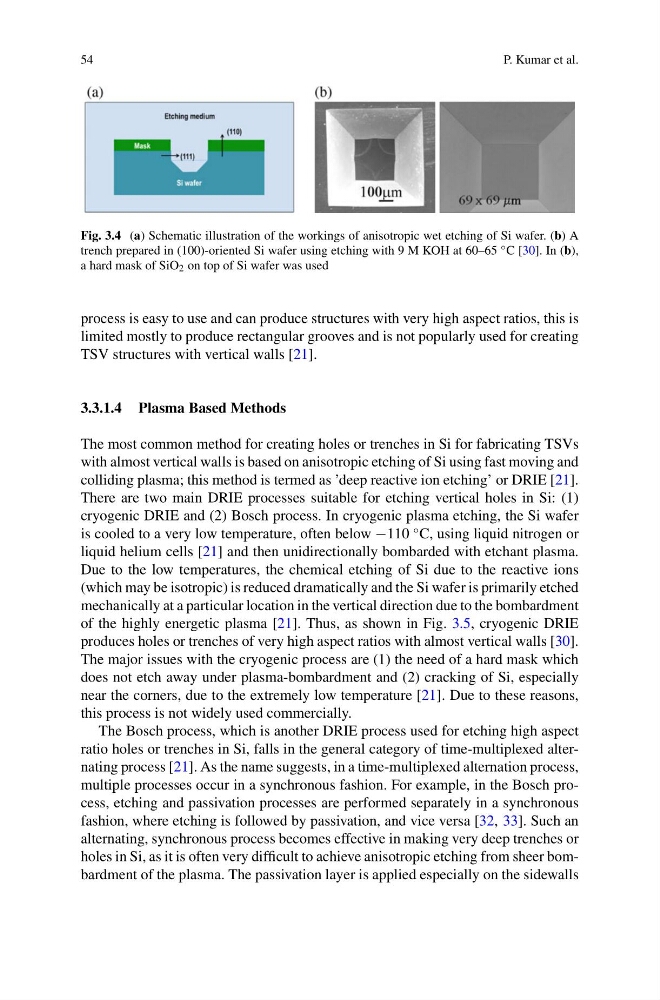
Fig. 3.4 (a) Schematic illustration of the workings of anisotropic wet etching of Si wafer. (b) A
trench prepared in (100)-oriented Si wafer using etching with 9 M KOH at 60–65 ◦ C [30]. In (b),
a hard mask of SiO 2 on top of Si wafer was used
process is easy to use and can produce structures with very high aspect ratios, this is
limited mostly to produce rectangular grooves and is not popularly used for creating
TSV structures with vertical walls [21].
3.3.1.4 Plasma Based Methods
The most common method for creating holes or trenches in Si for fabricating TSVs
with almost vertical walls is based on anisotropic etching of Si using fast moving and
colliding plasma; this method is termed as ’deep reactive ion etching’ or DRIE [21].
There are two main DRIE processes suitable for etching vertical holes in Si: (1)
cryogenic DRIE and (2) Bosch process. In cryogenic plasma etching, the Si wafer
is cooled to a very low temperature, often below −110
◦ C, using liquid nitrogen or
liquid helium cells [21] and then unidirectionally bombarded with etchant plasma.
Due to the low temperatures, the chemical etching of Si due to the reactive ions
(which may be isotropic) is reduced dramatically and the Si wafer is primarily etched
mechanically at a particular location in the vertical direction due to the bombardment
of the highly energetic plasma [21]. Thus, as shown in Fig. 3.5, cryogenic DRIE
produces holes or trenches of very high aspect ratios with almost vertical walls [30].
The major issues with the cryogenic process are (1) the need of a hard mask which
does not etch away under plasma-bombardment and (2) cracking of Si, especially
near the corners, due to the extremely low temperature [21]. Due to these reasons,
this process is not widely used commercially.
The Bosch process, which is another DRIE process used for etching high aspect
ratio holes or trenches in Si, falls in the general category of time-multiplexed alternating process [21]. As the name suggests, in a time-multiplexed alternation process,
multiple processes occur in a synchronous fashion. For example, in the Bosch process, etching and passivation processes are performed separately in a synchronous
fashion, where etching is followed by passivation, and vice versa [32, 33]. Such an
alternating, synchronous process becomes effective in making very deep trenches or
holes in Si, as it is often very difficult to achieve anisotropic etching from sheer bombardment of the plasma. The passivation layer is applied especially on the sidewalls
P. Kumar et al.
Fig. 3.4 (a) Schematic illustration of the workings of anisotropic wet etching of Si wafer. (b) A
trench prepared in (100)-oriented Si wafer using etching with 9 M KOH at 60–65 ◦ C [30]. In (b),
a hard mask of SiO 2 on top of Si wafer was used
process is easy to use and can produce structures with very high aspect ratios, this is
limited mostly to produce rectangular grooves and is not popularly used for creating
TSV structures with vertical walls [21].
3.3.1.4 Plasma Based Methods
The most common method for creating holes or trenches in Si for fabricating TSVs
with almost vertical walls is based on anisotropic etching of Si using fast moving and
colliding plasma; this method is termed as ’deep reactive ion etching’ or DRIE [21].
There are two main DRIE processes suitable for etching vertical holes in Si: (1)
cryogenic DRIE and (2) Bosch process. In cryogenic plasma etching, the Si wafer
is cooled to a very low temperature, often below −110
◦ C, using liquid nitrogen or
liquid helium cells [21] and then unidirectionally bombarded with etchant plasma.
Due to the low temperatures, the chemical etching of Si due to the reactive ions
(which may be isotropic) is reduced dramatically and the Si wafer is primarily etched
mechanically at a particular location in the vertical direction due to the bombardment
of the highly energetic plasma [21]. Thus, as shown in Fig. 3.5, cryogenic DRIE
produces holes or trenches of very high aspect ratios with almost vertical walls [30].
The major issues with the cryogenic process are (1) the need of a hard mask which
does not etch away under plasma-bombardment and (2) cracking of Si, especially
near the corners, due to the extremely low temperature [21]. Due to these reasons,
this process is not widely used commercially.
The Bosch process, which is another DRIE process used for etching high aspect
ratio holes or trenches in Si, falls in the general category of time-multiplexed alternating process [21]. As the name suggests, in a time-multiplexed alternation process,
multiple processes occur in a synchronous fashion. For example, in the Bosch process, etching and passivation processes are performed separately in a synchronous
fashion, where etching is followed by passivation, and vice versa [32, 33]. Such an
alternating, synchronous process becomes effective in making very deep trenches or
holes in Si, as it is often very difficult to achieve anisotropic etching from sheer bombardment of the plasma. The passivation layer is applied especially on the sidewalls