

608
Y. Li and D. Goyal
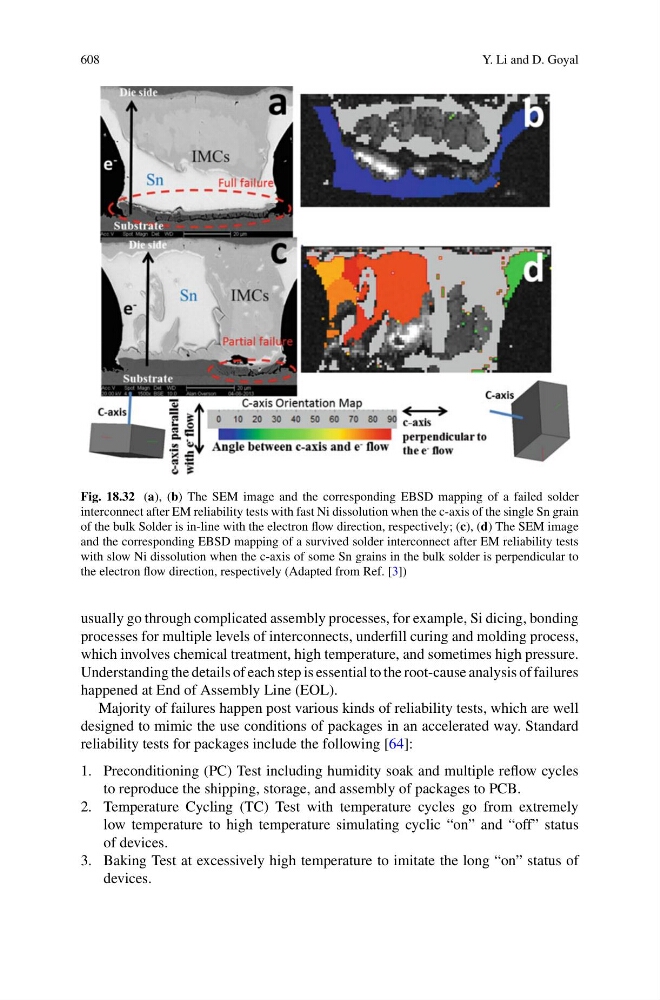
Fig. 18.32 (a), (b) The SEM image and the corresponding EBSD mapping of a failed solder
interconnect after EM reliability tests with fast Ni dissolution when the c-axis of the single Sn grain
of the bulk Solder is in-line with the electron flow direction, respectively; (c), (d) The SEM image
and the corresponding EBSD mapping of a survived solder interconnect after EM reliability tests
with slow Ni dissolution when the c-axis of some Sn grains in the bulk solder is perpendicular to
the electron flow direction, respectively (Adapted from Ref. [3])
usually go through complicated assembly processes, for example, Si dicing, bonding
processes for multiple levels of interconnects, underfill curing and molding process,
which involves chemical treatment, high temperature, and sometimes high pressure.
Understanding the details of each step is essential to the root-cause analysis of failures
happened at End of Assembly Line (EOL).
Majority of failures happen post various kinds of reliability tests, which are well
designed to mimic the use conditions of packages in an accelerated way. Standard
reliability tests for packages include the following [64]:
1. Preconditioning (PC) Test including humidity soak and multiple reflow cycles
to reproduce the shipping, storage, and assembly of packages to PCB.
2. Temperature Cycling (TC) Test with temperature cycles go from extremely
low temperature to high temperature simulating cyclic “on” and “off” status
of devices.
3. Baking Test at excessively high temperature to imitate the long “on” status of
devices.