

590
Y. Li and D. Goyal
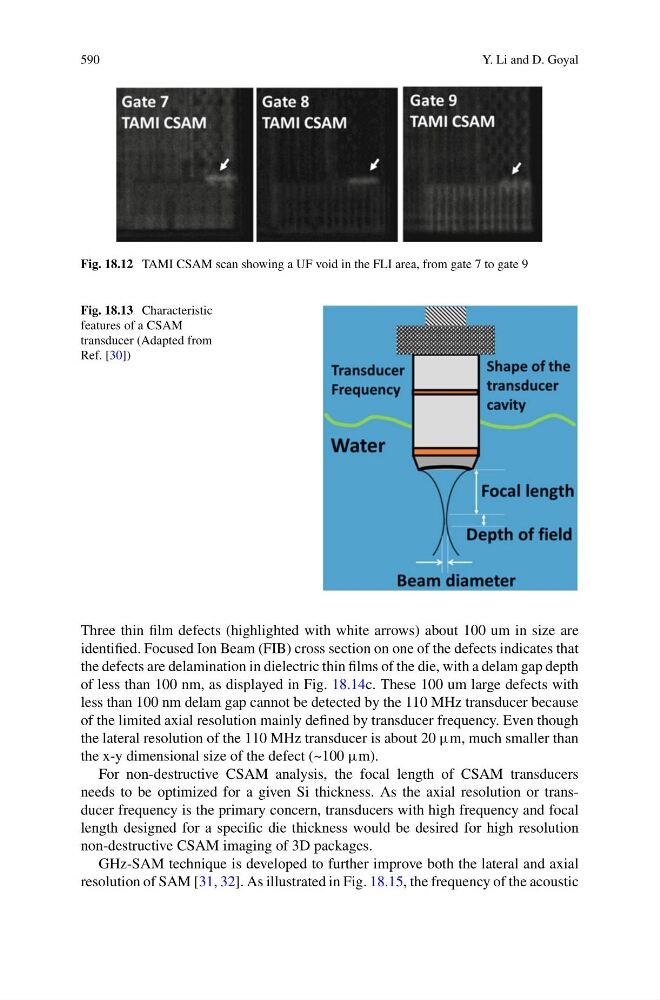
Fig. 18.12 TAMI CSAM scan showing a UF void in the FLI area, from gate 7 to gate 9
Fig. 18.13 Characteristic
features of a CSAM
transducer (Adapted from
Ref. [30])
Three thin film defects (highlighted with white arrows) about 100 um in size are
identified. Focused Ion Beam (FIB) cross section on one of the defects indicates that
the defects are delamination in dielectric thin films of the die, with a delam gap depth
of less than 100 nm, as displayed in Fig. 18.14c. These 100 um large defects with
less than 100 nm delam gap cannot be detected by the 110 MHz transducer because
of the limited axial resolution mainly defined by transducer frequency. Even though
the lateral resolution of the 110 MHz transducer is about 20 μm, much smaller than
the x-y dimensional size of the defect (~100 μm).
For non-destructive CSAM analysis, the focal length of CSAM transducers
needs to be optimized for a given Si thickness. As the axial resolution or transducer frequency is the primary concern, transducers with high frequency and focal
length designed for a specific die thickness would be desired for high resolution
non-destructive CSAM imaging of 3D packages.
GHz-SAM technique is developed to further improve both the lateral and axial
resolution of SAM [31, 32]. As illustrated in Fig. 18.15, the frequency of the acoustic