

558
Y. Wang et al.
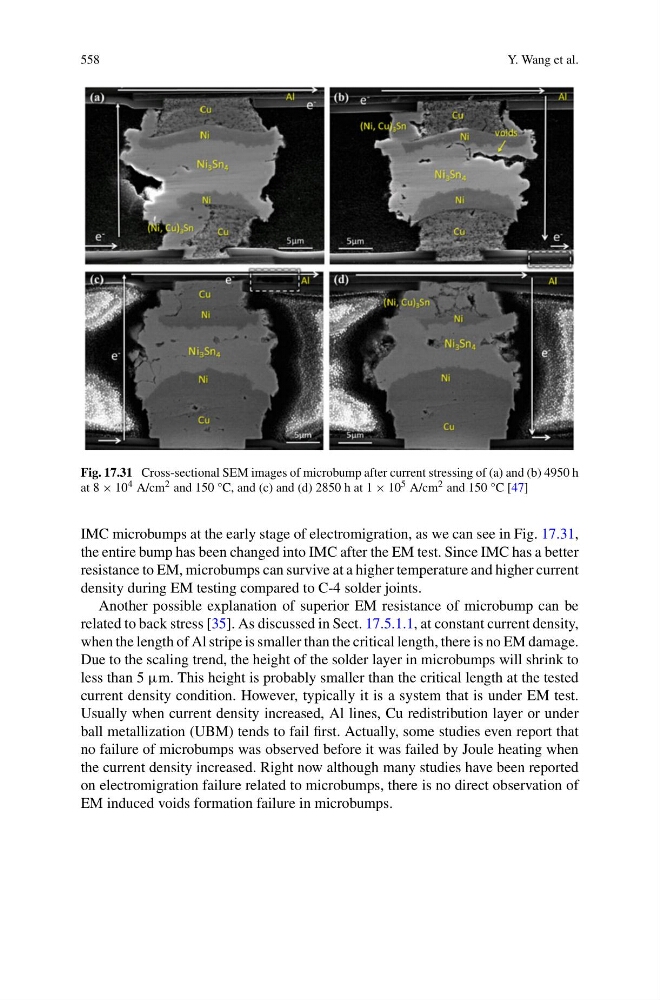
Fig. 17.31 Cross-sectional SEM images of microbump after current stressing of (a) and (b) 4950 h
at 8 × 10 4 A/cm 2 and 150 °C, and (c) and (d) 2850 h at 1 × 10 5 A/cm 2 and 150 °C [47]
IMC microbumps at the early stage of electromigration, as we can see in Fig. 17.31,
the entire bump has been changed into IMC after the EM test. Since IMC has a better
resistance to EM, microbumps can survive at a higher temperature and higher current
density during EM testing compared to C-4 solder joints.
Another possible explanation of superior EM resistance of microbump can be
related to back stress [35]. As discussed in Sect. 17.5.1.1, at constant current density,
when the length of Al stripe is smaller than the critical length, there is no EM damage.
Due to the scaling trend, the height of the solder layer in microbumps will shrink to
less than 5 μm. This height is probably smaller than the critical length at the tested
current density condition. However, typically it is a system that is under EM test.
Usually when current density increased, Al lines, Cu redistribution layer or under
ball metallization (UBM) tends to fail first. Actually, some studies even report that
no failure of microbumps was observed before it was failed by Joule heating when
the current density increased. Right now although many studies have been reported
on electromigration failure related to microbumps, there is no direct observation of
EM induced voids formation failure in microbumps.
Y. Wang et al.
Fig. 17.31 Cross-sectional SEM images of microbump after current stressing of (a) and (b) 4950 h
at 8 × 10 4 A/cm 2 and 150 °C, and (c) and (d) 2850 h at 1 × 10 5 A/cm 2 and 150 °C [47]
IMC microbumps at the early stage of electromigration, as we can see in Fig. 17.31,
the entire bump has been changed into IMC after the EM test. Since IMC has a better
resistance to EM, microbumps can survive at a higher temperature and higher current
density during EM testing compared to C-4 solder joints.
Another possible explanation of superior EM resistance of microbump can be
related to back stress [35]. As discussed in Sect. 17.5.1.1, at constant current density,
when the length of Al stripe is smaller than the critical length, there is no EM damage.
Due to the scaling trend, the height of the solder layer in microbumps will shrink to
less than 5 μm. This height is probably smaller than the critical length at the tested
current density condition. However, typically it is a system that is under EM test.
Usually when current density increased, Al lines, Cu redistribution layer or under
ball metallization (UBM) tends to fail first. Actually, some studies even report that
no failure of microbumps was observed before it was failed by Joule heating when
the current density increased. Right now although many studies have been reported
on electromigration failure related to microbumps, there is no direct observation of
EM induced voids formation failure in microbumps.