

540
Y. Wang et al.
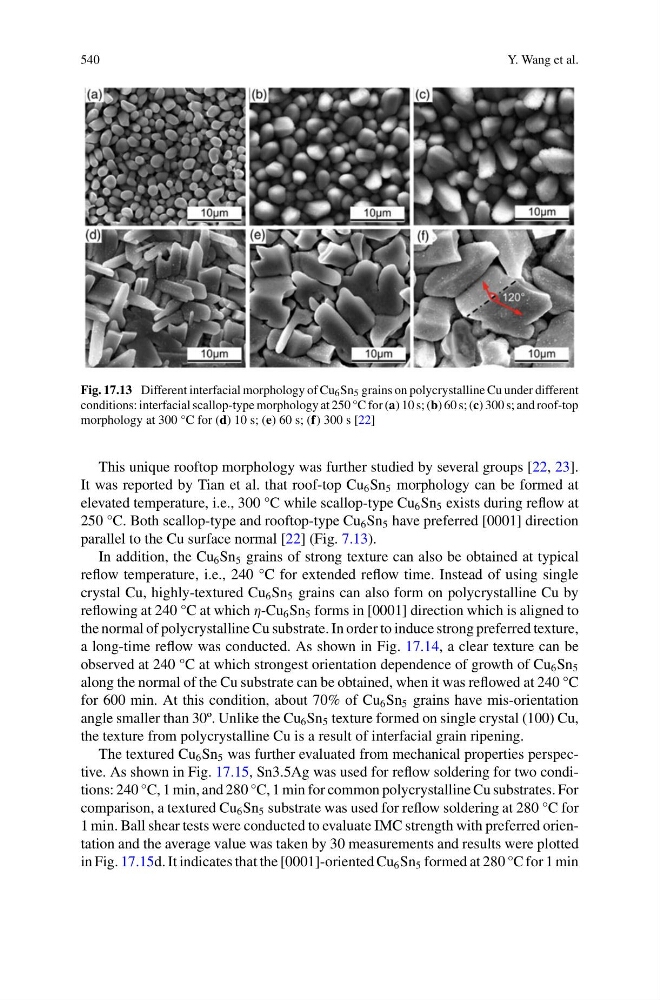
Fig. 17.13 Different interfacial morphology of Cu 6 Sn 5 grains on polycrystalline Cu under different
conditions: interfacial scallop-type morphology at 250 °C for (a) 10 s; (b) 60 s; (c) 300 s; and roof-top
morphology at 300 °C for (d) 10 s; (e) 60 s; (f) 300 s [22]
This unique rooftop morphology was further studied by several groups [22, 23].
It was reported by Tian et al. that roof-top Cu 6 Sn 5 morphology can be formed at
elevated temperature, i.e., 300 °C while scallop-type Cu 6 Sn 5 exists during reflow at
250 °C. Both scallop-type and rooftop-type Cu 6 Sn 5 have preferred [0001] direction
parallel to the Cu surface normal [22] (Fig. 7.13).
In addition, the Cu 6 Sn 5 grains of strong texture can also be obtained at typical
reflow temperature, i.e., 240 °C for extended reflow time. Instead of using single
crystal Cu, highly-textured Cu 6 Sn 5 grains can also form on polycrystalline Cu by
reflowing at 240 °C at which η-Cu 6 Sn 5 forms in [0001] direction which is aligned to
the normal of polycrystalline Cu substrate. In order to induce strong preferred texture,
a long-time reflow was conducted. As shown in Fig. 17.14, a clear texture can be
observed at 240 °C at which strongest orientation dependence of growth of Cu 6 Sn 5
along the normal of the Cu substrate can be obtained, when it was reflowed at 240 °C
for 600 min. At this condition, about 70% of Cu 6 Sn 5 grains have mis-orientation
angle smaller than 30º. Unlike the Cu 6 Sn 5 texture formed on single crystal (100) Cu,
the texture from polycrystalline Cu is a result of interfacial grain ripening.
The textured Cu 6 Sn 5 was further evaluated from mechanical properties perspective. As shown in Fig. 17.15, Sn3.5Ag was used for reflow soldering for two conditions: 240 °C, 1 min, and 280 °C, 1 min for common polycrystalline Cu substrates. For
comparison, a textured Cu 6 Sn 5 substrate was used for reflow soldering at 280 °C for
1 min. Ball shear tests were conducted to evaluate IMC strength with preferred orientation and the average value was taken by 30 measurements and results were plotted
in Fig. 17.15d. It indicates that the [0001]-oriented Cu 6 Sn 5 formed at 280 °C for 1 min
Y. Wang et al.
Fig. 17.13 Different interfacial morphology of Cu 6 Sn 5 grains on polycrystalline Cu under different
conditions: interfacial scallop-type morphology at 250 °C for (a) 10 s; (b) 60 s; (c) 300 s; and roof-top
morphology at 300 °C for (d) 10 s; (e) 60 s; (f) 300 s [22]
This unique rooftop morphology was further studied by several groups [22, 23].
It was reported by Tian et al. that roof-top Cu 6 Sn 5 morphology can be formed at
elevated temperature, i.e., 300 °C while scallop-type Cu 6 Sn 5 exists during reflow at
250 °C. Both scallop-type and rooftop-type Cu 6 Sn 5 have preferred [0001] direction
parallel to the Cu surface normal [22] (Fig. 7.13).
In addition, the Cu 6 Sn 5 grains of strong texture can also be obtained at typical
reflow temperature, i.e., 240 °C for extended reflow time. Instead of using single
crystal Cu, highly-textured Cu 6 Sn 5 grains can also form on polycrystalline Cu by
reflowing at 240 °C at which η-Cu 6 Sn 5 forms in [0001] direction which is aligned to
the normal of polycrystalline Cu substrate. In order to induce strong preferred texture,
a long-time reflow was conducted. As shown in Fig. 17.14, a clear texture can be
observed at 240 °C at which strongest orientation dependence of growth of Cu 6 Sn 5
along the normal of the Cu substrate can be obtained, when it was reflowed at 240 °C
for 600 min. At this condition, about 70% of Cu 6 Sn 5 grains have mis-orientation
angle smaller than 30º. Unlike the Cu 6 Sn 5 texture formed on single crystal (100) Cu,
the texture from polycrystalline Cu is a result of interfacial grain ripening.
The textured Cu 6 Sn 5 was further evaluated from mechanical properties perspective. As shown in Fig. 17.15, Sn3.5Ag was used for reflow soldering for two conditions: 240 °C, 1 min, and 280 °C, 1 min for common polycrystalline Cu substrates. For
comparison, a textured Cu 6 Sn 5 substrate was used for reflow soldering at 280 °C for
1 min. Ball shear tests were conducted to evaluate IMC strength with preferred orientation and the average value was taken by 30 measurements and results were plotted
in Fig. 17.15d. It indicates that the [0001]-oriented Cu 6 Sn 5 formed at 280 °C for 1 min