

504
P. Vianco and M. Neilsen
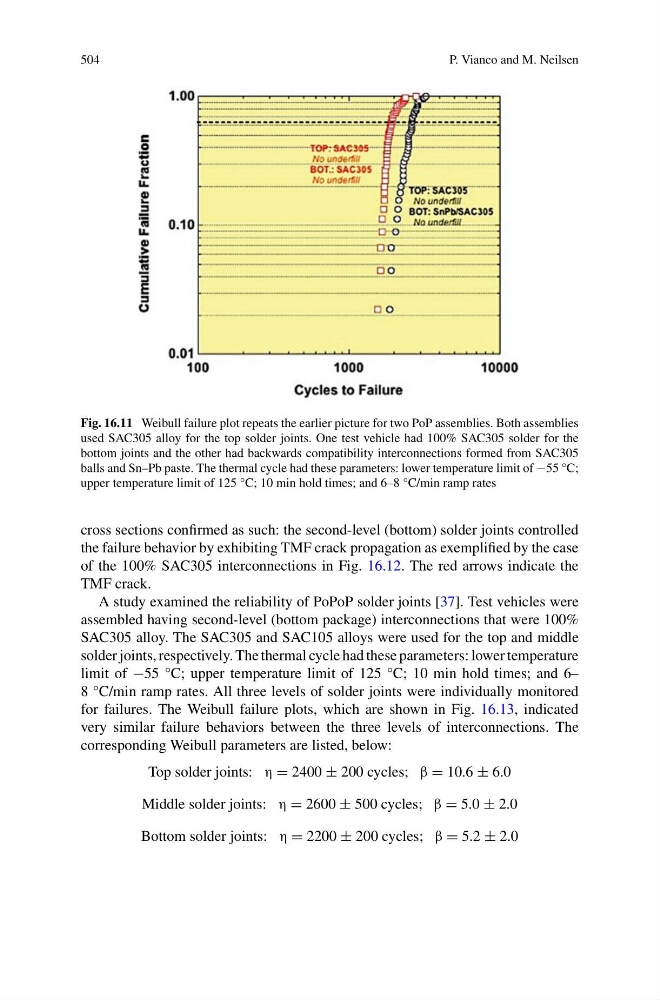
Fig. 16.11 Weibull failure plot repeats the earlier picture for two PoP assemblies. Both assemblies
used SAC305 alloy for the top solder joints. One test vehicle had 100% SAC305 solder for the
bottom joints and the other had backwards compatibility interconnections formed from SAC305
balls and Sn–Pb paste. The thermal cycle had these parameters: lower temperature limit of −55 °C;
upper temperature limit of 125 °C; 10 min hold times; and 6–8 °C/min ramp rates
cross sections confirmed as such: the second-level (bottom) solder joints controlled
the failure behavior by exhibiting TMF crack propagation as exemplified by the case
of the 100% SAC305 interconnections in Fig. 16.12. The red arrows indicate the
TMF crack.
A study examined the reliability of PoPoP solder joints [37]. Test vehicles were
assembled having second-level (bottom package) interconnections that were 100%
SAC305 alloy. The SAC305 and SAC105 alloys were used for the top and middle
solder joints, respectively. The thermal cycle had these parameters: lower temperature
limit of −55 °C; upper temperature limit of 125 °C; 10 min hold times; and 6–
8 °C/min ramp rates. All three levels of solder joints were individually monitored
for failures. The Weibull failure plots, which are shown in Fig. 16.13, indicated
very similar failure behaviors between the three levels of interconnections. The
corresponding Weibull parameters are listed, below:
Top solder joints: η = 2400 ± 200 cycles; β = 10.6 ± 6.0
Middle solder joints: η = 2600 ± 500 cycles; β = 5.0 ± 2.0
Bottom solder joints: η = 2200 ± 200 cycles; β = 5.2 ± 2.0
P. Vianco and M. Neilsen
Fig. 16.11 Weibull failure plot repeats the earlier picture for two PoP assemblies. Both assemblies
used SAC305 alloy for the top solder joints. One test vehicle had 100% SAC305 solder for the
bottom joints and the other had backwards compatibility interconnections formed from SAC305
balls and Sn–Pb paste. The thermal cycle had these parameters: lower temperature limit of −55 °C;
upper temperature limit of 125 °C; 10 min hold times; and 6–8 °C/min ramp rates
cross sections confirmed as such: the second-level (bottom) solder joints controlled
the failure behavior by exhibiting TMF crack propagation as exemplified by the case
of the 100% SAC305 interconnections in Fig. 16.12. The red arrows indicate the
TMF crack.
A study examined the reliability of PoPoP solder joints [37]. Test vehicles were
assembled having second-level (bottom package) interconnections that were 100%
SAC305 alloy. The SAC305 and SAC105 alloys were used for the top and middle
solder joints, respectively. The thermal cycle had these parameters: lower temperature
limit of −55 °C; upper temperature limit of 125 °C; 10 min hold times; and 6–
8 °C/min ramp rates. All three levels of solder joints were individually monitored
for failures. The Weibull failure plots, which are shown in Fig. 16.13, indicated
very similar failure behaviors between the three levels of interconnections. The
corresponding Weibull parameters are listed, below:
Top solder joints: η = 2400 ± 200 cycles; β = 10.6 ± 6.0
Middle solder joints: η = 2600 ± 500 cycles; β = 5.0 ± 2.0
Bottom solder joints: η = 2200 ± 200 cycles; β = 5.2 ± 2.0