

480
P. Vianco and M. Neilsen
joint because of their small size and fine pitch. Although dispensing flux or paste by
a typical dispenser or by jetting are viable solutions, they can create bottlenecks in
high-volume manufacturing lines.
The first-level interconnections are made with either flux, only, or with the use of
a solder paste. The two materials are referred to as dip flux and dip paste [9–11]. As
the terms imply, flux or paste is added to the solder balls of the packages by dipping
them into baths of either material. Dip flux is also referred to as tacky flux, which
signifies its added function, which is to prevent inadvertent movement between the
two packages, once they have been stacked upon one another. Such movement can
lead to solder joint defects. As described in the cited references, these materials are
precisely engineered to control the amount and consistency of the flux (or paste) that
is transferred to the solder balls in order to optimize assembly yields.
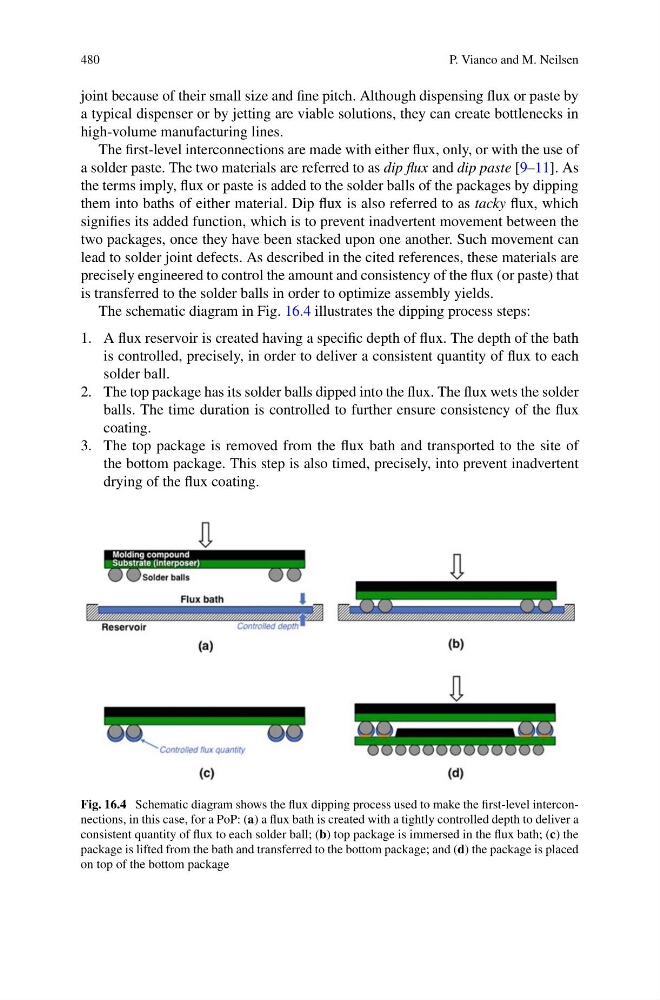
The schematic diagram in Fig. 16.4 illustrates the dipping process steps:
1. A flux reservoir is created having a specific depth of flux. The depth of the bath
is controlled, precisely, in order to deliver a consistent quantity of flux to each
solder ball.
2. The top package has its solder balls dipped into the flux. The flux wets the solder
balls. The time duration is controlled to further ensure consistency of the flux
coating.
3. The top package is removed from the flux bath and transported to the site of
the bottom package. This step is also timed, precisely, into prevent inadvertent
drying of the flux coating.
Fig. 16.4 Schematic diagram shows the flux dipping process used to make the first-level interconnections, in this case, for a PoP: (a) a flux bath is created with a tightly controlled depth to deliver a
consistent quantity of flux to each solder ball; (b) top package is immersed in the flux bath; (c) the
package is lifted from the bath and transferred to the bottom package; and (d) the package is placed
on top of the bottom package
P. Vianco and M. Neilsen
joint because of their small size and fine pitch. Although dispensing flux or paste by
a typical dispenser or by jetting are viable solutions, they can create bottlenecks in
high-volume manufacturing lines.
The first-level interconnections are made with either flux, only, or with the use of
a solder paste. The two materials are referred to as dip flux and dip paste [9–11]. As
the terms imply, flux or paste is added to the solder balls of the packages by dipping
them into baths of either material. Dip flux is also referred to as tacky flux, which
signifies its added function, which is to prevent inadvertent movement between the
two packages, once they have been stacked upon one another. Such movement can
lead to solder joint defects. As described in the cited references, these materials are
precisely engineered to control the amount and consistency of the flux (or paste) that
is transferred to the solder balls in order to optimize assembly yields.
The schematic diagram in Fig. 16.4 illustrates the dipping process steps:
1. A flux reservoir is created having a specific depth of flux. The depth of the bath
is controlled, precisely, in order to deliver a consistent quantity of flux to each
solder ball.
2. The top package has its solder balls dipped into the flux. The flux wets the solder
balls. The time duration is controlled to further ensure consistency of the flux
coating.
3. The top package is removed from the flux bath and transported to the site of
the bottom package. This step is also timed, precisely, into prevent inadvertent
drying of the flux coating.
Fig. 16.4 Schematic diagram shows the flux dipping process used to make the first-level interconnections, in this case, for a PoP: (a) a flux bath is created with a tightly controlled depth to deliver a
consistent quantity of flux to each solder ball; (b) top package is immersed in the flux bath; (c) the
package is lifted from the bath and transferred to the bottom package; and (d) the package is placed
on top of the bottom package