

478
P. Vianco and M. Neilsen
and PoPoP components come from the commercial supply chain and thus, have Pbfree solder balls. On the other hand, high-reliability electronics are still assembled
(albeit, to a declining degree) with Sn–Pb solder.
A mixed solder scenario warrants that consideration be given to the solder joint
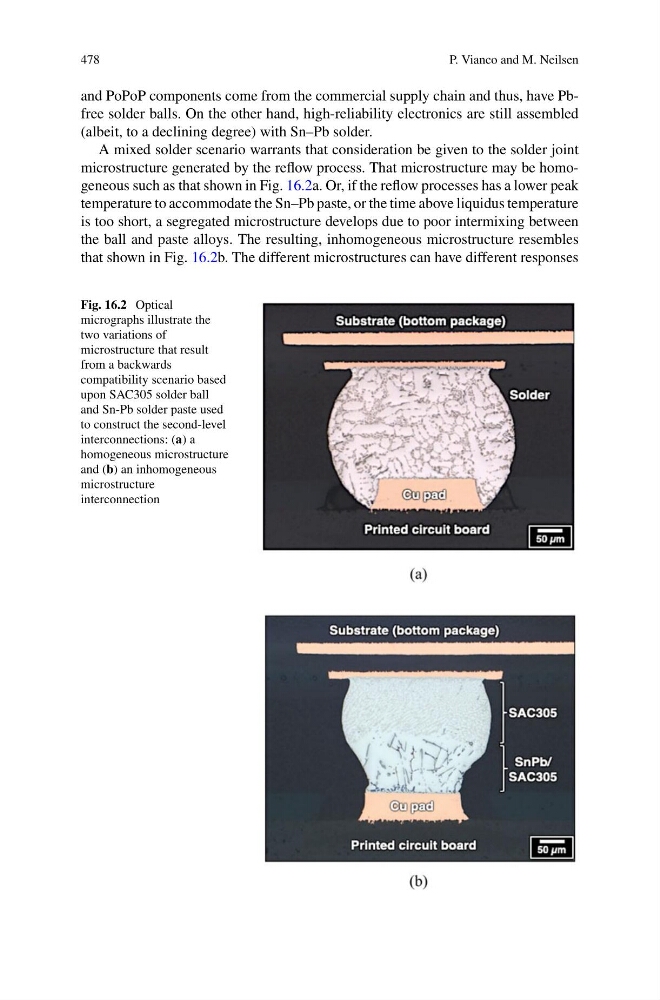
microstructure generated by the reflow process. That microstructure may be homogeneous such as that shown in Fig. 16.2a. Or, if the reflow processes has a lower peak
temperature to accommodate the Sn–Pb paste, or the time above liquidus temperature
is too short, a segregated microstructure develops due to poor intermixing between
the ball and paste alloys. The resulting, inhomogeneous microstructure resembles
that shown in Fig. 16.2b. The different microstructures can have different responses
Fig. 16.2 Optical
micrographs illustrate the
two variations of
microstructure that result
from a backwards
compatibility scenario based
upon SAC305 solder ball
and Sn-Pb solder paste used
to construct the second-level
interconnections: (a) a
homogeneous microstructure
and (b) an inhomogeneous
microstructure
interconnection
P. Vianco and M. Neilsen
and PoPoP components come from the commercial supply chain and thus, have Pbfree solder balls. On the other hand, high-reliability electronics are still assembled
(albeit, to a declining degree) with Sn–Pb solder.
A mixed solder scenario warrants that consideration be given to the solder joint
microstructure generated by the reflow process. That microstructure may be homogeneous such as that shown in Fig. 16.2a. Or, if the reflow processes has a lower peak
temperature to accommodate the Sn–Pb paste, or the time above liquidus temperature
is too short, a segregated microstructure develops due to poor intermixing between
the ball and paste alloys. The resulting, inhomogeneous microstructure resembles
that shown in Fig. 16.2b. The different microstructures can have different responses
Fig. 16.2 Optical
micrographs illustrate the
two variations of
microstructure that result
from a backwards
compatibility scenario based
upon SAC305 solder ball
and Sn-Pb solder paste used
to construct the second-level
interconnections: (a) a
homogeneous microstructure
and (b) an inhomogeneous
microstructure
interconnection