

460
L. Chen et al.
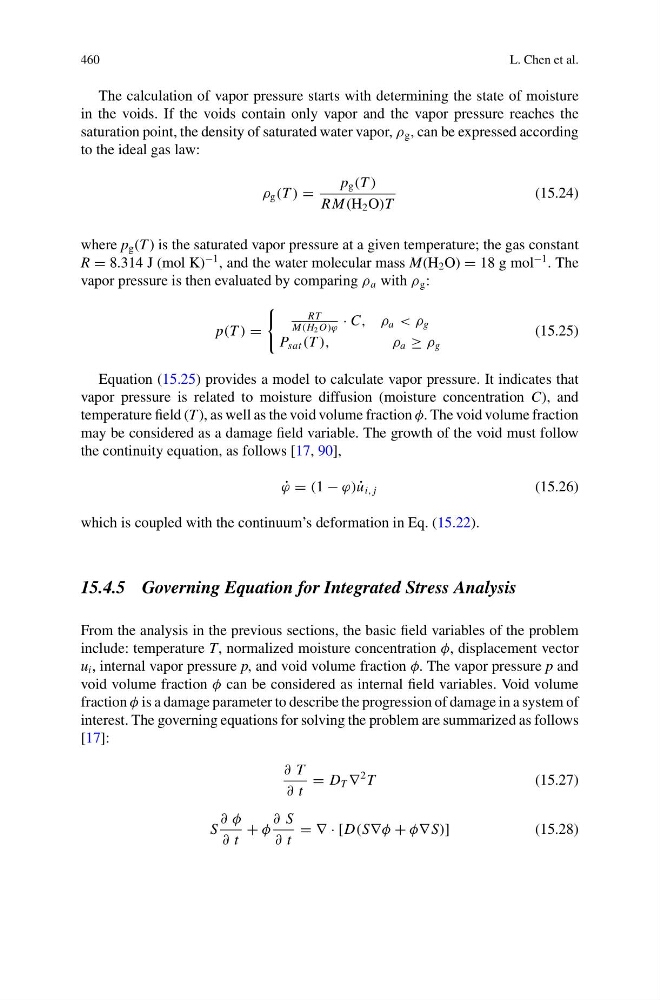
The calculation of vapor pressure starts with determining the state of moisture
in the voids. If the voids contain only vapor and the vapor pressure reaches the
saturation point, the density of saturated water vapor, ρ g , can be expressed according
to the ideal gas law:
ρ g (T ) =
p g (T )
R M(H 2 O)T
(15.24)
where p g (T ) is the saturated vapor pressure at a given temperature; the gas constant
R = 8.314 J (mol K)
−1 , and the water molecular mass M(H 2 O) = 18 g mol
−1 . The
vapor pressure is then evaluated by comparing ρ a with ρ g :
p(T ) =
RT
M(H 2 O)ϕ
· C, ρ a < ρ g
P sat (T ),
ρ a ≥ ρ g
(15.25)
Equation (15.25) provides a model to calculate vapor pressure. It indicates that
vapor pressure is related to moisture diffusion (moisture concentration C), and
temperature field (T ), as well as the void volume fraction φ. The void volume fraction
may be considered as a damage field variable. The growth of the void must follow
the continuity equation, as follows [17, 90],
˙
ϕ = (1 − ϕ) ˙
u i, j
(15.26)
which is coupled with the continuum’s deformation in Eq. (15.22).
15.4.5 Governing Equation for Integrated Stress Analysis
From the analysis in the previous sections, the basic field variables of the problem
include: temperature T, normalized moisture concentration φ, displacement vector
u i , internal vapor pressure p, and void volume fraction φ. The vapor pressure p and
void volume fraction φ can be considered as internal field variables. Void volume
fraction φ is a damage parameter to describe the progression of damage in a system of
interest. The governing equations for solving the problem are summarized as follows
[17]:
∂ T
∂ t
= D T ∇
2 T
(15.27)
S
∂ φ
∂ t
+ φ
∂ S
∂ t
= ∇ · [D(S∇φ + φ∇ S)]
(15.28)
L. Chen et al.
The calculation of vapor pressure starts with determining the state of moisture
in the voids. If the voids contain only vapor and the vapor pressure reaches the
saturation point, the density of saturated water vapor, ρ g , can be expressed according
to the ideal gas law:
ρ g (T ) =
p g (T )
R M(H 2 O)T
(15.24)
where p g (T ) is the saturated vapor pressure at a given temperature; the gas constant
R = 8.314 J (mol K)
−1 , and the water molecular mass M(H 2 O) = 18 g mol
−1 . The
vapor pressure is then evaluated by comparing ρ a with ρ g :
p(T ) =
RT
M(H 2 O)ϕ
· C, ρ a < ρ g
P sat (T ),
ρ a ≥ ρ g
(15.25)
Equation (15.25) provides a model to calculate vapor pressure. It indicates that
vapor pressure is related to moisture diffusion (moisture concentration C), and
temperature field (T ), as well as the void volume fraction φ. The void volume fraction
may be considered as a damage field variable. The growth of the void must follow
the continuity equation, as follows [17, 90],
˙
ϕ = (1 − ϕ) ˙
u i, j
(15.26)
which is coupled with the continuum’s deformation in Eq. (15.22).
15.4.5 Governing Equation for Integrated Stress Analysis
From the analysis in the previous sections, the basic field variables of the problem
include: temperature T, normalized moisture concentration φ, displacement vector
u i , internal vapor pressure p, and void volume fraction φ. The vapor pressure p and
void volume fraction φ can be considered as internal field variables. Void volume
fraction φ is a damage parameter to describe the progression of damage in a system of
interest. The governing equations for solving the problem are summarized as follows
[17]:
∂ T
∂ t
= D T ∇
2 T
(15.27)
S
∂ φ
∂ t
+ φ
∂ S
∂ t
= ∇ · [D(S∇φ + φ∇ S)]
(15.28)